Rasputin Dreamweaver Powers Infinite Commander Combos With Blink Tricks
Rasputin Dreamweaver still turns seven dream counters into explosive mana, and blink loops make him a real infinite combo commander, not just a Reserved List curiosity.
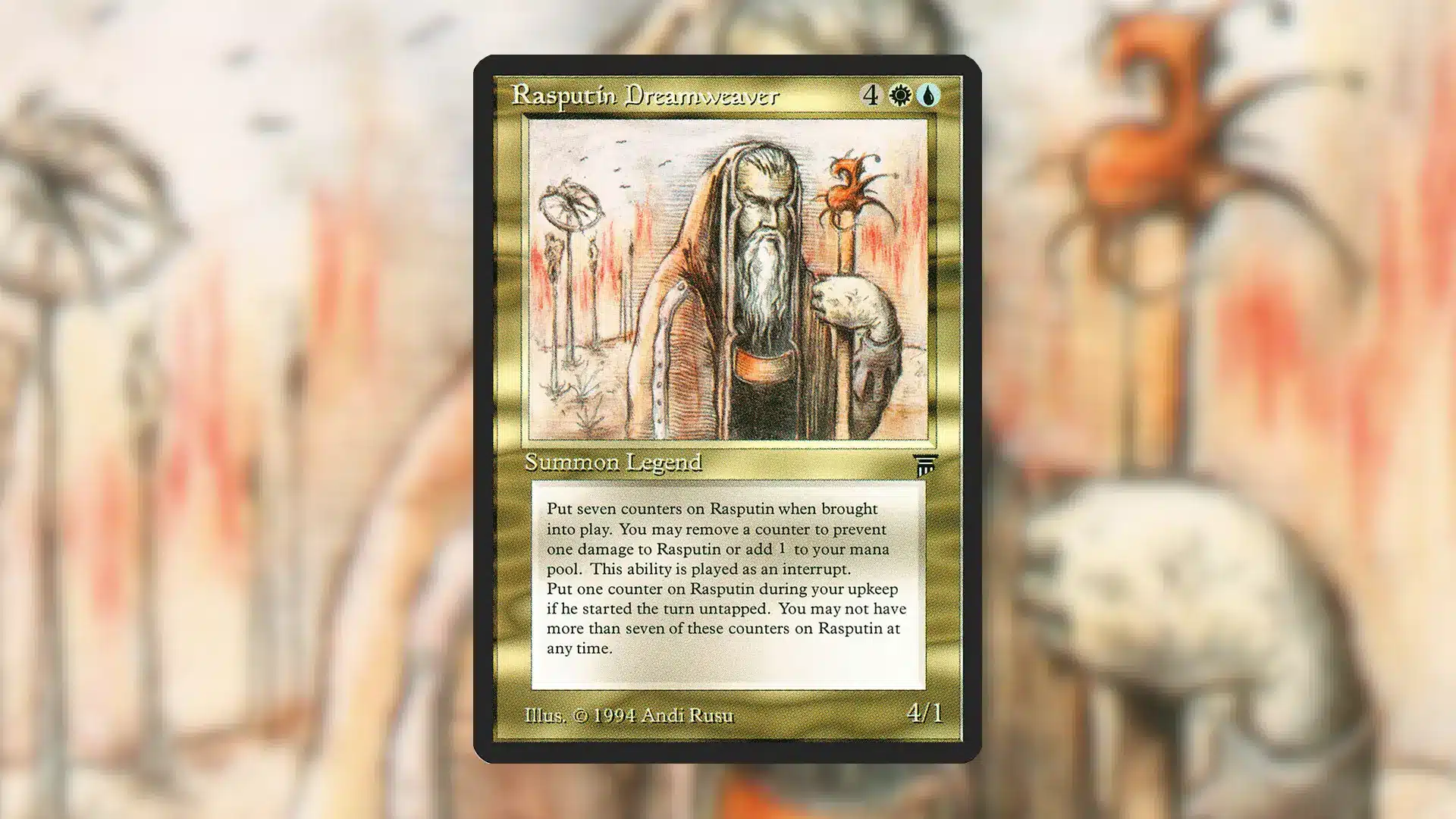
Why Rasputin Dreamweaver still matters
Rasputin Dreamweaver is one of those Legends cards that looks almost nostalgic until you sit down and count the mana. He enters with seven dream counters, and that is the whole trick: those counters behave like a stored burst of colorless mana that can be cashed in for a huge swing if you build around him correctly. He also has the kind of protection text that gives him a fighting chance to stick around long enough to matter, which is exactly what a Commander deck wants from its centerpiece.

The context matters too. Legends released on June 1, 1994 and contains 310 cards, so Rasputin comes from the game’s earliest legendary creature lineup. He is also a Reserved List card, and Wizards of the Coast’s reprint policy has kept Reserved List cards out of both premium and non-premium reprints since 2011. That combination explains why he still feels iconic, and why he is not a casual pickup. Contemporary price references put him roughly in the $130 to $160 range depending on condition and source, which creates the real tension around him: the card is powerful, but it is not a cheap way into Commander.
How the counters turn into real mana
The first thing to understand is that Rasputin is not just about one flashy activation. His dream counters are the engine, and the upkeep clause means you care a lot about whether he started the turn untapped. That detail is huge in play patterns, because it pushes you to protect him, blink him, or sequence your turns so he comes online at the right moment instead of sitting there doing nothing.
On a clean board, Rasputin already gives you a mana burst that many Commander decks would happily build around. In practice, that means you want to treat him like a rechargeable battery, not a one-shot value creature. Every time you reset him, those seven counters come back, and every time you spend them, you are converting a single card into a very real resource advantage.
Blinking is where the card becomes unfair
The simplest way to break Rasputin is to blink him. Ephemerate and Ghostly Flicker are the cleanest examples because they let you reset the creature and reclaim those dream counters. That means you can spend his stored mana, exile him, bring him back fresh, and do it all over again without needing some elaborate board state.
That loop is what moves Rasputin from “old legend with neat text” to “actual combo commander.” Once you start treating each blink as a refill, you can chain together turns where he keeps coming back full and keeps generating enough mana to fuel the rest of your deck. In Commander, that sort of recursive mana development is often more dangerous than raw card draw because it lets you go from setup to kill in a single turn cycle.
The infinite mana lines are real
The most important combo package is the one with Eldrazi Displacer. EDHREC and Commander Spellbook both document the line, and the reason it works is simple: Displacer can blink Rasputin for a cost that is smaller than the mana Rasputin effectively returns when he resets. Once the loop is online, you keep paying to blink him, resetting the seven counters, and turning those counters back into more mana than you spent.
That is not just a large burst, it is a positive loop. If you have the right support mana available, Rasputin and Eldrazi Displacer become a machine that can keep feeding itself until you have all the colorless mana you want. In Commander terms, that is the kind of interaction that forces the table to answer immediately or lose on the spot.
Nim Deathmantle creates another route to the same problem, especially when paired with Ashnod’s Altar. The sacrifice outlet plus recursion pattern turns Rasputin into a loop that keeps feeding mana back into the system, and combo databases also document Phyrexian Altar as a way to pivot that engine into infinite colored mana. That matters because once the mana stops being colorless-only, your win conditions open up dramatically. You are no longer just casting oversized artifacts, you are playing from a position where almost any expensive payoff becomes lethal.
The weird tech makes the deck even stranger
Cogwork Assembler and Mycosynth Lattice are the sort of cards that make Rasputin pilots grin and opponents start reading text boxes twice. They do not define the deck the way the blink engines do, but they show how far you can push the card once you are already committed to exploiting mana conversion. This is the part of the deck that feels less like fair Commander and more like a puzzle box built around an ancient legend.
That same logic points to the rest of the shell. Because Rasputin can produce so much colorless mana, the deck wants huge artifacts and X spells that actually cash that resource in for a win. You are not trying to play a normal Azorius midrange game. You are trying to assemble a board where every extra blink, recursion loop, or artifact payoff turns a stockpile of counters into a table-ending threat.
Azorius is the real constraint
The biggest practical limitation is the color identity. Blue-white gives you protection, blink spells, artifact synergies, and stack interaction, but it does not give you the easy ramp package green decks lean on. That means the support cards tend to be classic mana rocks and a few clever utility pieces instead of the kind of explosive land acceleration that makes other combo commanders trivial to assemble.
That limitation is part of why Rasputin is such an interesting deck to build today. You are not just sleeving up the most obvious ramp and calling it a day. You need to protect him, untap him, blink him, and make sure every piece in the 99 is pulling toward the same payoff. When the deck works, it feels absurdly efficient. When it stumbles, it feels like a pile of expensive artifacts and a legendary creature waiting to be answered.
Why the price tag changes the conversation
Rasputin Dreamweaver is still Commander-legal, still iconic, and still very much alive as a combo commander. But the Reserved List keeps him scarce, and scarcity changes who gets to use him. At roughly $130 to $160, he is not the kind of centerpiece you pick up on a whim, even if the gameplay is exactly the sort of thing Commander players love to break.
That is the real story here: Rasputin is not valuable because he is old. He is valuable because he turns one set of dream counters into repeated mana explosions, and the best blink shells can still abuse that text for infinite or near-infinite turns. In a format built around commanders defining the whole game, Rasputin Dreamweaver is more than collectible cardboard. He is a genuine engine, and if you can afford to build him, he still knows how to take over a table.
This article was produced by Prism’s automated news system from verified source data, official records, and press releases, then run through automated quality and moderation checks before publishing. The system is built and supervised by the people who set the standards it runs under. Read our full AI policy.
Did this article answer your question?