Spirit of Resistance gets new life in five-color Commander decks
Spirit of Resistance went from binder dust to real five-color tech, but only if your mana base can turn on all five colors fast enough.
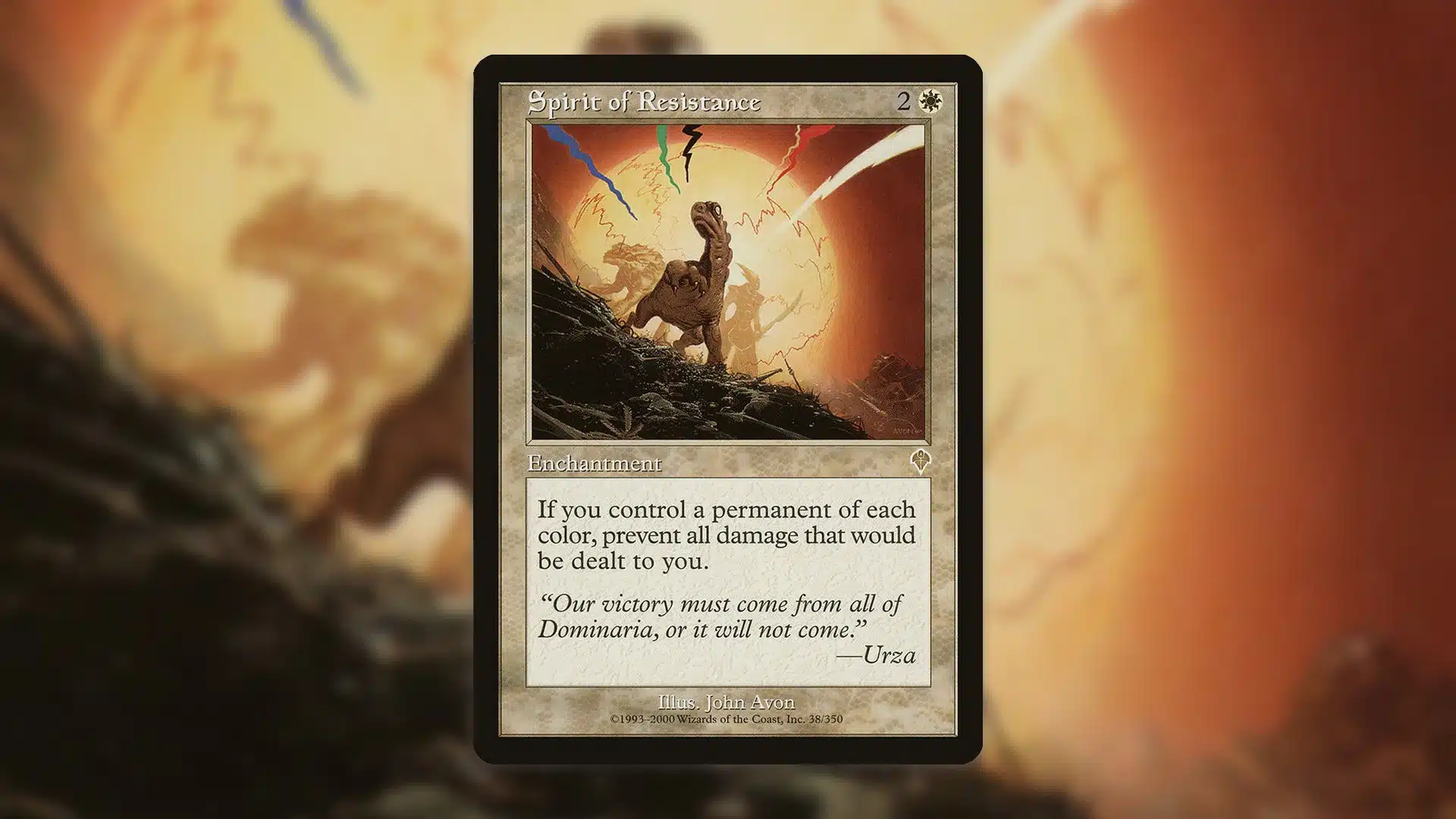
Spirit of Resistance finally has a real home
Spirit of Resistance used to read like the kind of odd Invasion-era enchantment you admire more than you sleeve. In modern Commander, though, the card has a very different profile: if your deck can put one permanent of each color onto the battlefield, a three-mana enchantment that blanks damage from every color starts to look less like a relic and more like a serious table tool.
That shift matters because Commander has changed around the card. Five-color decks are no longer rare curiosities, and the rise of new five-color commanders has made color requirements that once felt clunky suddenly feel routine. Add cards like Leyline of the Guildpact into the mix, and Spirit of Resistance stops looking like a hard build-around and starts looking like a payoff for doing something your deck already wanted to do anyway.
What Spirit of Resistance actually does
The card’s text sounds narrow until you picture a real Commander board. Spirit of Resistance asks for each color to be represented on the battlefield, then rewards you with protection from all colors. In practice, that means it is not just preventing a single removal spell or softening one combat step. It can shut the door on a huge swath of normal damage-based pressure once the condition is met.
That is the core reason the card deserves a second look. A lot of Commander players have learned to dismiss old enchantments that look awkward in isolation. Spirit of Resistance is one of those cards that feels underpowered if you read it as a puzzle piece, but much stronger if you read it as a political shield in a deck that is already built to produce every color.
Why five-color Commander changed the math
The biggest reason Spirit of Resistance is back on the radar is simple: more decks can cast it cleanly, and more decks can enable it quickly. Five-color commanders give you a shell where the enchantment’s condition is not some exotic dream state. It is a normal part of deck construction, especially if your list is already leaning on rainbow lands, treasure-fueled fixing, or other mana bases that naturally spread colors across the battlefield.
Leyline of the Guildpact is a perfect example of why the card’s ceiling has improved. When you can satisfy the color requirement from turn zero, Spirit of Resistance becomes much less of a midgame vanity piece and much more of a lock that can shape the entire table. That kind of opening is exactly why older cards are getting re-evaluated in Commander: the format now supplies the infrastructure they always wanted.
How often the lock actually matters
The important question is not whether Spirit of Resistance can be powerful. It can. The real question is how often you can turn it on early enough for it to matter before the table has already established a dominant position. If your mana base reliably presents all five colors on board, or if you have a way to meet the condition from turn zero, the enchantment can come online fast enough to influence the game from the moment it lands.

That said, this is still not a universal protection spell. The card does not automatically save your whole board state or preserve you from every angle of attack. It protects you from damage by color, which is huge in combat-heavy pods, but much less impressive when the table is leaning on a different axis entirely. In other words, the lock is real, but it is only as valuable as the pod you are sitting in.
Where Spirit of Resistance falls short
This is the part that keeps the card honest. Spirit of Resistance does not protect your creatures, your hand, your graveyard, or your library. It also does nothing against enchantment removal, so the table still has a clean answer if someone wants the card off the battlefield. And if your pod wins with Blood Artist-style life drain, combat math barely matters.
That limitation is exactly why the card is not a universal staple. In a table full of creature combat, burn, and fair pressure, Spirit of Resistance can be miserable to fight through. In a table where people are assembling noncombat engines, combo lines, or graveyard-based kill turns, it is much easier to shrug off. The difference between “absurd” and “fine” is mostly about what your opponents are trying to do.
Who should actually sleeve it
Spirit of Resistance makes the most sense in five-color decks that are already built to show all five colors early and often. If your mana base naturally supports that plan, the card becomes much easier to justify as a niche defensive tool. It also plays especially well if you enjoy enchantments that create awkward politics, because a damage shield can force combat to happen somewhere else or make an opponent spend removal on a card that was never going to win the game by itself.
The card is also a better fit for bracket-three style games where board texture and politics matter more than pure speed. In those pods, a weird protection enchantment can buy enormous leverage. In faster or more combo-heavy games, it can still be useful, but it is no longer the kind of card you jam just because it looks clever.
A real sleeper, not a nostalgia trap
Spirit of Resistance is not suddenly a staple, and it should not be treated like one. But it is also not the sort of old card you can safely laugh out of the room anymore. Five-color commanders, better fixing, and cards like Leyline of the Guildpact have made the enchantment more realistic than it has ever been, and that alone is enough to move it out of the binder and into real deck conversations.
That is what makes it a genuine sleeper. The ceiling is high, the niche is real, and the format finally gives it a chance to matter. If your five-color list can support it, Spirit of Resistance is no longer just an oddity from Invasion. It is the kind of forgotten enchantment that can quietly steal games when the table is trying to win the old-fashioned way.
This article was produced by Prism’s automated news system from verified source data, official records, and press releases, then run through automated quality and moderation checks before publishing. The system is built and supervised by the people who set the standards it runs under. Read our full AI policy.
Did this article answer your question?