Volrath remains one of Commander’s most abusable shapeshifters
Volrath still turns one mana and a few counters into nonsense, and the Grim Poppet line shows how quickly the old villain becomes a real Commander kill.
Volrath still does the dirty work
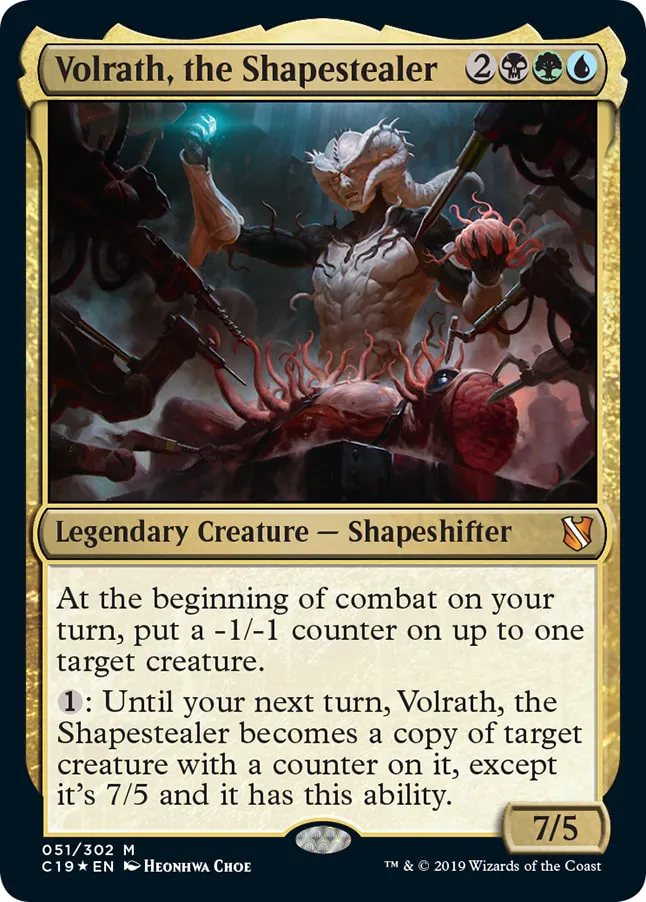
Volrath, the Shapestealer is the kind of Commander card that looks like nostalgia until it starts stealing games. The old Weatherlight villain already had the lore to match the menace, from his role as one of Yawgmoth’s trusted lieutenants to the story beat where he found slivers on another plane, dragged them to Rath, and used them as test material for Metallic Sliver. That kind of backstory matters because Volrath has always been more than flavor text bait: he is one of the cleanest examples of a legend whose rules text still converts into real pressure at a Commander table.

The card came back in the right shell
Commander 2019 gave Volrath a fresh home, and Wizards released that product on August 23, 2019 as four different 100-card game packs with an oversized foil commander card in each one. Volrath led Faceless Menace, the Sultai morph deck, which was already a clue about how Wizards wanted players to think about him. The personalization article for that deck said the quiet part out loud: if morphing is not your thing but copying other creatures is, Volrath is the card to build around.
That framing still holds up. Volrath is not just a weird alternate face for a morph deck. He is a commander that rewards knowing exactly when to activate, exactly what to copy, and exactly which battlefield counters to steal for value.
The timing trap that separates the cute builds from the sharp ones
Volrath’s copy ability is only one mana, and that is the headline. He can become any counter-bearing creature on the battlefield, which makes him absurdly flexible in a format where counters are everywhere. The catch is that activating the copy ability makes him lose his first ability until your next turn, so the timing of your activation matters if you want to keep the beginning-of-combat counter placement available that turn.
That is the detail players miss when they treat Volrath like a novelty. If you fire the ability too early, you can shut off the part of the card that keeps the engine moving. If you time it correctly, you get a commander that can slip into a new role, copy the right body, and still keep the rest of the board humming.
Why the same ability gets meaner than it looks
Volrath gets better the moment you stop thinking of him as a one-shot copy and start treating each activation as a fresh instance of an ability. That is what lets him sidestep once-per-turn restrictions on cards like Beledros Witherbloom or Gisa and Geralf. Copying them multiple times is not flashy in the abstract, but on the table it means you are turning a single commander into repeated access to effects the rest of the pod expected to see once.
The easiest way to make that happen is to increase the number of ways Volrath can refresh his job description. Illusionist’s Bracers and Locus of Enlightenment both make the card feel much less fair, because they help Volrath turn one activation into a larger burst of copied text. In practice, that means the deck can start as a value-copy build and then suddenly become a machine that keeps reusing the same powerful creature ability while everyone else is still reading the board.
Counters are the real fuel
A strong Volrath list does not need to chase gimmicks. It wants a dense field of counters so the commander always has something useful to become, and the best supporting cards are the ones that make those counters show up naturally.
- Generous Patron and Forgotten Ancient keep +1/+1 counters flowing, which gives Volrath easy copy targets and makes the board scale fast.
- Persistent Constrictor and Yawgmoth, Thran Physician supply -1/-1 counters, which are just as useful when you want to point Volrath at the right creature at the right time.
- Because Volrath only costs one mana to copy, every counter source on the table becomes a potential pivot point for the whole deck.
This is where the deck stops feeling like old-villain cosplay and starts feeling like a tuned engine. The best Volrath builds do not wait for the perfect creature. They manufacture the perfect creature, then let Volrath become it.
The cleanest combo line is brutally compact
The standout combo is Volrath plus Grim Poppet plus Hapatra, Vizier of Poisons. That line produces infinite ETB triggers and infinite 1/1 Snake tokens, and Commander Spellbook also catalogs it as an infinite token combo. Once that loop is online, an Altar of the Brood or a similar payoff turns all those entries onto the battlefield into a table kill.
The important part is how little setup it asks for relative to the payoff. This is not the kind of Commander combo that needs half a dozen dead draws and a prayer. It is a tight interaction package that slots naturally into a deck already interested in counters, copying, and creatures that do something unfair the moment Volrath wears their face.
Why Volrath is worth reviving now
Volrath is still one of those commanders that rewards deep rules knowledge without locking you into cute, outdated gameplay. He can play fair when you want him to, turning Generous Patron-style value into board presence, and he can pivot into something vicious the moment Grim Poppet and Hapatra line up. That range is what makes him feel current instead of merely memorable.
If the appeal is a commander that copies instead of morphs, that turns one mana into leverage, and that still has a real combo finish hiding inside a pile of counter synergy, Volrath remains exactly the kind of old villain worth bringing back to the table.
This article was produced by Prism’s automated news system from verified source data, official records, and press releases, then run through automated quality and moderation checks before publishing. The system is built and supervised by the people who set the standards it runs under. Read our full AI policy.
Know something we missed? Have a correction or additional information?
Submit a Tip