ASUS ROG Falchion Ace 75 HE Debuts at CES 2026 for $219
ASUS's Hall effect 75% board hits Best Buy for $219 with a jog wheel that dials actuation on the fly, no software required.

ASUS launched the ROG Falchion Ace 75 HE at CES 2026, a wired 75% keyboard priced at $219 and available in black or white at Best Buy starting in January. It ships with a carrying case, metal top and bottom plates, and PBT doubleshot keycaps — a build that Tom's Hardware reviewer Matt Safford called "very solid and premium."
The keyboard's core technology is ASUS's ROG Hall Sensor, which uses magnets instead of metal contacts to eliminate the wear-based inconsistency of traditional switches. ASUS claims 0.01mm keystroke detection resolution and actuation adjustable in 0.01mm steps across a 0.1mm to 3.5mm range. That range is slightly narrower than the 0.1–4mm window found on most competing Hall effect boards, though Safford noted he "certainly didn't miss the extra distance." The keyboard ships with factory-lubed ROG HFX V2 magnetic switches, which Safford described as "smooth and pleasing" with "effectively no key wobble." TheShortcut's reviewer put the feel in more tactile terms: the switches are "super stable and end with a thocky feel and sound," with 32g of initial force delivering "just enough resistance to feel like you're still pressing a real mechanical switch."
If you want more from the switches, the board is hot-swappable between the HFX V2 and the ROG HFX V2X. ASUS designed the V2X with a square-shaped stem and X-stabilizer mechanism for tighter wobble control and compatibility with both plunger and cross-shaped keycaps. TheShortcut's reviewer preferred the V2X personally, and both switch types are cross-compatible with other supported ROG HE keyboards.
Hardware controls set this board apart from most of its competition. A small jog wheel near the upper-right corner adjusts actuation point and Rapid Trigger sensitivity per-key or globally, without touching any software. The intended workflow, as Safford described it, is to rough-dial your actuation via the browser-based interface, then fine-tune from the wheel. His one complaint: there is no small numeric readout next to the wheel showing the value you are actually setting. A programmable touchbar along the back-left edge handles volume, playback controls, or any custom function you assign. The board also supports Rapid Trigger, Speed Trigger, and ASUS's Speed Tap mode, all designed to make rapid repeated inputs — side-strafing being the obvious use case — as lag-free as possible. KitGuru highlighted an 8KHz polling rate alongside those features as part of its assessment of the board's performance credentials.
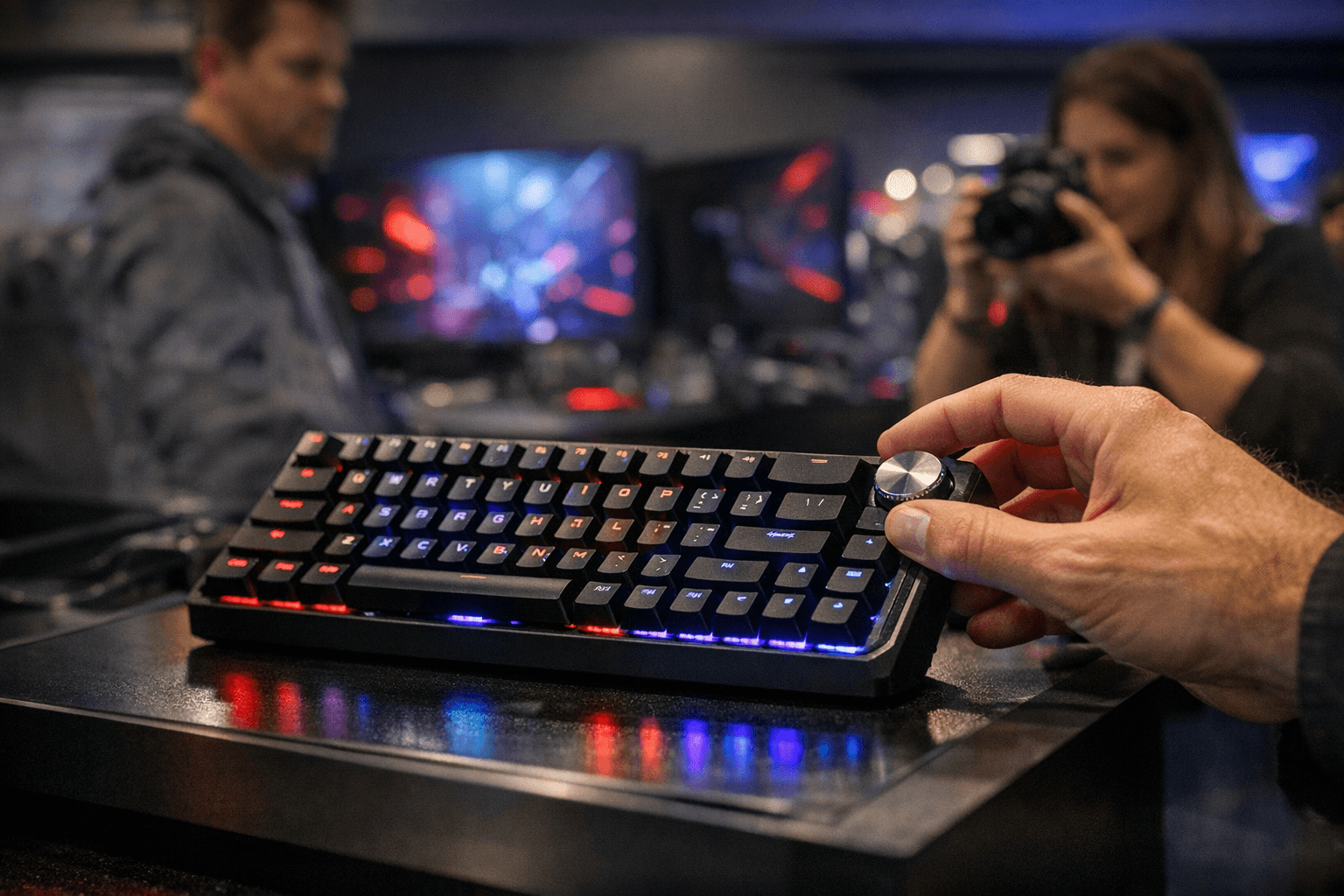
The 75% layout keeps the function row and navigation cluster (Delete, End, Page Up/Down) intact while trimming enough footprint to give mouse room on the desk. The included carrying case is a practical addition for anyone who travels with a keyboard, though Safford flagged that wired-only connectivity means you are always tethered — and that an internal battery would serve traveling users better.
At $219, KitGuru praised the capabilities while noting the price matches them. Safford said he would have "no major complaints switching to the Falchion Ace 75 HE" for gaming or work, though he gave a slight sonic edge to the Keychron K8 HE for its softer sound and more cushioned bottom-out. The jog wheel's ability to quickly toggle actuation settings off when switching from gaming to productivity work was, in his view, a genuine advantage over the competition.
This article was produced by Prism’s automated news system from verified source data, official records, and press releases, then run through automated quality and moderation checks before publishing. The system is built and supervised by the people who set the standards it runs under. Read our full AI policy.
Did this article answer your question?