ASUS ROG Falchion Ace HFX ZywOo Edition adds style and key improvements
ASUS dresses the Falchion Ace HFX in ZywOo flair, but the real upgrade is on the keys: PBT caps, a better spacebar, and hall-effect tuning that still feels serious.
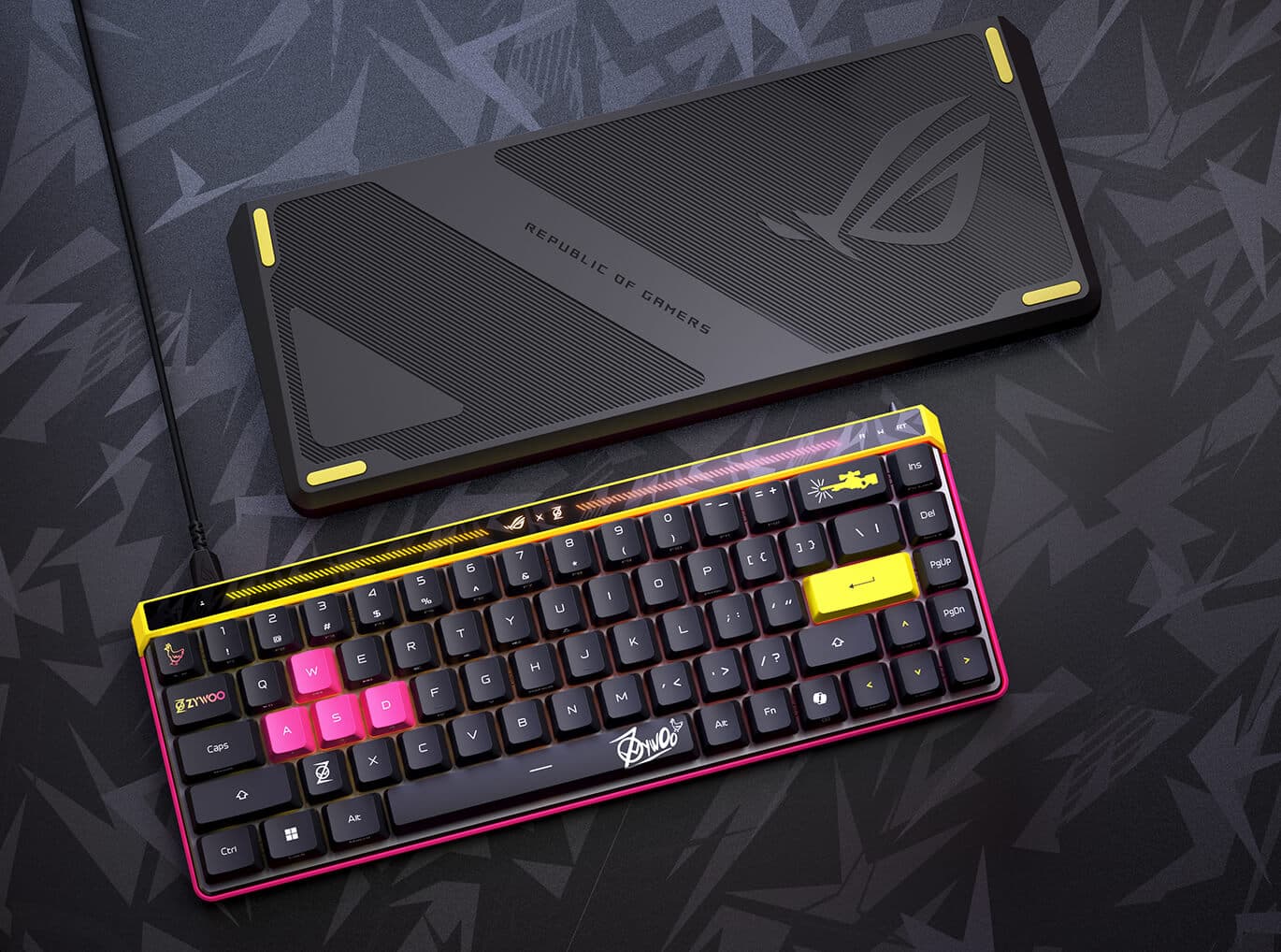
The Falchion Ace HFX ZywOo Edition looks like a collector piece first, and that is exactly the trap a lot of branded esports gear falls into. This board earns a closer look because ASUS did more than splash a pro-player name across the shell: it kept the hall-effect hardware intact and changed the parts your fingers actually notice.
ZywOo’s branding is loud, but the board is not just a poster
ASUS officially tied Mathieu “ZywOo” Herbaut to Republic of Gamers on May 16, 2025, calling him one of the most decorated Counter-Strike 2 stars and positioning him as a ROG keyboard ambassador. The Falchion Ace HFX ZywOo Edition arrived later as a 65% compact gaming keyboard built around that partnership, and the design leans hard into his identity with pink and yellow accents, magenta-tinted WASD keys, custom legends, and a signed spacebar.
The theme goes beyond a simple logo swap. ASUS’ own materials point to unique icons on ESC, Tab, Backspace, and Enter, while the review calls out the ZywOo references spread across the board, including the spacebar, Tab, and Z keys, plus an AWP motif and the classic Counter-Strike chicken. That kind of treatment makes sense for a player with real gravity behind the name: HLTV lists ZywOo as a 25-year-old French player for Team Vitality with three Major wins, three Major MVP awards, and No. 1 finishes in 2019, 2020, 2023, and 2025.
The useful part lives under the branding
What matters most is that ASUS did not strip away the base Falchion Ace HFX formula. The board still uses pre-lubed ROG HFX magnetic switches, and that is the reason this edition belongs in a mechanical-keyboard conversation instead of a merch discussion. Hall-effect switches are about controllability, and ASUS gives you a wide 0.1 mm to 4.0 mm actuation range, which turns the board into something you can actually tune for different tasks instead of just accepting a fixed switch point.
That tuning story is backed up by the rest of the feature set. Rapid Trigger, a dedicated RT control, Speed Tap mode, an interactive touch panel, and 8000 Hz polling all keep the board squarely in the gaming-performance lane, but they also make the keyboard feel more deliberate as hardware. If you care about fast repeated inputs, or you like being able to adjust how aggressive a board feels without changing the switches themselves, this is the part of the ZywOo Edition that carries real value.
ASUS also kept the compact travel-friendly identity of the Falchion line intact. The review points to refined acoustics, and that matters because hall-effect boards can be excellent on paper yet still feel hollow or clattery in practice. Here, the sound profile is supported by five dampening layers, two PORON and three silicone, which is the kind of internal work that actually changes the typing impression rather than just the spec sheet.
The upgrades that enthusiasts will feel immediately
This is where the collaboration edition starts earning its premium. ASUS did not stop at cosmetics and call it a day. The ZywOo model adds PBT keycaps and a better spacebar, and those are the changes most likely to show up the moment your hands land on the board.
PBT changes the day-to-day feel in a way that glossy marketing never can. It gives the deck a more substantial top surface, and on a compact 65% board with a narrow footprint, that kind of material swap does a lot to make the board feel less like a novelty and more like a serious desktop tool. The better spacebar matters for the same reason: it is the key you hit constantly, and on a themed board with so much visual noise, fixing the biggest contact point is exactly the right kind of restraint.
The chassis also keeps a few practical touches that fit the actual use case. ASUS includes dual USB-C ports for quick switching between two PCs, three adjustable tilt angles, and a cover case, which makes the board easier to carry and easier to live with on a desk. That package is rounded out by extra keycaps, a puller, and a USB-C to USB-A cable, so the box feels functional rather than inflated.
Price, connection choice, and who this board is really for
Cowcotland pegs the suggested retail price at 219.90 euros, and that is where the review gets more skeptical. Hall-effect competition has intensified, and several rivals now undercut premium pricing, especially when wireless is part of the comparison. ASUS’ wired-only choice, combined with the aluminum top plate, ABS base, and ISO-FR layout, makes the board feel like a focused regional variant rather than a no-compromise luxury flagship.
That does not make it a bad buy. It means the value case depends on what you want from a collaboration board: if you want the strongest possible mix of personality and substance, the ZywOo Edition actually delivers something beyond decoration. If you want wireless convenience or a more upscale chassis, the price lands harder, because the aesthetic extras do not erase the fact that the real upgrade here is still the same hall-effect platform with better keycaps and a smarter spacebar.
That is the cleanest way to read this board from across the room and from under your fingertips. The ZywOo styling is what pulls you in, but the PBT caps, tuning range, dampening, and existing Falchion Ace HFX strengths are what keep it from feeling like an esports decal job once you start typing or firing off rapid inputs.
This article was produced by Prism’s automated news system from verified source data, official records, and press releases, then run through automated quality and moderation checks before publishing. The system is built and supervised by the people who set the standards it runs under. Read our full AI policy.
Did this article answer your question?