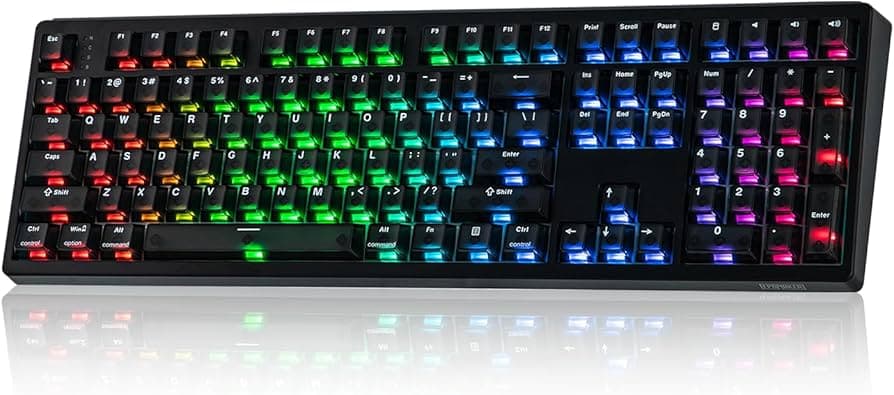
Das Keyboard 5QS Mark II favors full-size productivity over modern trends
The 5QS Mark II is a rare full-size board that still behaves like a desktop work tool. It leans on layout, acoustics, and Linux support instead of hot-swap hype.
The Das Keyboard 5QS Mark II is built for the corner of the market that still wants a 104-key board to disappear into the workday and stay there. At $229, it is not chasing the compact-wireless, gasket-mounted, hot-swap conversation dominating enthusiast desks; it is leaning into full-size consistency, a 3.3-pound chassis, a 6.5-foot cable, and a layout that keeps the function row, navigation cluster, arrows, and numpad intact.
A full-size board with a clear job
That layout is the point. The 5QS Mark II uses a US 104-key arrangement, so spreadsheet users do not have to surrender the numpad, coders do not lose dedicated navigation keys, and office-heavy workflows keep the muscle memory that a 75% board often interrupts. Das Keyboard pairs that traditional footprint with an anodized aluminum top plate, a sturdy plastic base, vivid RGB lighting, a detachable magnetic wrist rest, full NKRO, sound-dampening foam, and an oversized volume knob.
There is a deliberate seriousness to the hardware choices. The keyboard is not built around hotswap experimentation, wireless flexibility, or a modular enthusiast shell, and that will be a dealbreaker for some builders who like to open a board and tune everything themselves. But for a user who wants a stable desk anchor and a consistent typing platform, the 5QS Mark II makes the more conservative argument with real conviction.
The switch choice does most of the persuasion
The tested version uses Cherry MX2A Brown switches, and that detail matters more here than the RGB layer. CHERRY lists MX2A Brown as tactile and pre-lubed, with 45 cN actuation force, 2 mm pre-travel, 4 mm total travel, and a 100 million keystroke rating for the standard Brown variant. That is a familiar Brown profile on paper, but the MX2A revision adds updated stem and spring engineering plus factory lubrication, which should matter to anyone who likes a light tactile bump without the scratchier reputation older Browns can carry.
In practical use, that switch spec fits the board’s identity. Browns are still one of the safest picks for writing, coding, and general office work because they keep the feedback subtle and the bottom-out feel easy to live with over long sessions. On a full-size board like this, that means the switches are not trying to turn every keystroke into a performance; they are there to support sustained work.
Acoustics and desk feel are part of the pitch
Das Keyboard has not just dressed the board up in aluminum and lighting. The 5QS Mark II also includes sound-dampening foam, which is one of the clearest signs that this is meant to be a desk-first productivity tool rather than a loud showpiece. That matters in an office or shared home setup, where the difference between a sharp, hollow board and a more muted one is felt all day.
The detachable magnetic wrist rest adds to that use-case focus. So does the oversized volume knob, which fits the board’s practical side better than a row of novelty extras ever could. Together, those choices make the 5QS Mark II feel like a keyboard that expects to be used for hours at a time, not just photographed.
Software features are the old smart-keyboard idea, not a gimmick
The 5QS Mark II still carries Das Keyboard’s smart-keyboard DNA. The original 5Q launched in 2018 as a cloud-enabled, open-API RGB mechanical keyboard, and the whole concept was that the keyboard could work as both an input device and an output device. Das Keyboard framed that as a way to surface things like weather, stock quotes, project progress, and CPU usage directly on the keys.
That idea survives in the 5QS Mark II, but the newer board pairs it with a stronger sense of restraint. Das Keyboard announced the Mark II refresh in October 2024, highlighting Cherry MX2A switches, sound dampening, revamped electronics, and firmware lockdown. That reads less like reinvention and more like tightening the bolts on a known formula.
Linux support is one of the real differentiators
Where the 5QS Mark II separates itself from many premium keyboards is software support. Das Keyboard lists Windows, macOS, Ubuntu, and Linux Mint support, with a Mac mode available, and the company’s Q software download page includes Linux versions for the 5Q, 5QS, and 4Q family. That is a meaningful detail in a segment where Linux users are often left relying on partial compatibility or unofficial workarounds.

For people who live in Linux terminals or mixed-platform setups, that support changes the ownership equation. A board with a strong layout and strong software only becomes genuinely useful when the software side does not collapse outside Windows, and this is one of the few premium, full-size mechanicals that treats that as a core requirement rather than a footnote.
The tradeoffs are obvious, and that is the point
The compromises are just as clear as the strengths. The 5QS Mark II uses a single USB Type-A connection, and the cable is permanently attached, which feels dated at this price. There is no wireless mode, no USB passthrough, and no onboard storage, so it cannot play the same flexibility game as more modern boards built around portability or frequent profile hopping.
Still, the omissions make more sense when the board is viewed as a productivity instrument rather than a tinkerer’s chassis. If the workday depends on a stable full layout, a tactile Brown switch, and software that does not leave Linux behind, those missing extras matter less than they would on a smaller enthusiast board whose main appeal is customization.
A rare niche in a crowded market
The 5QS Mark II ends up occupying a narrow but real space: a wired, full-size, desktop-first mechanical keyboard that keeps the classic layout intact while still giving users per-key RGB, smart notifications, and a modern MX2A switch feel. It is not the board for someone chasing the latest compact trend or the most mod-friendly case.
It is the board for the desk that still needs a numpad, still values a function row, and still wants the keyboard to feel like a serious tool. That is a smaller audience than the one that flocks to 75% boards, but the 5QS Mark II is built with enough clarity that it never pretends otherwise.
This article was produced by Prism’s automated news system from verified source data, official records, and press releases, then run through automated quality and moderation checks before publishing. The system is built and supervised by the people who set the standards it runs under. Read our full AI policy.
Did this article answer your question?