First-time builder creates wireless split keyboard with long-lasting batteries
Lu's first board is a wireless split Choc daily driver, and its months-long battery life shows how far serious customs have come for newcomers.
A debut board that skips the usual starter path
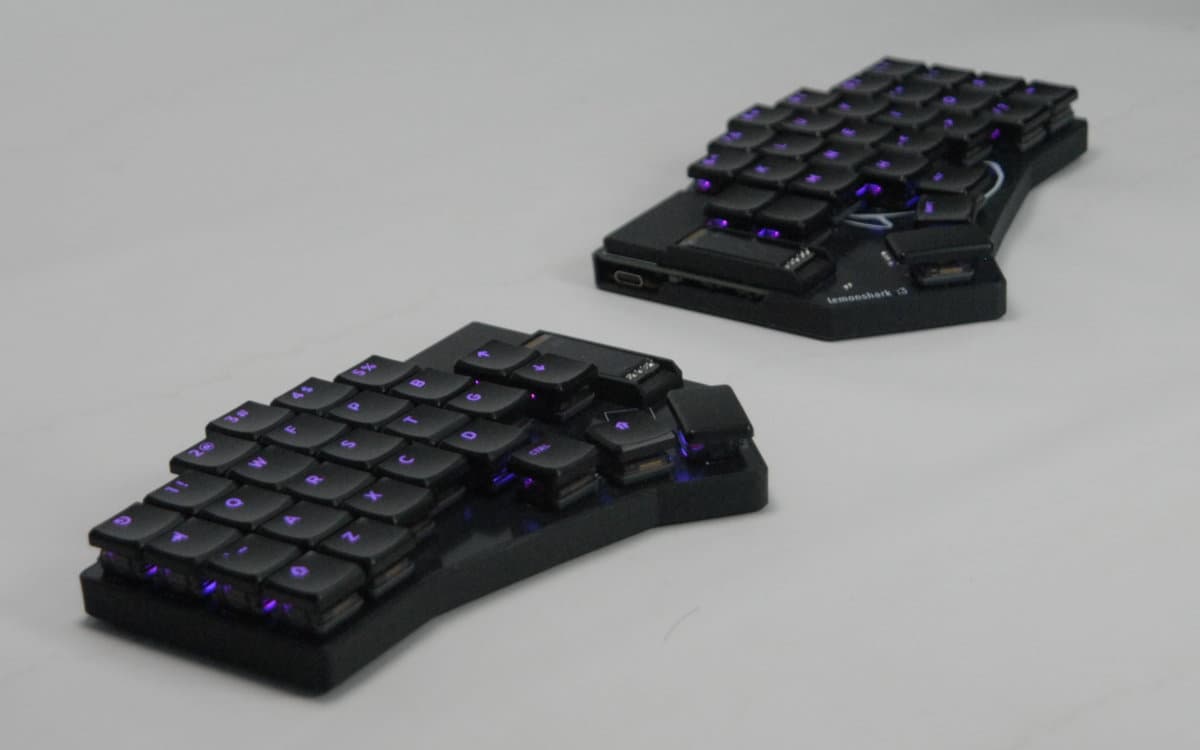
Lemonshark is lu’s first keyboard project, and that alone makes it worth a closer look. Instead of beginning with a safe, familiar starter build, lu, who also goes by stardustArc and fuzzytomatohead, jumped straight into a wireless split with low-profile Kailh Choc switches, per-key RGB, and nice!view displays. That is not the path of someone dabbling in the hobby. It is the path of someone who already understands what makes a board livable every day.
The most revealing detail is that this is not just a shelf piece. Lu has been dailying Lemonshark for about three months after moving away from a 100% membrane keyboard, which gives the project a real-world test most first boards never get. The result is a debut that feels less like a novelty and more like proof that the custom keyboard scene is becoming more approachable without becoming less serious.
Why the wireless split stack matters
Lemonshark sits squarely in the wireless ergonomic corner of the hobby, one of the most active spaces in keyboards right now. It uses ZMK, and that matters because ZMK is built for split keyboards where each half runs its own controller and the halves communicate as a single device. In practice, that means a builder can make a true split board without giving up the convenience and polish people expect from a modern daily driver.
The controller choice reinforces that direction. Lemonshark uses the nice!nano V2, a Pro Micro drop-in replacement designed for wireless keyboards around the Nordic nRF52840 BLE chip, with on-board lithium battery charging. That combination lowers the barrier to building a wireless split, because the controller does a lot of the hard work that once required far more custom wiring and compromise.
There is a quieter but important detail here too: Nice Keyboards includes a software-level switch to cut power to LEDs, because LEDs can still draw current even when they appear off. That kind of engineering-minded feature is exactly what makes today’s wireless builds feel more practical than aspirational. You are not just buying convenience, you are building around the realities of battery drain.
Battery life is the real headline
RGB is usually where battery life goes to die, so Lemonshark’s numbers are the story inside the story. Lu says the board can run its LEDs for about 10 hours at 15% brightness, and can last for months when the lights are off. That is the kind of tradeoff that tells you the builder was thinking about use, not just aesthetics.
The display choice fits that same philosophy. nice!view is described as a low-power, high-refresh display made for wireless keyboards, with a typical power draw of about 10 microamps and a 30Hz refresh rate. For a battery-powered split, that is a very different proposition from throwing any small screen onto a board and hoping the battery survives. It is a reminder that the most successful wireless customs are usually the ones where every component earns its keep.
For people watching the hobby from the outside, this is one of the most useful takeaways from Lemonshark. The old assumption was that a serious custom meant a wired board, a heavy case, and a long build process. Lemonshark shows a newer reality: serious can also mean wireless, low-profile, and power-conscious, if the entire stack is chosen with the same goal.
A compact layout built for layers and thumbs
At about 56 keys in a 6x4+3-ish split ergonomic layout, Lemonshark stays compact without feeling stripped down. That size matters because low-key-count boards depend on layers, thumb clusters, and efficient key placement rather than brute-force key count. On a board like this, the layout is doing as much work as the hardware.
The low-profile Choc switch choice also shapes how the board lives on a desk and in a bag. In the ergonomic DIY world, builders often prioritize shorter travel, thinner cases, and portability, and Lemonshark fits that pattern neatly. It is part of the same design conversation as other wireless Choc splits, including SofleChocWireless, which also pairs per-key RGB with nice!view-style displays. That comparison makes Lemonshark feel less like an isolated experiment and more like a new entry in an established but still fast-moving ecosystem.
The software choice matches the typing goal
Lu’s layout choice, a modified Colemak-DH, is another sign that this build was designed as a daily tool rather than a showcase board. Colemak-DH is a minor modification of Colemak intended to improve comfort, and it is especially well suited to symmetric ergonomic keyboards. The layout’s logic lines up naturally with a split board, where you want the hands to travel less and the thumbs to do more of the work.
That pairing helps explain why the board has stuck as a daily driver for three months. When the layout, the hardware, and the firmware all point in the same direction, the result feels coherent rather than experimental. You can see why a first-time builder would land on this combination and then keep using it: it offers the ergonomics of a serious custom without making wireless feel fragile or impractical.
Revision, honesty, and why the first PCB still matters
One of the most valuable parts of Lemonshark is how open it is about the rough edges. Lu says the V1 PCB had bodges and janky solutions, and is already recommending a V2 PCB. That kind of transparency is gold in the keyboard community, because it shows the gap between a successful first build and a polished revision that other people might actually want to copy.
The public repository on GitHub turns that lesson into something useful for the rest of the scene. Because the project is shared as stardustArc/lemonshark, builders can inspect the choices behind the board instead of only seeing the final photos. That makes Lemonshark more than a personal milestone. It becomes a reference point for anyone wondering whether a first serious wireless split is still a moonshot.
Lemonshark’s real significance is that it narrows the distance between beginner curiosity and a board that can live on your desk for months. A first-time designer built a wireless split Choc keyboard with batteries, RGB, low-power displays, and a layout tuned for ergonomic typing, then kept using it long enough to prove it works. That is the clearest sign yet that the barrier to building a serious custom is not gone, but it is falling fast.
This article was produced by Prism’s automated news system from verified source data, official records, and press releases, then run through automated quality and moderation checks before publishing. The system is built and supervised by the people who set the standards it runs under. Read our full AI policy.
Did this article answer your question?