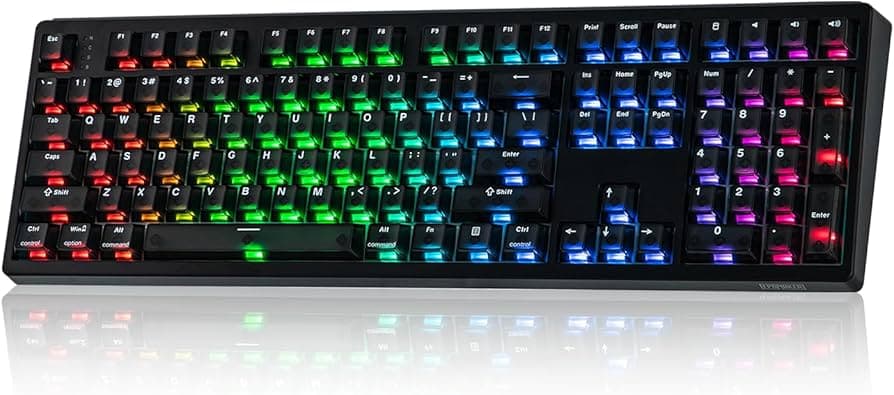
Flydigi FS68 magnetic keyboard uses multi-Hall design for FPS precision
Flydigi’s FS68 leans on multi-Hall sensing, with a four-sensor WASD cluster, to chase cleaner movement control than today’s standard magnetic boards.

Flydigi is pushing the FS68 Magnetic Keyboard as more than another rapid-trigger board with a flashy spec sheet. The real pitch is sensor architecture: a Multi-Hall Core setup that uses more than one sensing path to stabilize the top of a keypress, shrink dead zones, and cut the kind of drift or ghosting that can muddy fast FPS inputs.
That matters because the fight in magnetic keyboards has moved well past raw polling-rate bragging rights. Flydigi scheduled the FS68 reveal for April 22, 2026 at 19:00 Beijing time and paired it with a 65% compact layout meant to leave more room for mouse movement. Most keys use dual sensors, while the WASD cluster gets a four-sensor array, a configuration Flydigi says gives the movement keys tighter control than a standard single-sensor magnetic board.

The company’s pre-release messaging also leaned hard into the idea of better real-world control rather than abstract benchmarks. Flydigi’s Pre-RT claim is built around detecting reduced finger pressure before the stem fully bottoms out, and the company says that approach can shave roughly 5 to 10 milliseconds off a keypress in the right conditions. That is the sort of claim competitive players will compare directly against the rapid-trigger systems already established by Wooting and Razer.
Wooting has said it introduced Rapid Trigger in 2019 and brought it to wider attention with the Wooting 60HE in 2022. Razer’s Huntsman V3 Pro line counters with Analog Optical Switches Gen-2, Rapid Trigger, and adjustable actuation from 0.1 to 4.0 mm. RTINGS’ Hall-effect explanation gives the underlying context: these boards use magnetic sensors instead of physical contacts, which lets them track travel continuously rather than waiting for a fixed switch point. That makes the FS68’s multi-sensor design relevant only if it translates into more consistent calibration, cleaner analog accuracy, and more reliable movement under repeated strafing.
Flydigi is also trying to make the FS68 feel like a proper daily board, not just a tournament weapon. Product listings describe aluminum-alloy construction, sound-dampening foam, a Honeycomb Buffer Pad, and a single-key slotted plate, all aimed at softening the sound and bounce without sacrificing rigidity. The EVA Ayanami Rei edition adds pale azure and white styling tied to the character, turning the keyboard into both a performance play and a collector piece. That combination is the new benchmark question for magnetic keyboards: not just how fast they trigger, but whether their sensor design, tuning, and feel are good enough to force Wooting, Razer, and the rest of the field to answer.
This article was produced by Prism’s automated news system from verified source data, official records, and press releases, then run through automated quality and moderation checks before publishing. The system is built and supervised by the people who set the standards it runs under. Read our full AI policy.
Did this article answer your question?