Handwired split keyboard uses molded tin tenting weights and latching Bluetooth selector
Molded tin tenting weights and a zero-energy Bluetooth selector turn Hawk into a split keyboard that solves real ergonomic and multi-device problems.
The practical parts are the headline
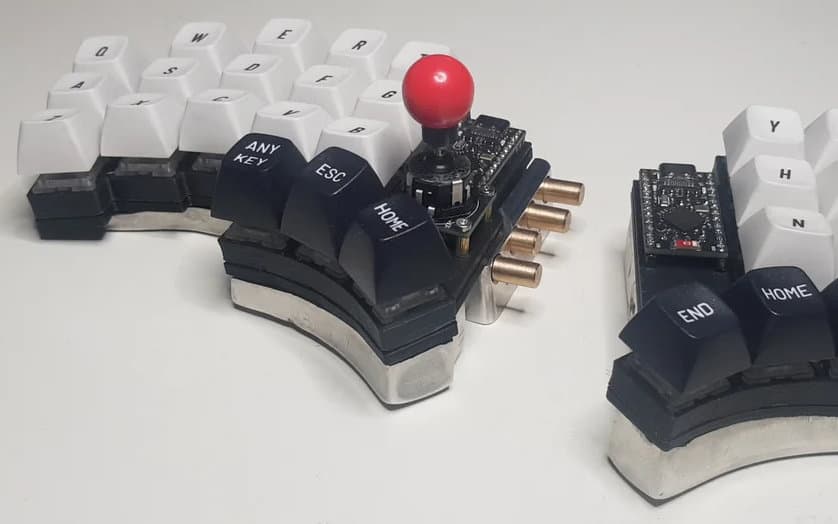
Hawk’s smartest moves are not the ones you usually notice first. The molded tin tenting weights and the latching Bluetooth selector solve two of the most annoying split-keyboard problems at once: keeping the halves stable in a tented position, and making multi-device switching legible without burning power on a display.
That is the kind of thinking that makes DIY boards feel better than an off-the-shelf purchase. VBNC8, also shown as Admirable-Guava-6138, built Hawk as a handwired split keyboard with 36 keys in a 5x3+3 layout, and the whole project reads like an argument that ergonomics should be shaped into the hardware itself, not added later as an accessory.
Molded tin as tenting hardware, not just ballast
The tenting weights are the most unusual part of the build because they are doing two jobs at once. They add ballast, which helps keep the halves planted, and they also provide the tenting hardware that raises the board into a more ergonomic angle.
The process is part sculpture, part fabrication: VBNC8 printed PLA positives, formed plaster or sand molds, poured molten tin, then finished the parts with drilling, machining, and polishing. That is a serious amount of work for a part many keyboards leave to third-party stands, but it solves a real problem for split boards, where tenting can reduce wrist extension and forearm pronation.
This is why split boards often feel more intentional than slab keyboards. The split shape already lets each hand sit in a more natural position, and the tenting pushes that further by letting the halves settle into a posture that feels designed, not improvised. On a compact 36-key board like Hawk, that kind of physical tuning matters even more because there is less room to waste on hardware that does not earn its place.
A Bluetooth selector that tells you everything without a screen
The other standout part is the latching pushbutton Bluetooth selector. Instead of relying on an active display, the switch position itself communicates state with a permanent zero-energy display function.
That is a very keyboard-builder way to think about workflow. If you bounce between devices, a selector like this makes pairing and profile switching feel tactile and immediate, and it avoids the extra complexity of a live screen just to answer a basic question: which machine is this board talking to right now? In a wireless split build, that kind of clarity is worth more than visual flair.
The selector also fits the overall logic of Hawk. Every control seems to exist because it does something concrete, not because the board needed another visible gimmick. That is a big reason DIY boards keep pulling people in: they treat user interface as physical design, where the act of switching state should feel as deliberate as the act of typing.
Why 36 keys still make sense
Hawk sits in the part of the hobby where smaller is not a compromise, it is the point. Split keyboards are commonly built to separate the hands into two halves, which can improve hand, wrist, and shoulder position, and they are often much smaller than conventional keyboards, sometimes as compact as 40% layouts or 36-key designs.
That scale matters because it changes how you use the board. With a 5x3+3 layout, you are not carrying around a mini version of a full keyboard. You are committing to a layout that assumes layers, deliberate reach, and a cleaner relationship between movement and function.
That is also where ZMK comes in. ZMK supports split keyboards where the two halves communicate and operate as one device, which makes it a natural fit for builds like Hawk that combine wireless control logic with highly customized hardware. The firmware is part of the story here because it lets the builder make the board feel unified even when the hardware is physically divided.
The extra controls show the board was built to be used
Hawk also includes a five-way encoder switch, which VBNC8 says is mainly for media control and cursor movement on another layer. That choice tells you a lot about the build philosophy. Instead of packing the board with redundant keys, the builder added a compact control cluster that can handle everyday navigation without breaking the 36-key footprint.
That kind of input-method novelty is one reason differentiated keyboards get so much attention in the hobby. A board like this is not just about typing speed or a clean case. It is about turning common tasks, like changing volume or nudging a cursor, into actions that feel anchored in the hardware.
What Hawk teaches beyond the board itself
Hawk works because the parts that look eccentric are actually the most practical. The molded tin weights solve balance and tenting in one move, the latching Bluetooth selector makes device switching obvious without a powered display, and the five-way encoder keeps utility close at hand without bloating the layout.
VBNC8’s GitHub and YouTube presence reinforces that this is part of a broader maker practice, not a one-off art object. In that sense, Hawk is a clean example of why the DIY end of mechanical keyboards still beats buying something finished: it lets the builder turn ergonomics, portability, and multi-device use into one cohesive object, then make the hardware itself tell the story.
This article was produced by Prism’s automated news system from verified source data, official records, and press releases, then run through automated quality and moderation checks before publishing. The system is built and supervised by the people who set the standards it runs under. Read our full AI policy.
Did this article answer your question?