Jeff Geerling hacks Apple Touch ID into a mechanical keyboard with 3D printing
Jeff Geerling’s Touch ID hack tackles a real Mac keyboard pain point: keep mechanical switches without giving up Apple’s biometric login. It’s clever, but still hard to copy.
The daily pain point this build solves
Jeff Geerling’s Touch ID project lands because it fixes a problem a lot of Mac mechanical-keyboard users know well: once you leave Apple’s own keyboard, you usually lose the fast, thumb-on-sensor convenience of Touch ID. That means more password typing, less friction at unlock, and one more small annoyance every time you want Apple Pay or a quick authenticated login.
His December 3, 2025 post makes the case from inside that exact frustration. Geerling had already upgraded to a mechanical keyboard, but Apple’s biometric hardware is so tightly controlled that there still is no mainstream mechanical keyboard with Touch ID built in. Instead of waiting for Apple or a third-party brand to bridge that gap, he built the bridge himself.
How the hack is assembled
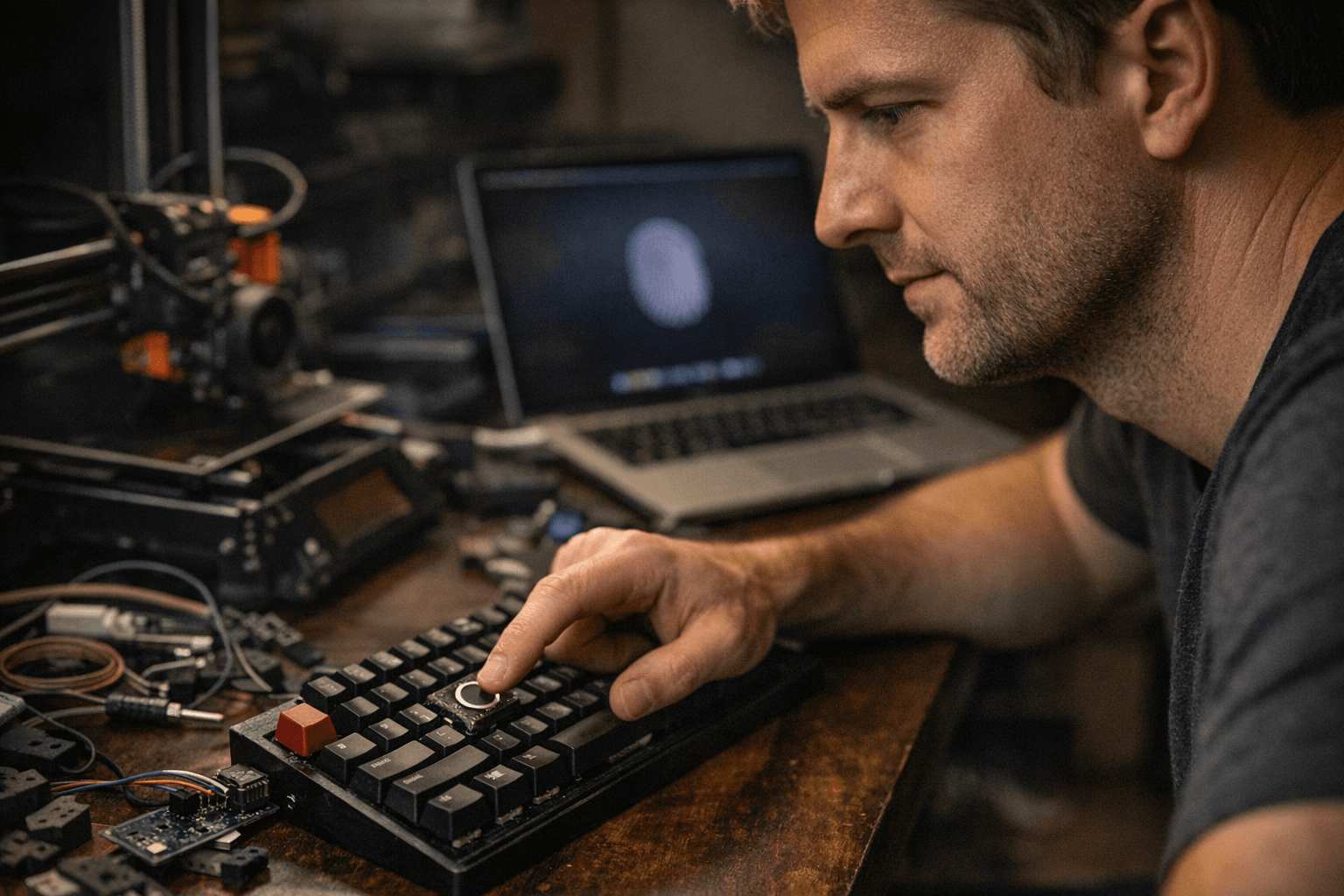
The core idea is simple enough to explain and demanding enough to scare off most people: take an Apple Magic Keyboard with Touch ID, remove the Touch ID hardware, and place it in a custom 3D-printed box alongside the keyboard’s logic board. That turns Apple’s biometric hardware into a separate little accessory while preserving the part that talks to the Mac.
Geerling says he was not the first person to think of it. The first version of the idea he saw came from a Snazzy Labs video, which gives the project a useful context shift: this is not just a novelty mod, it is a recurring answer to a real unmet need. Hackaday’s coverage of the broader mod scene describes the process more bluntly, noting that the logic board, Touch ID sensor, and connector hardware get removed and rebuilt in a custom enclosure. The tradeoff is harsh but honest: the original keyboard is left unusable for normal typing.
Why Apple’s design makes this possible
Apple’s own security model explains why the workaround works at all. The Touch ID sensor in the Magic Keyboard is not storing biometric templates on the keyboard itself; instead, it has to be securely paired to the Mac’s Secure Enclave before use. That keeps the biometric trust chain on the Mac side rather than in the accessory housing.
There are still limits. Apple says a Magic Keyboard with Touch ID can be securely paired with only one Mac at a time, although one Mac can maintain secure pairings with up to five Magic Keyboard with Touch ID keyboards. Apple also says the external Touch ID keyboard works with Macs using Apple silicon, so this is very much an Apple-silicon-friendly trick rather than a universal desktop keyboard hack.
What the commercial product tells you about demand
Apple did not always sell the keyboard separately. It first appeared bundled with the 24-inch iMac, then became available on its own in 2021 for $149. The current USB-C version in Apple’s store is listed for Mac models with Apple silicon running macOS 15.1 or later, and it sells for $149.99.
That price matters because it frames Geerling’s argument. He says Apple could sell a small standalone Touch ID box, and he would pay about $50 for one. In other words, the project is not only about personal tinkering; it is a proof that there is a product-shaped gap between Apple’s existing hardware and the way mechanical-keyboard fans actually want to work.
Why this is useful, and why it is still a stretch
The usefulness is obvious once you live in the workflow. Mechanical keyboard users get the typing feel they prefer, but they can still unlock quickly, authenticate purchases, and keep the friction low across the day. That combination is the whole point: the build is not about showing off 3D printing, it is about refusing the usual either-or choice between input feel and Apple convenience.
The stretch is just as real. You need a donor Apple Magic Keyboard with Touch ID, the willingness to open it up, the ability to move tiny electronics into a custom enclosure, and a tolerance for the fact that the original keyboard can no longer serve as a normal keyboard. Add Apple’s hardware lock-in, the Apple-silicon requirement, and a retail price that already sits at $149.99, and the path starts to look less like a casual weekend mod and more like a specialist project.
Why the maker community keeps circling back to it
This is not a one-off stunt floating in isolation. Printables already hosts downloadable 3D-print projects for similar standalone Touch ID enclosures, which suggests the idea has enough traction to sustain its own tiny design ecosystem. That matters because it turns the hack from a single creator’s curiosity into a persistent subculture around a very specific Mac problem.
That persistence is the real story underneath the cleverness. Mac users who care enough about mechanical keyboards to build around them are also often the users who care most about effortless login and Apple Pay, so the overlap is natural. What Jeff Geerling demonstrates is not that everyone should do this, but that the demand is strong enough to justify a hack, and maybe, eventually, a product.
The bottom line for keyboard builders
Geerling’s build shows that the barrier is not technical possibility so much as product packaging. Apple has the Touch ID hardware, the security model, and the ecosystem; enthusiasts have the will to splice them into a form factor that fits their desks. Until Apple sells the missing piece as a standalone accessory, this remains a compelling proof of concept with real-world value, but also with enough hardware, cost, and usability friction to keep it in the hands of the most determined builders.
This article was produced by Prism’s automated news system from verified source data, official records, and press releases, then run through automated quality and moderation checks before publishing. The system is built and supervised by the people who set the standards it runs under. Read our full AI policy.
Did this article answer your question?