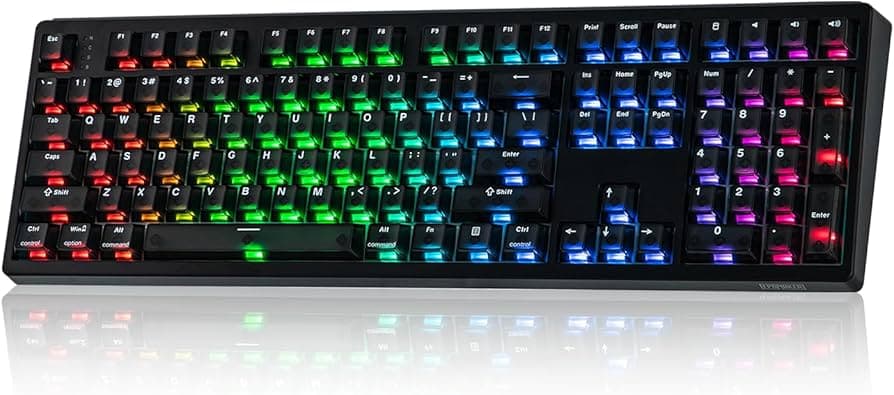
KiiBOOM Phantom81 V4 pairs frosted acrylic style with 75% practicality
Frosted acrylic gets the spotlight, but the Phantom81 V4 also brings VIA, hot-swap support, tri-mode wireless, and an 8000mAh battery to the 75% formula.

KiiBOOM’s Phantom81 V4 is trying to answer a question that matters every time a keyboard looks too pretty to trust: can a frosted acrylic board still behave like a serious daily driver? The 75% layout keeps the function row and arrow keys in play while shrinking the footprint, and the rest of the package leans hard into the enthusiast checklist with VIA support, hot-swap sockets, tri-mode wireless, and an 8000mAh battery.
Why the 75% layout still makes sense
The appeal starts with the layout itself. A 75% board typically keeps the function row, arrow keys, and a compressed navigation cluster while dropping the numpad, landing around 81 to 84 keys. KiiBOOM lists the Phantom81 V4 as an 81-key, 75% format board, which puts it in the sweet spot for people who want something smaller than a full-size board but refuse to give up the keys they actually reach for every day.
That matters because the Phantom81 V4 is not trying to sell compactness as a gimmick. It is pitched as a board that saves desk space without turning basic movement, layer access, or function-key use into a chore. In other words, it is built for the user who wants a cleaner setup, but still expects the board to work like a keyboard first and a design object second.
The frosted acrylic look is not just decoration
The visual identity is what makes the Phantom81 V4 stand out in a crowded field of black aluminum rectangles. KiiBOOM pairs the frosted acrylic case with side ambient lighting and standard RGB backlighting, so the board glows through the shell instead of hiding its lighting inside it. The company also adds small touches that push the board toward display-piece territory, including cat paw-shaped silicone pads, a metal strip on top, and an aluminum alloy weight on the back.
KiiBOOM’s product page says the semi-transparent finish is meant to hide internal components while resisting fingerprints and scratches, and that the case uses a stainless-steel weight base for stability. That combination tells you exactly who this board is for: people who care about how a keyboard looks in a setup photo, but still want it to feel planted on the desk when the typing starts. The styling is loud, but it is not purely cosmetic.
Programmability is the part that makes it credible
The real test for any looks-first board is whether it disappears into your workflow after the novelty wears off. The Phantom81 V4 has the right answer on paper because KiiBOOM says it supports VIA driver customization, and VIA is built for browser-based layout configuration, testing, and design. That gives the board a place in the modern custom-keyboard ecosystem, where remapping, layers, and rapid iteration are part of the normal routine rather than an afterthought.
KiiBOOM also lists the Phantom81 V4 as hot-swappable, which is a major practical advantage if you like to tune switches without committing to a solder job. Combined with RGB control and macro support in the driver software, the board is aimed squarely at users who want a flexible base, not a sealed consumer product with limited options. That is the difference between a pretty board you admire and a board you actually build around.
Wireless behavior is built for real use, not just spec-sheet noise
The Phantom81 V4’s tri-mode connectivity covers Bluetooth 5.0, 2.4GHz wireless, and USB-C wired use. That is the kind of spread that matters in daily use because it lets the board move between a clean wireless setup and a low-latency wired connection without forcing a hardware change. For a 75% board meant to live on a desk, that flexibility is a stronger selling point than a flashy feature you only notice once.
The 8000mAh battery is the other key number here. It is a clear step up from the original Phantom 81, whose product page listed a 4000mAh battery, and it signals that KiiBOOM is treating wireless use as more than a convenience add-on. In a board that is already trying to win on aesthetics, the bigger battery helps keep the wireless story grounded in practicality rather than showroom appeal.
The Phantom81 line has been moving toward this point for a while
The V4 is not a one-off experiment. It arrives as the latest step in a series that has already moved through the Phantom 81, Phantom 81 V2, and Phantom 81 V3. The original Phantom 81 emphasized 81 keys, additional poron foam layers, and a 4000mAh battery, while the V2 brought gasket mounting, a PC mounting plate, south-facing LEDs, hot-swapping, and Bluetooth 5.0 plus 2.4GHz support.
The V3 kept pushing the platform forward with a full-key hot-swappable PCB and upgraded plate-mounted stabilizers. Put together, that progression shows KiiBOOM has been iterating on the Phantom81 family with sound tuning, mounting, wireless behavior, and hot-swap flexibility in mind. The V4 builds on that identity by combining the series’ enthusiast-friendly foundation with a more dramatic frosted acrylic presentation.
A board that wants to be both centerpiece and workhorse
The Phantom81 V4 lands in a niche that has only gotten more crowded: premium decorative keyboards that still need to hold up as everyday tools. KiiBOOM’s own brand language points to creative designs for audio, mechanical keyboards, and garage-kit enthusiasts, and this board fits that playbook exactly. It is not a hall-effect speed board, and it is not a stripped-down office slab. It is a compact custom-style 75% board that tries to earn its place through layout efficiency, VIA support, hot-swap flexibility, and serious wireless hardware.
That is why the Phantom81 V4 feels more convincing than a pure style piece. The frosted acrylic shell, ambient lighting, cat paw feet, and polished weight details absolutely make it setup-photo friendly, but the underlying spec sheet is sturdy enough to keep the board in rotation after the first week. The styling gets your attention; the 75% practicality is what makes it stay.
This article was produced by Prism’s automated news system from verified source data, official records, and press releases, then run through automated quality and moderation checks before publishing. The system is built and supervised by the people who set the standards it runs under. Read our full AI policy.
Did this article answer your question?