LP44 Split brings brutalist CNC aluminum to wireless low-profile typing
LP44 Split turns a compact wireless split into a CNC aluminum statement piece, built for low-profile portability without giving up split ergonomics.
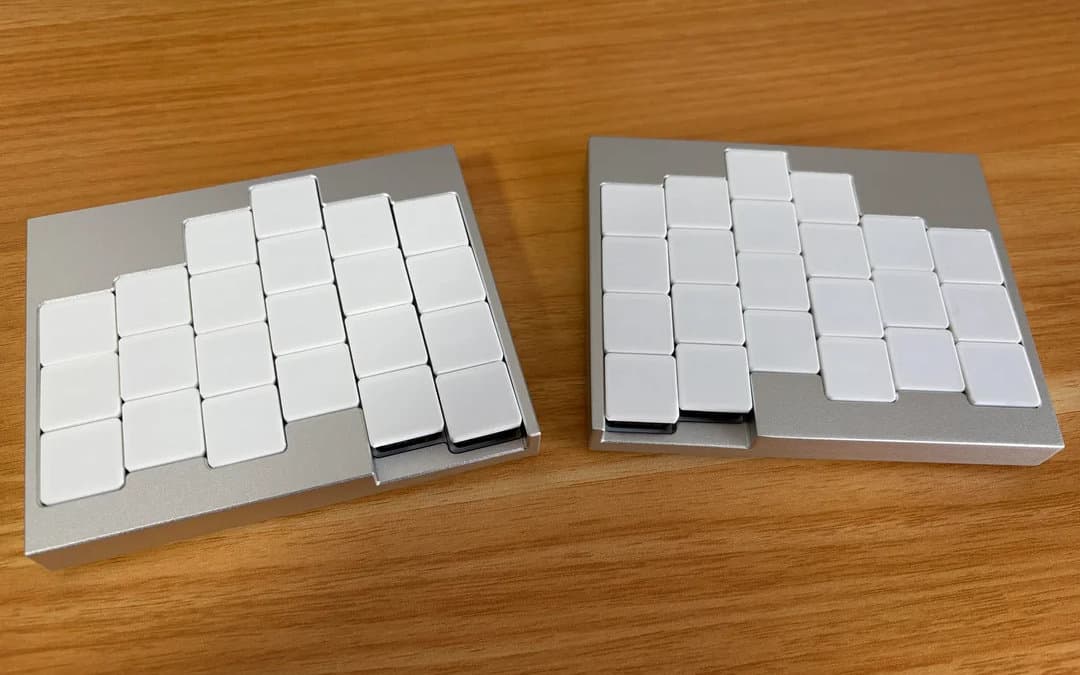
The LP44 Split lands in that rare part of the hobby where a board feels less like a one-off experiment and more like a community signal. Juncho26’s design compresses 44 keys, wireless ZMK control, and a 12 mm CNC aluminum shell into a low-profile split that is clearly chasing portability, but with enough finish to appeal to people who care about casework as much as layout.
A compact split with a deliberate point of view
At its core, the LP44 Split is a low-profile wireless split keyboard with a column-staggered layout and a very specific personality. The case is intentionally square and described as brutalist, not because that was the aesthetic target from the start, but because limited CAD experience pushed the creator toward a simpler, stronger form. That detail matters in this corner of the hobby, where some of the most interesting boards come from solving constraints honestly instead of polishing them away.
The project is not trying to be an all-purpose split for every desk. It is built for people who want the ergonomic benefits of a split board, the lighter travel footprint of a low-profile build, and the feel of a premium CNC enclosure. The result is a board that sits closer to a refined field tool than a flashy showpiece.
What the LP44 Split actually brings to the table
The headline specs are easy to read and harder to dismiss. LP44 Split uses 44 keys in a 6x3+4-ish split arrangement, runs wirelessly on ZMK, and uses soldered XIAO nRF52840 controllers. The case is CNC aluminum, and the whole board comes in at 12 mm thick, which is a serious statement in a world where many split DIY boards still lean chunky, open, and obviously handmade.
The thin profile depends on soldered Choc switches, with support for Choc v1 or v2. That choice keeps the board in the low-profile lane rather than trying to cover every switch ecosystem at once. A custom keycap set built around 17 mm spacing reinforces that this is a cohesive build system, not a random collection of compatible parts.
Even small details support that impression. The power switch is tucked underneath and out of sight, which keeps the top surface clean and preserves the board’s stripped, industrial look. For a wireless split, that kind of layout discipline matters because it turns practicality into part of the design language.
Why the build feels different from the usual split DIY path
A lot of split keyboards in the DIY world trade on flexibility, but they also ask the builder to accept compromise: thicker cases, more visible hardware, more steps, and more obvious seams between parts. The LP44 Split takes a different route by making the low-profile, wireless, metal-case combination the whole point. That shifts it away from a generic split kit and toward something closer to a finished design statement.
The tradeoff is that this kind of board is less forgiving than a more conventional open split. Soldered Choc switches, a CNC case, and custom spacing make it feel more locked in than a highly modular build. If you want a board that can endlessly mutate across layouts, switch types, and case styles, the LP44 Split is not really aiming at that lane. It is aiming at people who know what they want and want it executed with precision.
There is also a cultural tradeoff here. Low-profile wireless splits have become a recognizable pattern in the hobby, but LP44 Split shows how that pattern is maturing. Instead of stopping at “it works,” this project pushes toward a more finished, more portable object that still speaks the language of enthusiast hardware.
The lineage behind the design
LP44 Split is not floating in isolation. The repository explicitly points to TOTEM and delta-omega as inspirations, and that connection places it inside a very clear open-source lineage. TOTEM, by _GEIST_, is a 38-key column-staggered low-profile split built around Seeed Studio XIAO controllers, with wired RP2040/QMK and wireless nRF52840/ZMK variants. Its build guide also spells out the parts list in a way builders recognize immediately: 38 Choc switches, 38 diodes, two XIAO controllers, and a battery option for wireless use.
delta-omega pushes the portability side even further. It is a portable ultra-low-profile wireless 3×5+2 split with BLE wireless, 34 keys, splayed-and-staggered Choc spacing, a CNC aluminum case, and support for Cherry MX ULP or Kailh PG1316s. Its documentation also carries a practical warning about reading the guide carefully, which fits the same builder culture LP44 Split is speaking to: these boards reward attention.
Against that backdrop, LP44 Split reads like the next logical step. It keeps the wireless, low-profile, open-source split idea alive, but expands to 44 keys and leans harder into the premium-metal aesthetic. It is less minimal than delta-omega and less compact than TOTEM, but it combines their most appealing ideas into a larger, more polished package.
Who this board is really for
LP44 Split is for the builder who wants split ergonomics without surrendering portability. It is for the person who likes the feel of Choc switches, trusts ZMK for wireless efficiency and flexibility, and wants a case that looks purpose-built instead of improvised. If your ideal DIY board is still easy to toss into a bag, this one makes a lot of sense.
It is also for the kind of enthusiast who enjoys seeing design constraints turned into identity. The square, brutalist case is not a failure to chase elegance, it is a record of the build’s logic. In a hobby that often celebrates perfection, LP44 Split is compelling because it shows how a board can still feel resolved when the maker works with limitations instead of pretending they were never there.
The GitHub repository currently shows no stars and no forks, which only sharpens the sense that this is a niche project still finding its audience. That does not make it small in ambition. If anything, it makes the board feel like a clean snapshot of where compact wireless splits are headed: more refined, more portable, and more comfortable wearing their engineering on the outside.
The LP44 Split starts with split ergonomics, but its real draw is the way it turns that familiar format into a compact piece of CNC aluminum with a point of view. That is what makes it feel less like another keyboard project and more like a signpost for the next wave of low-profile builder culture.
This article was produced by Prism’s automated news system from verified source data, official records, and press releases, then run through automated quality and moderation checks before publishing. The system is built and supervised by the people who set the standards it runs under. Read our full AI policy.
Did this article answer your question?