MelGeek Centauri80 impresses with premium design and standout software
The Centauri80 tries to convert Hall-effect skeptics with a luxe shell, sharp OLED styling, and Hive software that feels built for real use.

A first impression that does most of the selling
The Centauri80 does not walk into the room like a cautious first attempt. It shows up like a statement piece, with MelGeek leaning hard into premium presentation, sci-fi styling, and a flagship aura that makes the board feel more ambitious than the average gaming keyboard. That matters because the people most likely to eye Hall-effect boards with skepticism are usually not looking for another spec dump. They want a board that feels meaningfully different the moment it lands on the desk, and that is exactly the lane MelGeek is trying to own.
The unboxing experience reinforces that pitch. The box is described as stylish and secure, and the accessories package goes beyond the bare minimum with the expected tools, a microfiber bag or cover, extra keys, stickers, a manual, and a USB-C cable. In a market where many gaming boards are still sold as functional plastic slabs, that level of presentation is part of the product story, not just packaging.
What the hardware says before you type
On paper, the Centauri80 is built to look and feel like a serious desktop fixture. MelGeek lists it as a wired single-mode board with 83 keys, which immediately tells you where its priorities sit: stability, permanence, and a layout that is compact enough to stay interesting without going ultra-minimal. The case is aluminum alloy, the keycaps are transparent PC, and the board uses an OEM profile, all of which push it toward a more premium, custom-adjacent feel than a typical mass-market gaming deck.
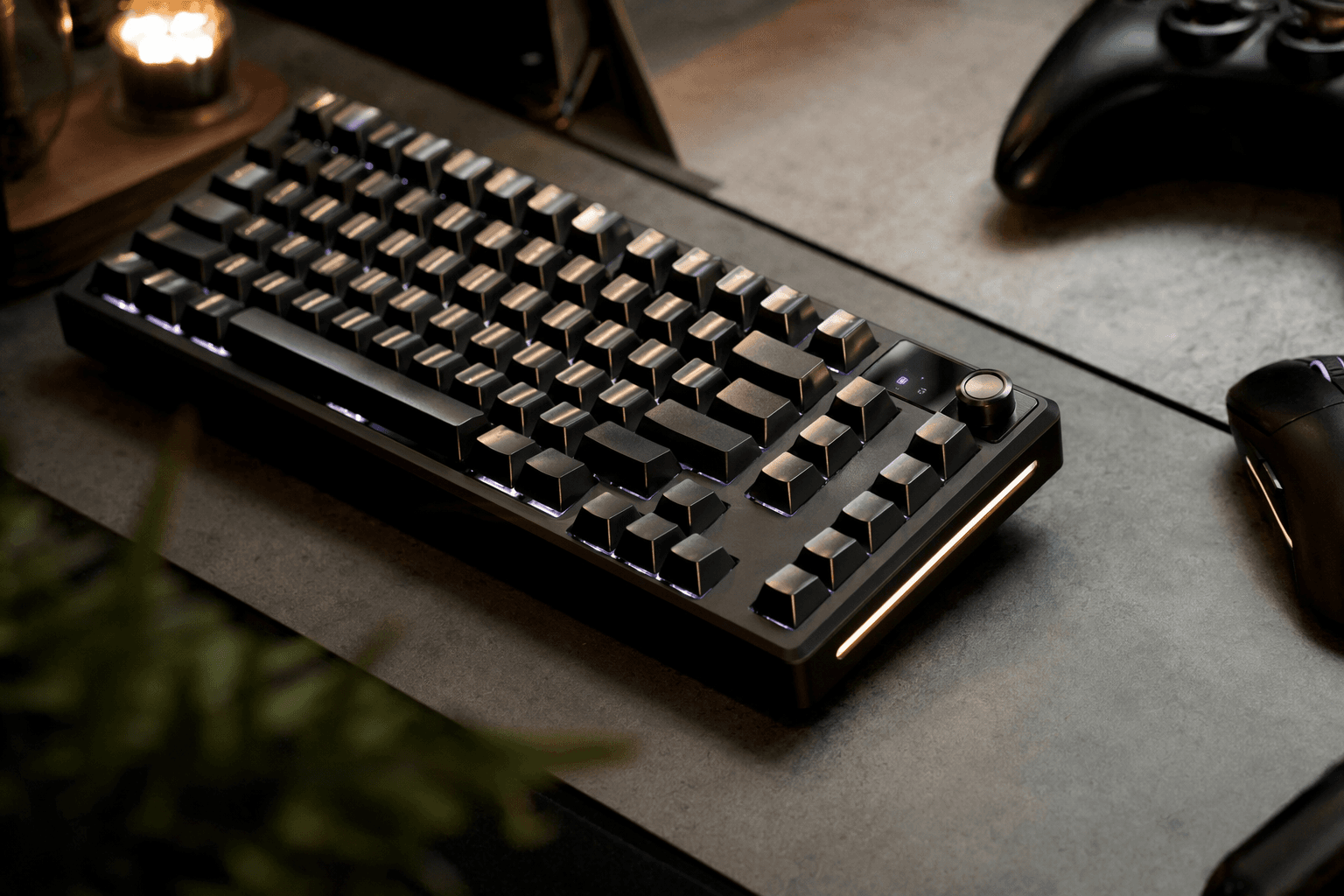
The 1.78-inch OLED screen is one of the board’s signature details, and MelGeek specifies a 368×448 resolution at 326 PPI, with claimed peak brightness of 700 nits, plus or minus 50. That screen is not just flair for flair’s sake. It helps the Centauri80 read like a hardware object with a personality, the kind of thing that can justify space on a crowded desk even before you start talking about actuation curves or rapid trigger.
There is also a practical tradeoff baked in here: no wireless, no Bluetooth fallback. For some buyers, that will be a dealbreaker. For others, it is an easy concession if the goal is a fixed desktop board where latency, consistency, and fewer variables matter more than portability.
Why Hall effect still has a real payoff
This is where the Centauri80 starts to matter beyond aesthetics. Hall-effect gaming keyboards are not just a niche tech flex anymore because they allow adjustable pre-travel on a per-key basis, which gives you a level of control that mainstream gaming boards still cannot match in the same way. That is the core reason the category keeps pulling in curious players: it turns key feel into something you can tune, rather than something you simply accept.
MelGeek’s own performance claims place the Centauri line at 8000Hz polling with 0.125ms latency, which is the kind of spec sheet language that speaks directly to competitive-minded buyers. The Centauri80 is clearly not trying to be a typing-first curiosity with gaming branding slapped on later. It is built to make the low-latency, adjustable-actuation promise feel central to the experience.

The bigger question is whether that promise would survive contact with daily use. Based on the available details, MelGeek is trying to answer that by pairing the magnetic-switch hardware with a software layer that does not feel like an afterthought.
Hive is the difference between promising and usable
For magnetic keyboards, software is often the line between an impressive demo and a board you actually keep in your setup. Hive is where the Centauri80 makes its strongest case. MelGeek says the browser tool lets you instantly edit profiles and colors from the browser, and the Hive guide highlights rapid trigger, custom actuation, macros, lighting, and snap tap settings as core features.
That list matters because it covers both the enthusiast and practical sides of the hall-effect equation. Rapid trigger and custom actuation are the headline features people buy into first. Macros, lighting, and profile management are the everyday tools that decide whether a keyboard becomes part of your workflow or just another experiment. The reviewer’s reaction suggests Hive clears a higher bar than expected, with the app described as one of the best keyboard configuration tools they had used because it makes remapping, actuation changes, lighting tweaks, and profile management feel straightforward without flattening the underlying depth.
That combination is rare enough to stand out. A lot of gaming keyboard software either buries you in menus or strips back control in the name of simplicity. Hive appears to be trying to keep both sides intact, which is exactly what a Hall-effect board needs if it wants to win over people who are curious but not yet fully converted.

Where the Centauri80 fits in the crowded gaming-board field
The Centauri line was announced in late 2025, with launch coverage placing release on November 25, 2025, and MelGeek has described it as the company’s most significant product debut in its 10-year history. That framing makes sense once you look at how the board is being positioned. This is not just another refresh of a familiar gaming formula. It is MelGeek trying to bridge enthusiast keyboard identity and competitive hardware expectations in one package.
Later coverage put pricing at about $299 for the Centauri60 and $359 for the Centauri80, though that can vary by listing and region. At that level, the Centauri80 is not an impulse buy. It is competing in the same mental category as other premium gaming boards that are judged on both feel and features, not just whether they work out of the box.
That is why the strongest argument for the Centauri80 is not a single spec. It is the way the whole package hangs together: aluminum case, OLED screen, 83-key layout, magnetic-switch performance, and software that seems built for actual ownership rather than launch-day hype. The reviewer ending up effectively committed to using it daily says a lot, because that is the real test for a board like this. First-upgrade excitement fades fast. A keyboard that still feels worth keeping after the novelty wears off is the one that earns attention, and the Centauri80 looks designed to pass that test.
Know something we missed? Have a correction or additional information?
Submit a Tip