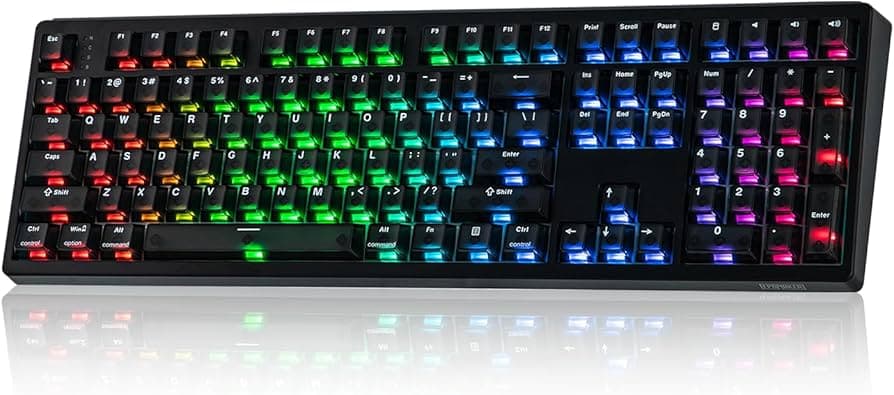
MelGeek Real81 brings premium build to crowded 75 percent keyboards
MelGeek’s Real81 tries to outgrow the 75 percent crowd with a dense gasket-mount build, hall-effect speed claims, and tuning that feels more serious than its name.

The MelGeek Real81 lands in one of the most crowded corners of the keyboard market, the 75 percent layout where buyers want arrows, function-row access, and as much desk space back as possible. That is exactly why it needs a sharper identity than most boards in this class, and MelGeek is clearly aiming for one: a compact keyboard with premium construction, aggressive performance claims, and enough polish to make enthusiasts look twice.
A 75 percent board built to feel less generic
At $139.00, the Real81 sits in the range where a lot of boards try to do everything and end up feeling interchangeable. MelGeek answers that problem with a dense spec sheet of its own: 330 mm by 140 mm by 44 mm, about 1100 g, and an approximate 6.5 degree typing angle. Those numbers matter because they tell you this is not a lightweight shell with flashy marketing, but a heavy, compact board meant to feel anchored on the desk.
The construction language pushes in the same direction. MelGeek describes the Real81 as part of its REAL Series, a line the company says was built to reject spec-sheet hype and focus on real user needs. An aluminum top case and gasket-mount construction give the board a more deliberate enthusiast profile than the usual off-the-shelf gaming slab, and the fixed typing angle reinforces that sense of a board that was tuned, not just assembled.
Why the feel and acoustics matter here
In a crowded 75 percent segment, typing feel and acoustics are often what separate a board people keep from one they move on quickly. The Real81’s gasket mount points toward a softer landing and a more controlled sound signature, while third-party retail listings add a 5-layer sound-dampening setup to the picture. That combination suggests MelGeek is not chasing pure sharpness or raw speed alone. It is trying to make the keyboard pleasant to live with, which is the real test for a premium-leaning compact board.
That is also where the Real81 becomes more interesting than its name suggests. The board makes the most sense if you treat it as a focused gaming and typing tool with a serious stock tune, not as a do-everything daily driver. The compact footprint helps mouse-heavy setups, but the fixed angle and the premium-leaning construction also imply that MelGeek wanted a specific feel, not endless adjustability.
The speed claims are loud, but they are not the whole story
MelGeek’s own product page comes in hot with performance language: a quoted 0.01 mm response time, full-key zero dead zone, true 8K polling, 16K scan rate, and 0.125 ms latency. Those are the kinds of numbers that define the current magnetic-keyboard arms race, and third-party listings repeat the same headline specs, including 8,000 Hz polling and 16K scanning. The Real81 is clearly being positioned in that hall-effect and rapid-trigger conversation, not outside it.
That matters because the market is full of boards making similar promises. In that kind of segment, raw numbers get attention, but stability, sound, and everyday comfort decide whether a board feels like a genuine contender or just another competent 75 percent. The Real81’s appeal is that it combines those headline-speed claims with a heavier, more considered chassis, which gives the whole package more credibility than a simple spec race.
Lighting, layout, and the small things that change daily use
MelGeek also gives the Real81 a few quality-of-life touches that fit the practical side of the layout. The REAL Series includes a dynamic light bar with static, breathing, and RGB modes, and MelGeek says the backlighting is enhanced to help users find the arrow keys quickly. On a 75 percent board, that is not fluff. Arrow-key visibility and layout clarity are part of what makes the format work for real desks, not just for photos.
There is also a customization angle here. MelGeek says the design can be customized with separate side panels, which gives the board a little more personality than the average compact board. For readers who care about how a keyboard looks next to the rest of a setup, that kind of external flexibility helps the Real81 feel more like a product with an identity, rather than a generic black rectangle with a magnetic switch inside.
Software support and long-term ownership
One of the more important bits for enthusiasts is that MelGeek provides software and firmware downloads through its site, with KBTools and VIA-related resources among the supporting materials. That is a useful signal for anyone who cares about remapping, layers, and the ability to tune a board after the first week of ownership. In a segment where some boards are bought for a spec sheet and forgotten, configurability is part of what keeps a board relevant.
That ownership story also fits the way MelGeek is presenting the REAL81 inside its wider lineup. The company now groups the board with other magnetic and hall-effect keyboards, including products such as Centauri and the MADE series, which shows this is part of a broader move toward higher-spec gaming and enthusiast boards. The Real81 is not a one-off experiment. It is part of a larger push to make the REAL Series look like a serious platform.
MelGeek’s own brand history adds some context. The company says it officially established the brand in 2018 after earlier work that included the Z70 keyboard kit and MDA keycaps, while an industry profile describes MelGeek as a Chinese brand founded in 2014. However you trace the timeline, the company has clearly spent years building a reputation around mechanical keyboards and accessories, and Shenzhen-based MelGeek is now using that background to sell the Real81 as more than a quick-spec gaming release.
The Real81’s place in the market is easy to understand: it is trying to solve the crowded 75 percent problem by being denser, better tuned, and more focused than the average safe option. If you want a compact board that feels premium in hand, leans into magnetic-switch speed, and looks like it was built with intent, the Real81 has the right arguments. If you want a board that disappears into the background, this one is doing the opposite, and that is exactly what gives it a shot at standing out.
This article was produced by Prism’s automated news system from verified source data, official records, and press releases, then run through automated quality and moderation checks before publishing. The system is built and supervised by the people who set the standards it runs under. Read our full AI policy.
Did this article answer your question?