MSI’s Strike Alloy TMR pairs magnetic switches with a smart control display
MSI’s Strike Alloy TMR pushes 8K polling and Rapid Trigger, then adds a 4.3-inch touchscreen and M.2 SSD bay.

MSI is leaning hard into feature convergence with the Strike Alloy TMR Wireless and Strike Nexus, but the bigger question for mechanical keyboard readers is simple: does this solve a real desk workflow problem, or just stack more complexity on top of a board that already has to feel right? The combo debuted at COMPUTEX Taipei in Taipei, Taiwan, as MSI pitched it as one system for gaming, streaming and productivity, with TMR magnetic switches, up to 8,000 Hz polling in wired and 2.4 GHz wireless modes, 0.01 mm actuation precision and Rapid Trigger behavior for fast resets. Bluetooth 5.3 tri-mode connectivity was part of the package too.
The keyboard hardware itself is the more convincing part of the pitch. MSI’s award listing says the Strike Alloy TMR uses a dual hot-swappable design that supports both magnetic and mechanical switches, which gives it a broader lane than a pure hall-effect board locked into one ecosystem. That matters in this community because the appeal of magnetic switches is not just speed, it is adjustable actuation, while traditional mechanical switches still win on familiarity, switch variety and long-term modding comfort. MSI wrapped that in a premium magnesium-aluminum chassis and a Best Choice Award win, signaling that this was not being positioned as a toy concept.
The Strike Nexus module is where the line between useful and overbuilt gets interesting. MSI says the module adds a 4.3-inch touchscreen, connects over USB-C at up to 10 Gbit/s, and can show real-time system data while also acting as a shortcut surface. It also houses an external M.2 SSD enclosure with hardware password protection. In practice, that turns the setup into a desk centerpiece that can fold together monitoring, macros and extra storage. For some users, that is exactly the kind of accessory consolidation that clears space. For others, it is another screen and another enclosure competing for attention beside a board that should probably be judged first on typing feel, switch implementation and latency.
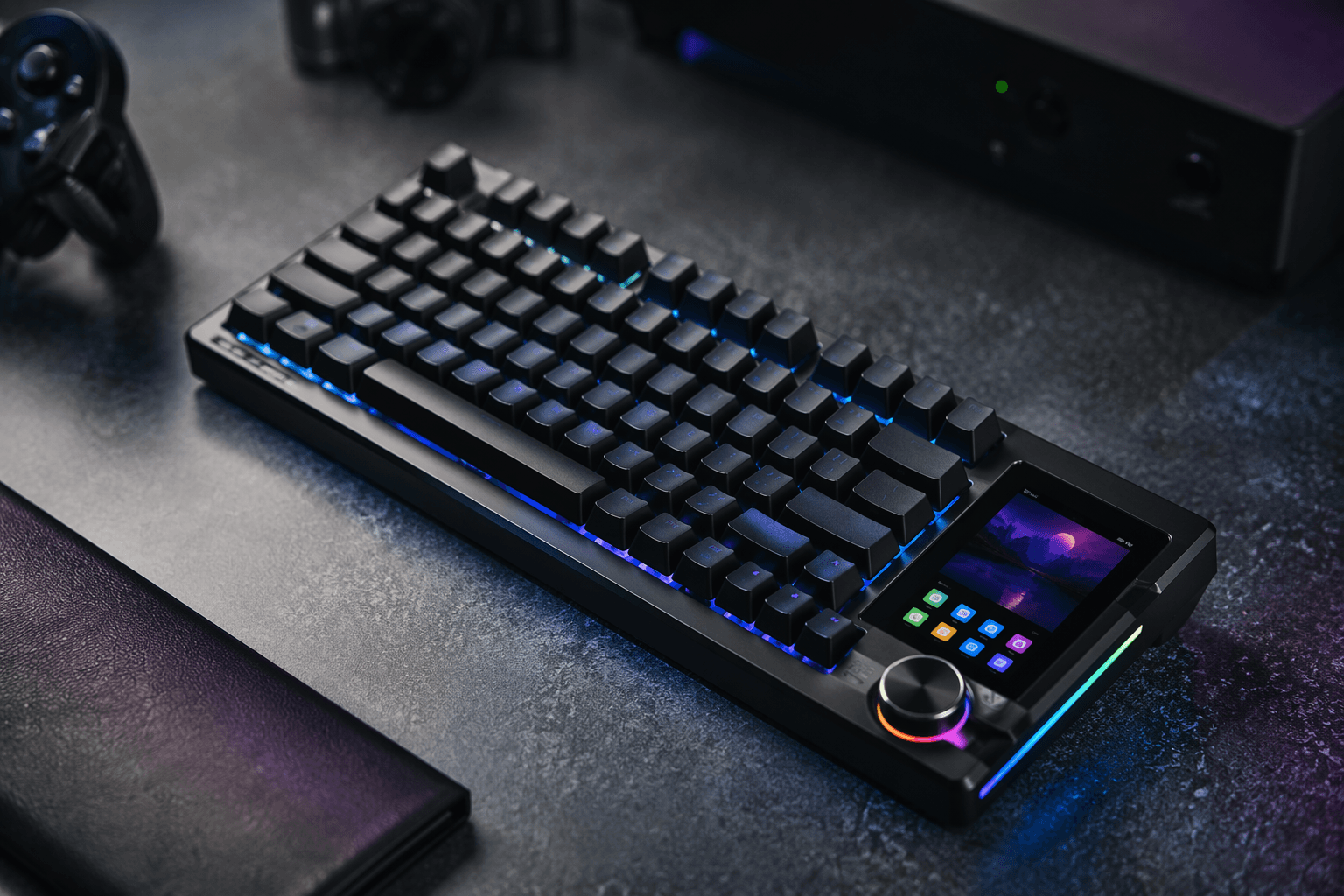
MSI’s own keyboard roadmap suggests this is not a one-off experiment. The STRIKE PRO WIRELESS launched on August 5, 2025, with Kailh Midnight Pro Silent switches, hot-swappable 5-pin support, tri-mode connectivity, a 4,200 mAh battery and a magnetic memory-foam wrist rest, all of which pointed toward a broader “desk hub” approach. The Strike Alloy TMR and Strike Nexus push that idea further, and MSI’s anniversary messaging emphasized software-hardware integration across client, cloud and intelligent edge environments. The concept is ambitious, but the verdict for keyboard fans will come down to a familiar test: whether the extra hardware earns its footprint once the novelty wears off and the typing starts.
This article was produced by Prism’s automated news system from verified source data, official records, and press releases, then run through automated quality and moderation checks before publishing. The system is built and supervised by the people who set the standards it runs under. Read our full AI policy.
Know something we missed? Have a correction or additional information?
Submit a Tip