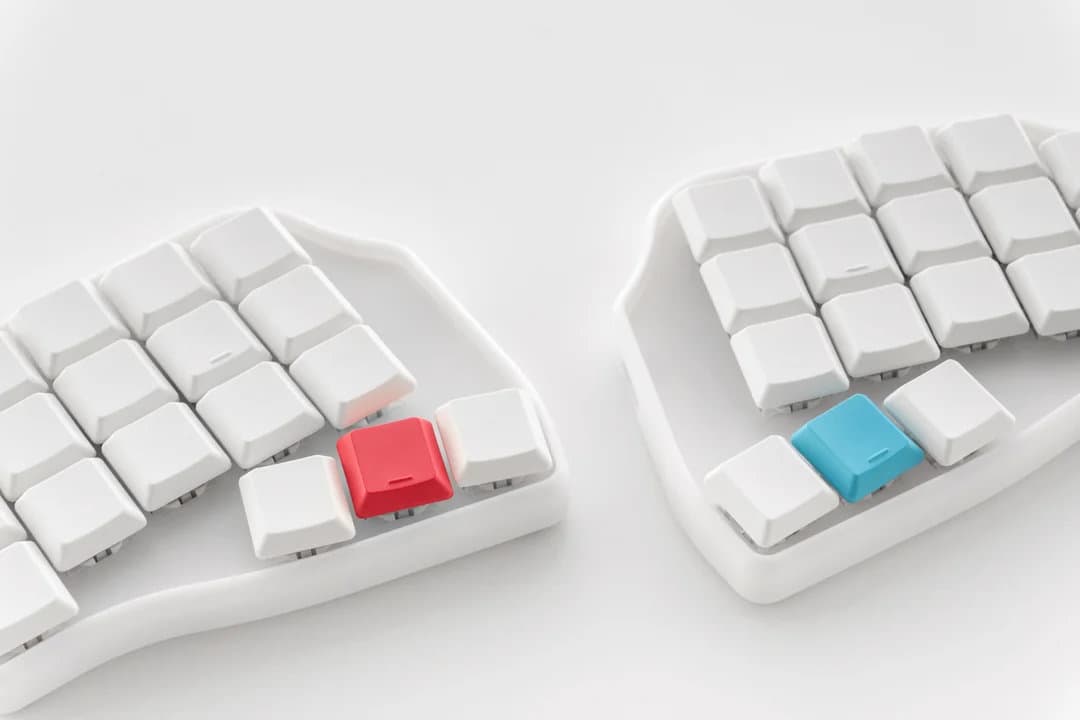
Pling! pairs wireless ZMK support with a soldered low-profile split design
Pling! swaps hot-swap tinkering for a soldered, low-profile split built to be finished once and daily-driven. Its ZMK wireless setup keeps the board lean and portable.
Pling! arrives as a compact answer to the split-board itch: a 54-key, 6x4+3 column-staggered layout, a low-profile shell, and a wireless ZMK setup wrapped around soldered Gateron KS27 switches. The build uses a Seeed Studio XIAO BLE controller based on Nordic Semiconductor’s nRF52840, plus a reversible PCB and a case made from acrylic and 3D-printed parts. It surfaced in KBD #212 on May 24, 2026, and it reads like a deliberate statement from someone who wants one finished board, not another long weekend of parts-swapping.
That philosophy is right there in the project’s own framing: “Set it and forget it, for good or for worse.” The repository is even more explicit, saying the board was designed to optimize for Binit’s “skinny long fingers” and to “embrace the internals instead of hiding it.” In practice, that means no hotswap sockets, no headers, and no jumper pads. The payoff is a cleaner internal layout and fewer loose interfaces to rattle, fail, or complicate the build. The cost is just as clear: this is not the board for people who want to audition every switch in a drawer or tear into the controller side every few months.
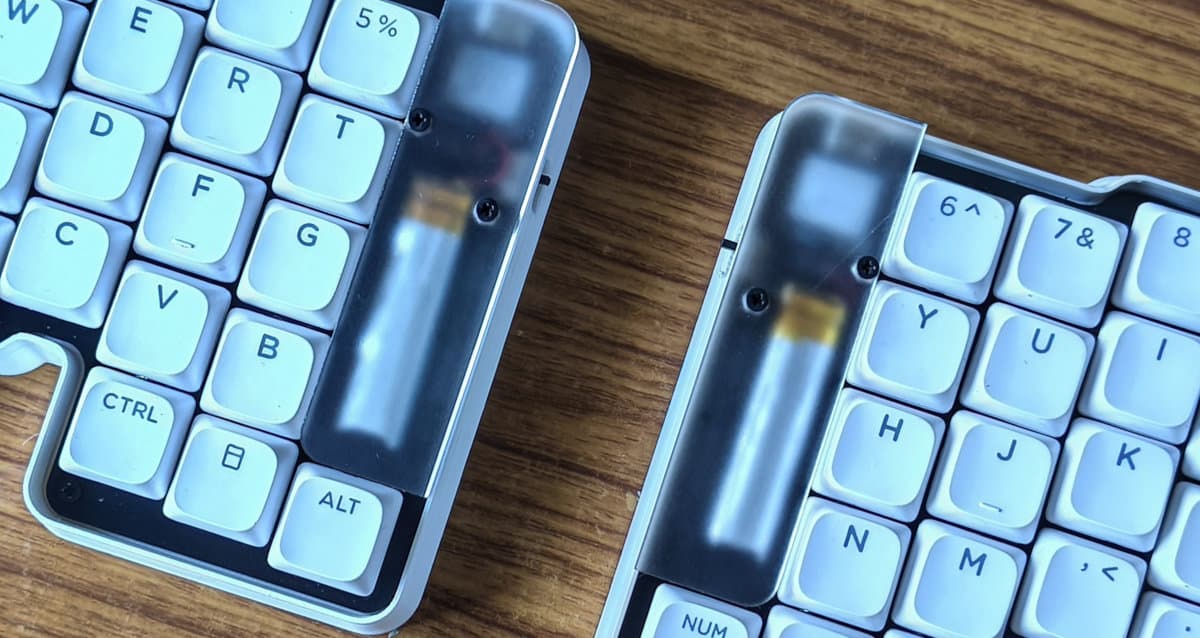
Pling! still gives the enthusiast details that matter. The thumb cluster is a three-key setup, indicator LEDs shine through frosted acrylic, and the batteries are 250 mAh units. The PCB is flippable without jumper pads, and the same gerbers were used to order boards from JLC. Gateron KS27 switches also fit the brief physically, with published specs commonly listing 1.5 mm of pre-travel and 2.75 mm of total travel, which helps explain why the finished board can stay so low while still feeling like a proper mechanical keyboard rather than a compromise.
The firmware choice matches the hardware. Pling! uses ZMK, which is built for split keyboards where each half runs its own controller and the two sides communicate as a single device. ZMK also supports Nordic nRF52-class hardware, which puts the XIAO BLE in familiar territory. The firmware repo was generated from the unified ZMK config template, so the project stays inside a modern wireless split ecosystem that values power efficiency and layout flexibility as much as the case itself.
Binit says a previous half-split was built about four years earlier, and Ergonaut One was a major inspiration for both the design and PCB layout. That lineage matters. Ergonaut One launched in 2023 as an open-source ergonomic wireless split that was meant to be affordable, good-looking, and DIY-friendly, with Xiao-based wireless Gateron KS-33 hardware and 260 mAh per half. Pling! sits in that same lineage, but its appeal is sharper: it is what happens when a split keyboard stops asking to be a project and starts acting like an endgame.
This article was produced by Prism’s automated news system from verified source data, official records, and press releases, then run through automated quality and moderation checks before publishing. The system is built and supervised by the people who set the standards it runs under. Read our full AI policy.
Know something we missed? Have a correction or additional information?
Submit a Tip