Liuzijue breathing may deepen relaxation in anxious university students
A Liuzijue warm-up helped anxious students relax longer than mindful breathing alone. The sequence may matter as much as the breath itself.
The payoff in this study is immediate: a short Liuzijue warm-up helped anxious university students settle into mindfulness more deeply than mindful breathing alone. In a randomized crossover trial, the combined sequence did not just feel different, it produced more sustained relaxation, stronger heart-rate-variability changes, and better concentration during the breathing session.
What Liuzijue adds before mindfulness begins
Liuzijue is not just another meditation label. In earlier literature, it is described as a traditional Chinese exercise that links controlled breathing with simple body movements and six speech sounds, which gives it a more structured feel than sitting with the breath alone. That matters here because the study is testing a very specific question: whether a preparatory breath practice can make standard mindful breathing easier to enter and easier to hold.
That idea is not new to the Liuzijue literature. A 2021 randomized controlled trial in 98 stroke patients with dysarthria found that Liuzijue qigong, paired with basic articulation training, improved respiratory-control and speech-related outcomes. The new university-student study takes that same body-breath-voice logic into a very different setting, where the goal is not speech rehabilitation but a calmer nervous system.
How the trial was built
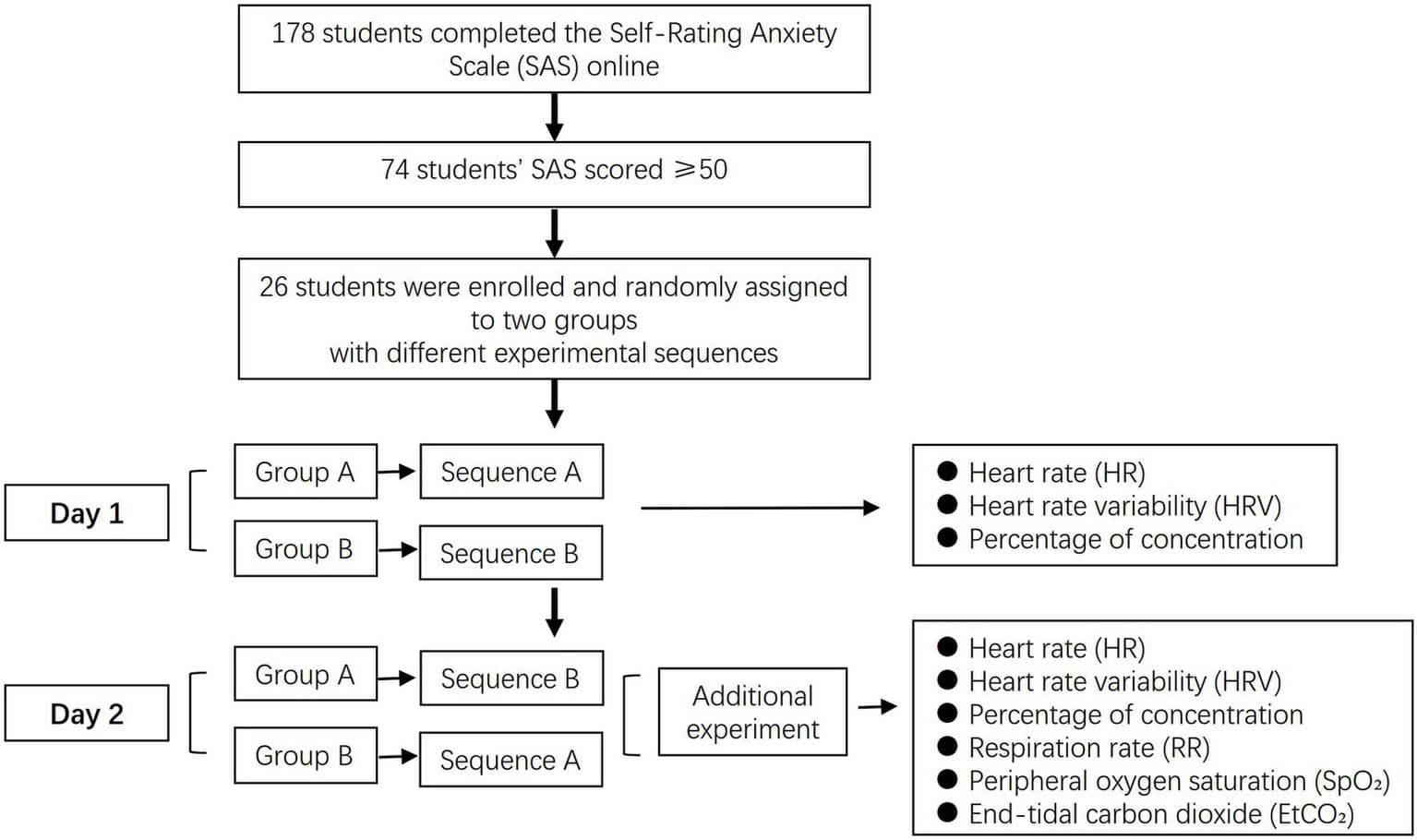
The Frontiers in Psychology paper, published on July 13, 2026, focused on 24 male university students with anxiety symptoms. Their mean age was 21 ± 2, and their average Self-Rating Anxiety Scale score was 57 ± 8, which places this squarely in a group with elevated anxiety rather than casual stress. The researchers used a randomized crossover design on consecutive days, so each participant completed both conditions.
One condition was 15 minutes of mindful breathing alone. The other paired 5 minutes of Liuzijue breathing with 10 minutes of mindful breathing. That setup is useful because it keeps the dose of mindfulness close to the same while changing what happens at the start, making the first five minutes the real variable under the microscope.
Why the combination held relaxation longer
The combined Liuzijue plus mindful breathing condition produced more sustained relaxation than mindful breathing alone. In the abstract, the authors reported greater continued heart-rate reduction and larger increases in heart-rate-variability measures in both time and frequency domains, which are the kind of physiological shifts researchers look for when a relaxation response is sticking around after the session ends.
The pattern inside the breathing session points to a possible reason. During Liuzijue breathing, respiratory rate was lower, SpO was higher, and EtCO was lower from minutes 2 through 5. Participants also reported stronger concentration during the later mindful breathing segment after the Liuzijue warm-up, suggesting that the preparatory practice may have helped them arrive at mindfulness with less friction and more focus.
The simplest reading is not that mindful breathing failed. It is that, for these students, the body seemed to benefit from a short runway before the sitting practice began. Liuzijue may have shifted respiration and oxygenation enough to make the subsequent mindful breathing more effective, which is exactly the kind of practical distinction anxious readers care about when choosing between breath-based techniques.
Where this fits in the wider mindfulness evidence
This study lands inside a larger university-student mindfulness literature that already points in the same direction. A 2023 Frontiers in Public Health systematic review and meta-analysis pulled together 21 studies and found mindfulness interventions effective for improving university students’ mental health, with most programs running for 8 weeks to 3 months. The new Liuzijue paper does not replace that longer-term work, but it adds a more immediate question: what kind of breathing sequence helps students get the most out of the minutes they do have?
The broader mental-health backdrop explains why that question matters. The World Health Organization says depression and anxiety are the two most prevalent mental health disorders in China and estimates that about 41 million people in China live with anxiety disorders. In the United States, the National Institute of Mental Health says about a third of adolescents and adults experience an anxiety disorder at some point, and it flags the college transition as a particularly important window for anxiety research.
For campus counseling centers and wellness programs, that makes a low-cost, easy-to-teach breathing sequence especially interesting. The study suggests that mindfulness teachers do not have to treat every breath practice as interchangeable. A short Liuzijue primer may help anxious students settle faster, concentrate more clearly, and hold onto relaxation longer than a standard mindful breathing session by itself.
The most practical lesson is the first five minutes. If plain mindful breathing feels like asking an anxious body to sit still before it is ready, this study points to a different path: start with a structured breath-based warm-up, then move into mindfulness. For students choosing between breath practices, the evidence here says the sequence may be just as important as the silence.
This article was produced by Prism’s automated news system from verified source data, official records, and press releases, then run through automated quality and moderation checks before publishing. The system is built and supervised by the people who set the standards it runs under. Read our full AI policy.
Did this article answer your question?