Mindfulness and hope can work together to support well-being
Mindfulness and hope are not the same skill. New research shows they work best together, with mindful hope grounding future plans in the present.

A Scientific Reports study published on April 1, 2026 found that mindfulness and hope were not correlated with each other. Both were still linked to well-being, but in different ways. That split helps frame mindful hope as two distinct capacities working together so future thinking does not drift into wishful thinking.
Mindfulness and hope do different jobs
Ilene Berns-Zare draws a distinction at the center of the conversation: mindfulness is the capacity to notice what is true right now, while hope is the ability to imagine a goal, see pathways toward it and keep the motivation to move. That lines up with the three-part hope framework long associated with C. Rick Snyder: a desired goal, strategies for getting there and the agency to pursue them.
The American Psychological Association describes hope in similarly active terms, linking it to goal-setting, agency and cognitive restructuring. The point is not to choose between accepting the present and working for change. It is to let present-moment awareness keep hope from becoming abstract, brittle or self-defeating.
That is where the phrase mindful hope earns its keep. Berns-Zare describes it as a balanced psychological state in which present-focused awareness supports constructive, future-oriented thinking.
What the new study found
David B. Feldman, Shauna L. Shapiro and Diane E. Dreher surveyed 145 undergraduates, with a mean age of 18.83; 112 were women, 32 men and one participant did not report gender.
Mindfulness and hope were not correlated with each other, with r = .05 and p = .56. Across the well-being measures used in the study, their shared variance was 1.8 percent or less.
The study also showed that each one lined up with different outcomes. Mindfulness was uniquely associated with lower anxiety, disinhibition and negative-assertive control. Hope was uniquely associated with higher life satisfaction and positive-assertive control.
Why the distinction matters in hard seasons
That split is especially relevant when life is not tidy. In burnout, mindfulness helps you notice the body signals, the mental fog and the urge to keep pushing long after the tank is empty. Hope, in that same moment, gives you a way to frame recovery as something reachable, even if the next step is simply asking for help, taking a day off or reducing one impossible demand.
Grief works differently, but the same pairing still matters. Mindfulness lets pain be present without demanding that it be fixed on command. Hope does not erase loss; it keeps room open for meaning, ritual and the small return of future plans when the person is ready for them.
Hope is an action-oriented process. By January 2024, modern hope research still traced back to Snyder’s work in the 1980s and his 2002 definition. Snyder’s cognitive-motivational theory remains one of the most influential theories of hope, even as newer and more nuanced models have emerged over the past decade.
Thema Bryant said hope is not “a denial of what is, but a belief that the current situation is not all that can be.”
How mindful hope shows up in ordinary practice
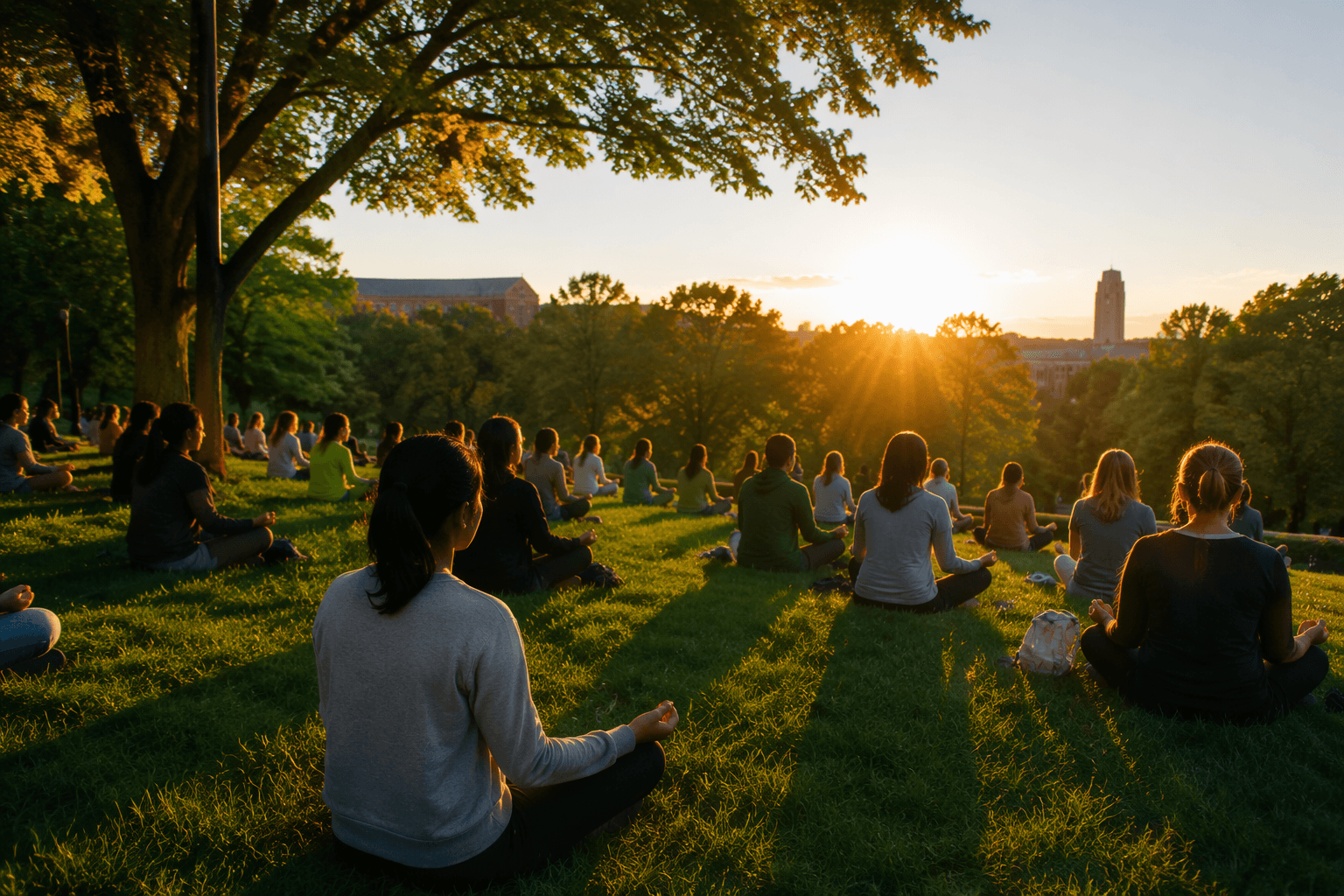
Berns-Zare’s examples are deliberately modest. Mindful hope can start with pausing at the beginning of the day instead of reaching immediately for the first demand. It can be as simple as taking the first bite of a meal with awareness, or looking out a window before moving into the next task.
Self-compassion sits close to this practice. Paying attention one moment at a time can make turbulence more workable, because you are not layering self-criticism on top of whatever is already hard.
A simple mindful hope reset can look like this:
1. Notice the present without editing it. Name the real pressure, whether that is fatigue, sadness, financial stress or a stalled recovery.
2. Identify one goal that is still meaningful. Keep it concrete, not grand.
3. Ask what path and what next action are actually available today. The aim is not a perfect plan, just a livable one.
4. Return to the body for a breath, a pause or a meal taken with attention, so the goal stays grounded in reality.
A 2022 longitudinal study of 253 Hong Kong college students found that, during the COVID period, hope and mindfulness measured at time 1 were associated with lower internalizing and externalizing behaviors at time 2, and sense of coherence significantly mediated those links.
This article was produced by Prism’s automated news system from verified source data, official records, and press releases, then run through automated quality and moderation checks before publishing. The system is built and supervised by the people who set the standards it runs under. Read our full AI policy.
Did this article answer your question?