Bards & Cards breaks down Citadel paints for beginner Warhammer painters
Standing in front of the Citadel rack gets easier once you treat each paint as a tool. Bards & Cards maps the range to the exact job you need done.
The first Citadel problem is not painting, it is buying
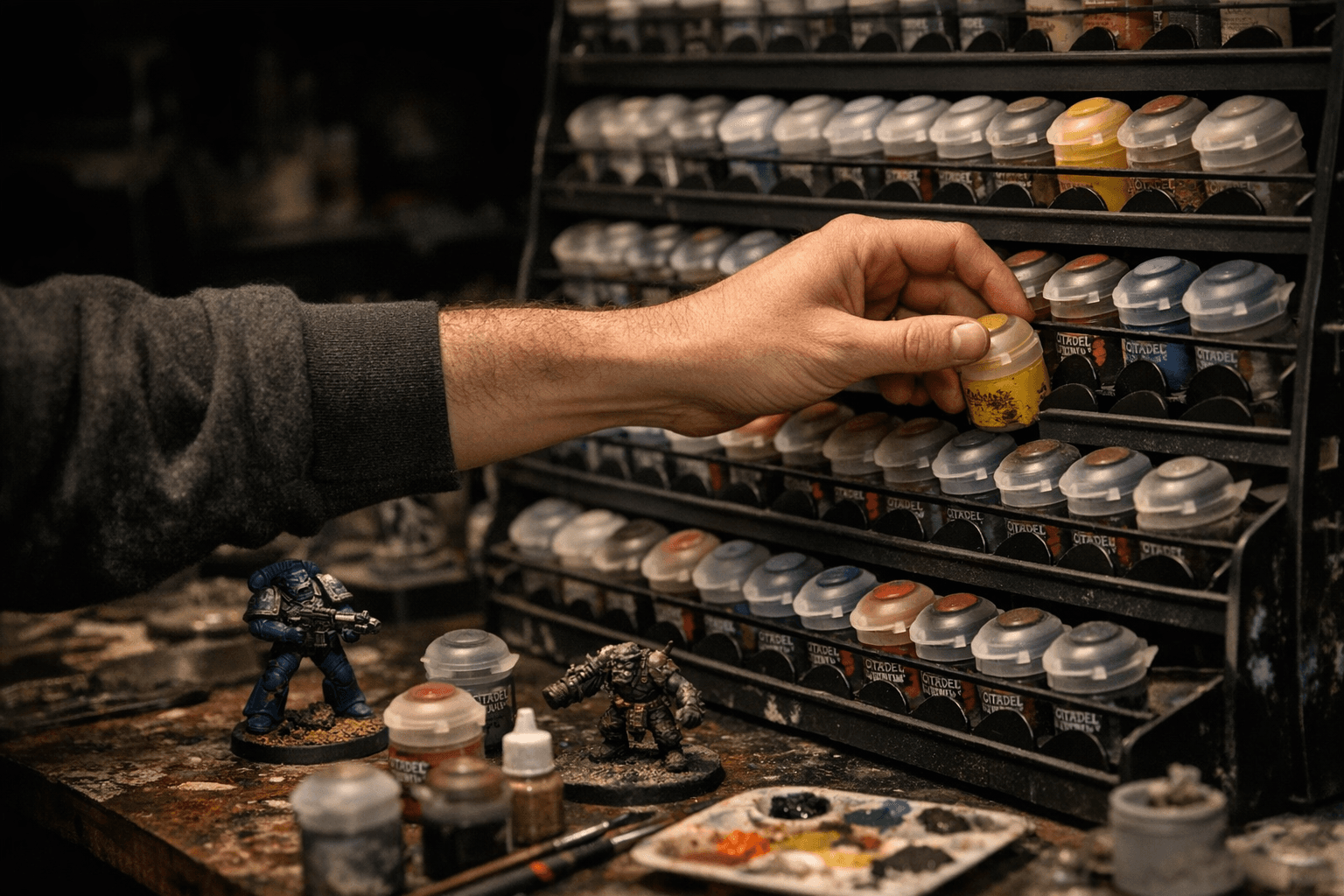
Every new Warhammer painter knows the moment: you are staring at the Citadel rack and every bottle looks useful, but none of them look obvious. Bards & Cards cuts straight through that confusion by treating the range as a set of specialized tools instead of a wall of nearly identical colors. That matters because Citadel Colour is not a loose pile of paints, it is a system built around how miniatures are actually painted, from the first basecoat to the last highlight.
Games Workshop says the line has been growing since 1984 and now includes more than 300 colours. That scale is exactly why beginners can waste money if they buy by label alone. The smarter move is to match the paint type to the job you need done right now, whether that is covering primer, adding depth, building highlights, or putting down a fast base for an entire squad.
Use this if you need a solid first coat: Base paints
Base paints are the safest answer when you are starting from bare primer and need strong, even coverage. Warhammer describes them as high-pigment foundation coats, built to create a solid basecoat with strong coverage instead of a sheer tint. In practice, this is the paint that lets your army’s main color actually look like a real color after the first pass, instead of something you have to build up forever.
If you are assembling a beginner shopping list, Base paints are where the logic starts to click. Pick them for the armor plate, cloth, skin tone, or any other main surface that needs to read cleanly from across the table. They are the part of the range that does the heavy lifting first, so the rest of the paint job has something stable to sit on.
Use this if you want cleaner edges and smoother transitions: Layer paints
Layer paints are thinner than Base paints and are designed for highlights and transitions over dried base coats. Warhammer says they contain less pigment and are meant for adding crisp highlights while slowly building up color changes. That makes them the next step once the main coat is down and you want the model to start popping.
This is where a beginner can see the difference between simply coloring a miniature and actually finishing one. Layer paints help you push raised details forward, especially on shoulder pads, robes, faces, and weapons where you want the eye to land. They are also useful when you want gradual blending without jumping straight to a final highlight that looks too harsh.
Use this if you want the biggest payoff for the least effort: Shade paints
Shade paints are the easiest Citadel category to understand and, for many beginners, the most immediately rewarding. Warhammer says they are formulated to flow into recesses, drawing out details with natural-looking depth and shadow. That means the paint does the work of finding the panel lines, folds, and texture for you.
This is also where the Bards & Cards advice becomes practical buying guidance rather than theory. A good Shade can make a model look finished faster than almost anything else in the rack, especially when you are painting rank-and-file troops or trying to bring out armor details with minimal fuss. Games Workshop also said in June 2022 that Shades had been reformulated to flow even better into gaps and recesses, which is a useful reminder that this part of the range is actively tuned for easier use.
Use this if you want speed in a single pass: Contrast paints
Contrast paints are the shortcut that changed how a lot of people look at beginner painting. Games Workshop says they can be applied over a white basecoat to base, shade, and layer a miniature in one go, which is why they became such a major part of the modern Citadel conversation. In June 2022, the company added 25 new Contrast paints to the line, expanding what that quick-paint approach can cover.
That does not make Contrast a replacement for every other paint type, but it does make it a powerful first-project tool. If you are trying to get troops tabletop-ready fast, test a color scheme before committing, or push through a batch of models without getting bogged down in multiple steps, Contrast belongs on the shortlist. Games Workshop originally launched Contrast in 2019 as a faster, easier way to paint miniatures, and that intention still shows in how the range is framed.
Use this if you want gore, slime, texture, or effects: Technical paints
Technical paints are the most clearly specialized category in the Citadel system. Warhammer says they are built for special effects like gore, slime, basing texture, corrosion, and spectral glows. That makes them less about general color coverage and more about finishing touches that change how a model or base feels on the table.
For a beginner, the best way to think about Technical paints is as the effects drawer. You do not need them for every miniature, but they become valuable the moment you want a muddy base, an otherworldly glow, or a particular battlefield look that ordinary paints cannot create on their own. They are one of the clearest examples of why the Citadel line works best when you treat each bottle as a separate tool.
Use this if your process depends on drybrushing, airbrushing, or batch priming: Dry, Air, and Spray paints
The rest of the range fills in the workflow around the core categories. Dry paints are designed for drybrushing, which makes them the obvious pick when you want quick texture and edge-catching effects on raised details. Air paints are formulated for airbrush use, so they make sense if your hobby setup includes sprayed blends or smooth application through an airbrush.
Spray paints are meant for fast, even basecoating multiple miniatures at once. That is a major time saver if you are working on a squad, a horde, or any army project where individual brush priming would slow you down. Put simply, these categories are not extras. They are the parts of the line that let you choose a workflow instead of forcing every miniature through the same painting path.
Why the system is worth learning before you buy
Games Workshop says all Citadel Colour pots are tested on the production line for quality control, which is a reassuring detail for anyone spending real money on a first set of paints. It also says Citadel Colour is made specifically for miniatures, and that distinction matters when you are trying to avoid hobby-store guesswork. The range is not random craft paint with fantasy branding attached. It is a modular system built around miniatures from the start.
That is why the Bards & Cards approach lands so well for beginners. Once you stop asking, “Which paint looks good?” and start asking, “What job does this paint do?”, the rack becomes readable. Base gets you coverage, Layer gives you highlights, Shade brings out depth, Contrast speeds up the process, Technical adds effects, and Dry, Air, and Spray adapt the method to your tools. For anyone trying to spend less time decoding labels and more time painting, that is the difference between an expensive detour and a smart first purchase.
What a practical starter buy really looks like
A curated starter setup does not need to be huge to be effective. A strong first buy usually means one Base for your main color, one Shade to deepen it, one Layer for clean highlights, and, if you want speed or a faster batch-painting route, one Contrast or Spray option that matches your project. If your army scheme calls for weathering, slime, glowing magic, or rough ground, add a Technical paint only when that effect actually matters.
That is the real value of understanding the Citadel system. It helps you buy for your first project instead of buying for the whole hobby in one trip. And once the rack stops looking like a puzzle, the painting table starts looking a lot more inviting.
This article was produced by Prism’s automated news system from verified source data, official records, and press releases, then run through automated quality and moderation checks before publishing. The system is built and supervised by the people who set the standards it runs under. Read our full AI policy.
Did this article answer your question?