Closer Look at the Golden Demon Slayer Sword Winner: David Arroba’s 800‑Hour Diorama
David Arroba spent 800 hours — half of them building before a brush touched the model — to claim the Slayer Sword at AdeptiCon 2026. Here's what you can steal this weekend.
Eight hundred hours is not a typo.
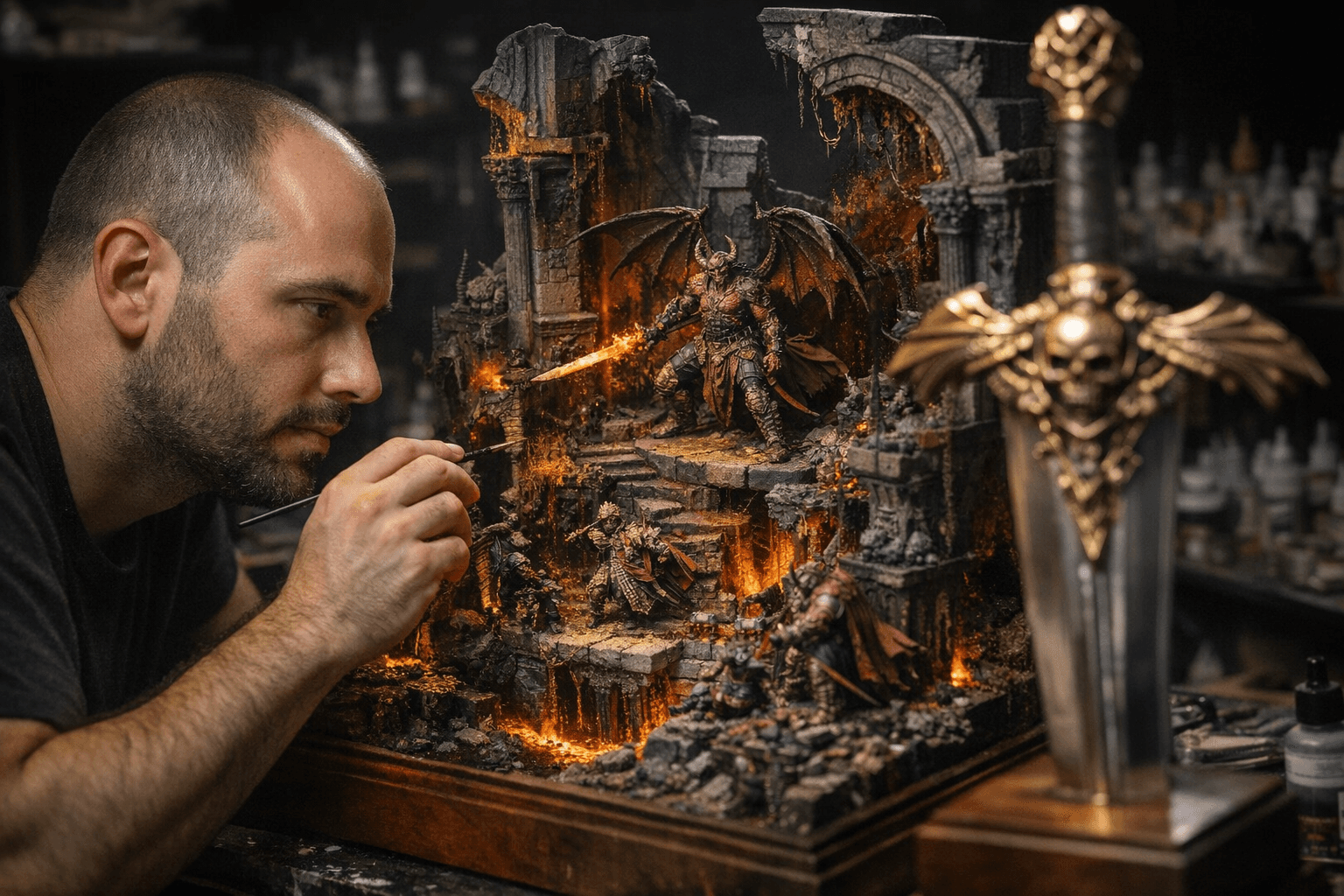
When Spanish painter David Arroba stood at the Baird Center in Milwaukee during AdeptiCon 2026, Slayer Sword in hand, he was holding the result of roughly a year's worth of evenings and weekends compressed into a single object: a Soulblight Gravelords diorama built around Prince Vhordrai, Lord of the Crimson Keep. His first words to Warhammer TV captured the moment perfectly: "I feel like I'm in a dream, it's amazing."
The Slayer Sword is the peak of the Golden Demon competition, which itself is the peak of competitive miniature painting. It does not go to the piece with the cleanest blends or the most ambitious conversion. It goes to the entry that wins on every variable simultaneously: technical painting, composition, basing, and storytelling. At the 179th Golden Demon overall and the fifth AdeptiCon North America edition, spread across 16 categories with 40 unique artists taking awards, judges handed that total package to Arroba without hesitation.
So: 800 hours is the ceiling. Here is what is inside it that you can take home.
Technique 1: Build the story before you buy the second model
The first question Arroba answered was not "how should I paint the dragon?" It was "what does the Soulblight Gravelords army look like as a complete scene?" His answer determined every figure in the case. Prince Vhordrai was the anchor because, as Arroba explained to Warhammer Community, he considers it "one of the best models ever made by Games Workshop." But Vhordrai alone is a single miniature entry. To push it into diorama territory, Arroba added a Necromancer and skeletons, choosing them specifically "to represent the Soulblight Gravelords army in the best possible way."
The weekend-scale version of this: before purchasing a second figure for your diorama or base, write one sentence describing the moment you are trying to freeze. Every figure you add should either be the subject of that moment or a witness to it. If it does neither, leave it out.
Technique 2: The 50/50 rule
Of Arroba's 800 hours, approximately 400 went to construction: building and sculpting the elaborate base, positioning figures, and integrating the whole scene before a drop of paint was applied. The other 400 went to painting. That ratio is not accidental. At Slayer Sword level, the judges evaluate the base as part of the painting. An underdeveloped base with immaculate brushwork still scores lower than a piece where both halves are equally considered.
For a project you can complete in a weekend, the principle scales directly. If you plan six hours of painting on a centrepiece, spend three hours on construction first. That means texturing the base, positioning figures for optimal viewing from the front and a 45-degree angle, and making sure the lighting logic of the base matches the lighting logic of the models before anything is glued permanently.
Technique 3: Decide on an implied light source before primer hits the model
One of the core compositional decisions in a winning diorama is implied ambient light: where is the light coming from in the scene, and does every element reflect that consistently? Arroba's Painting Desk Roadshow conversation with host Ed on Warhammer+ covers his thought process behind composition and colour palette in depth, including work-in-progress shots that show how that logic developed across the project. The underlying principle is visible in the finished piece regardless: every figure in the scene is illuminated from the same implied source, so the diorama reads as a single coherent environment rather than a collection of individually painted models sharing a base.
The weekend application: before you prime, sketch a rough thumbnail of your scene and mark where the light falls. Use that map to pre-shade your zenithal. Every highlight placement and shadow value you apply afterwards should answer back to the thumbnail, not your desk lamp.
Technique 4: Build texture through diluted layers, not single passes
Arroba has described his approach to surface quality across multiple interviews and tutorials: he has a strong preference for "very diluted paint" and works intensively with the brush "to create a lot of drawing and texture." The result is surfaces that read as complex because they are built through accumulated thin passes rather than a single opaque application. On a piece like Prince Vhordrai, where you have Zombie Dragon wing membranes, skeletal bone, armour, and terrain all within the same frame, each material needs to feel like itself rather than like paint.
For a weekend project: resist the impulse to solve texture in one layer. Prime, basecoat thin, let dry, then commit to at least three increasingly specific passes of diluted paint to establish shadow depth, midtone complexity, and specular highlights. On organic surfaces, this layering is what separates a flat result from something that reads as actual material.
Technique 5: Make the composition the subject, not the centrepiece model
Arroba's own words are the most useful briefing here. When asked what his favourite part of the finished piece was, he did not name the dragon or the vampire. He said: "My favourite part of the piece is the composition in general, because I believe it represents the Soulblight Gravelords army the way I imagined it in my head." That framing is worth internalizing. The diorama's job is not to display Prince Vhordrai; it is to make a viewer feel the presence of the entire faction.
At display-painting scale, this means every element of the base and every secondary figure should push the viewer's eye toward the dominant focal point while also contributing to the scene's atmosphere. For a weekend project with a single hero model: elevate the figure slightly on a textured plinth, add one environmental detail that speaks to their faction or backstory, and make sure no part of the base competes visually with the face or weapon of the primary subject.
The man behind the piece
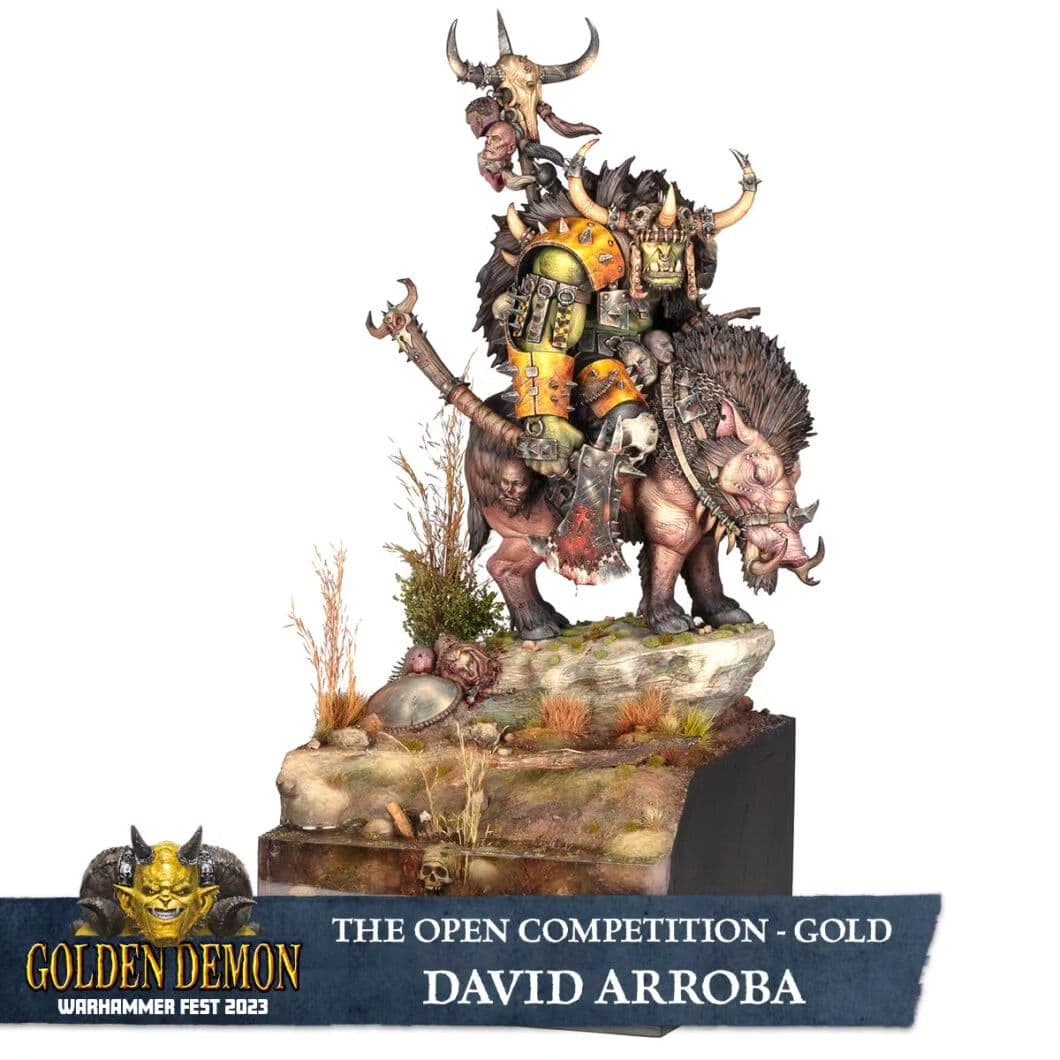
Arroba is not a first-timer who got lucky on a single entry. According to the Golden Demon Compendium, he has five previous competition awards on record: two golds at Warhammer Fest 2023 (the Open Competition for an Orc Boss on Boar and the Warhammer Age of Sigmar Large Model category for a Daemon Prince), a silver in Warhammer Age of Sigmar Single Miniature that same year, plus a silver and a bronze from a Warhammer World event in 2022. He also runs a painting academy in Madrid and co-founded the miniature brand Akelarre Models alongside Garbiñe Arroyo.
The Slayer Sword in Milwaukee was his first. It came from a piece where, by his own estimate, exactly half the total time never touched a brush at all. That is the part the final photographs will never show you, and it is probably the most transferable lesson of all.
For extended footage including work-in-progress shots and a detailed conversation about palette decisions and time budgeting, the Painting Desk Roadshow episode with Arroba is available on Warhammer+.
This article was produced by Prism’s automated news system from verified source data, official records, and press releases, then run through automated quality and moderation checks before publishing. The system is built and supervised by the people who set the standards it runs under. Read our full AI policy.
Did this article answer your question?