Goonhammer explains how to magnetize Warmachine cohorts with precision
Magnetizing MKIV cohorts pays off where it counts: cleaner swaps, safer transport, and one painted force that covers more loadouts.
The real win is flexibility you can actually use
Magnetizing a Warmachine MKIV cohort stops being a hobby flex the moment you see what it saves: one painted force that can change loadouts without a second build, a second paint job, or a nervous breakdown at the storage case. Goonhammer’s guide, published by Trish Ross on May 21, 2026, treats magnetization as a precision job, not a party trick, and that makes it especially useful for MKIV players who want their models ready for the table, the shelf, and the carry case.
That matters because MKIV was built around customization from the start. Privateer Press launched the edition on March 7, 2023 after beta testing that began at the end of October 2022, and the company positioned the WARMACHINE app as the center of the system, with complete rules, list-sharing, match play, and free access to model stats. The models themselves were designed with 3D-printed construction and smaller part counts, and Privateer Press explicitly framed warjacks as magnet-friendly from the jump.
Which kits are worth magnetizing first
The biggest payoff lands on the kits that actually ask you to make loadout decisions. Character Warjack Packs for Storm Legion, Sea Raiders, Winter Korps, and House Kallyss are obvious candidates, because those packs include unique weapons and heads, the exact kind of parts you want to swap instead of locking in forever. Battleboxes are just as strong a fit, since each one includes a warcaster or warlock plus two warjack or warbeast models with customizable options.
That is the real hobby advantage here: once those pieces are magnetized, you are not building a display model with one permanent pose. You are building a modular kit that can move from one list to another, survive transport with less stress on fragile joints, and stay useful even when your preferred loadout changes. Privateer Press made that expectation even clearer when it sold Hobby Magnet Packs with ten 1/8-inch magnets and ten 3/16-inch magnets, which is a pretty blunt signal that magnet work is not some fringe workaround in MKIV.
The measurements are the point
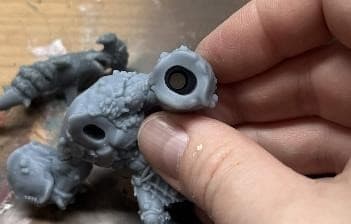
Goonhammer does not waste time pretending magnetization is vague. The guide gives exact sizes for different jobs, using 3/16 inch by 1/16 inch magnets for large slots and 1/8 inch by 1/16 inch magnets for small slots. It also recommends spacer magnets when you need to fill a gap, which is the sort of detail that separates a usable joint from a floppy one.
That spacing advice is the heart of the article. Goonhammer warns that even about 1/32 inch of extra gap can cut magnet pull force roughly in half, which is why sloppy depth is such a headache on a model that will be handled, packed, unpacked, and reconfigured over and over. If you have ever had a weapon arm sit just a little too proud of the socket and then refuse to stay put once paint or varnish adds thickness, you already know why this matters.
Alignment beats brute force
The other big lesson is that magnet orientation is not something to eyeball and hope for the best. Goonhammer explains that letting magnets naturally align themselves creates a stronger and more reliable pull than forcing them into an awkward position, and that is exactly the sort of advice that saves you from a model that looks fine on the bench but behaves badly on the table.
The guide’s hardware list makes that practical too. It does not just cover magnets and spacers, it even includes a soldering iron for removal if things go wrong, which tells you how seriously the article treats recovery as part of the workflow. That is a very hobby-realistic touch, because the hardest magnet jobs are usually not the ones you planned well, they are the ones you have to fix after a crooked hole, a shallow seat, or a polarity mistake.
Why this fits Warmachine’s design better than most systems
MKIV is especially friendly to this kind of work because the line has been built around modularity for years. Privateer Press’s July 28, 2022 hobby article on Orgoth Sea Raiders said the printed resin kits had preset magnet holes and were lighter than older resin and metal models, and it described modular warjacks as a feature that lets you swap a head or arm between games. That same article used a pin vise, 1/8-inch magnets, and a polarity-checking tool, which lines up neatly with the more precise Goonhammer approach.
There is a longer hobby tradition here too. Goonhammer’s own 2020 magnetization guide treated magnets as a standard solution for weapon swaps, transport, and subassemblies, and MKIV simply gives that old idea better targets. With the WARMACHINE app handling rules updates, cloud army storage, and later additions like the annual update on January 10, 2024 and the Duos format on February 14, 2024, flexible hardware keeps making more sense. If your lists can change, your models should be able to keep up.
A guide worth bookmarking before paint goes on
That is why this piece lands for painters as much as gamers. Magnetization usually happens before priming and painting, and once a joint is painted, varnished, and weathered, a bad fit becomes a permanent annoyance. MKIV’s official magnet support, from the launch-era design notes to the hobby magnet packs and the customizable Battleboxes, means you are not fighting the system when you magnetize a cohort, you are meeting it where it already wants to go.
For Orgoth Sea Raiders, Cygnar Storm Legion, Khador Winter Korps, and the other MKIV builds that live and die on optional parts, the benefit is simple: one careful magnet job turns a single painted cohort into a much more useful collection. That is the point Goonhammer gets right. The magnets are not the hobby. The freedom they buy you is.
This article was produced by Prism’s automated news system from verified source data, official records, and press releases, then run through automated quality and moderation checks before publishing. The system is built and supervised by the people who set the standards it runs under. Read our full AI policy.
Did this article answer your question?