Goonhammer reviews new Horus Heresy Rapier Batteries, with magnetisation tips
The new Rapier Batteries offer rare tabletop flexibility: easier plastic builds, stronger visual presence, and magnetisation that protects your paintwork.
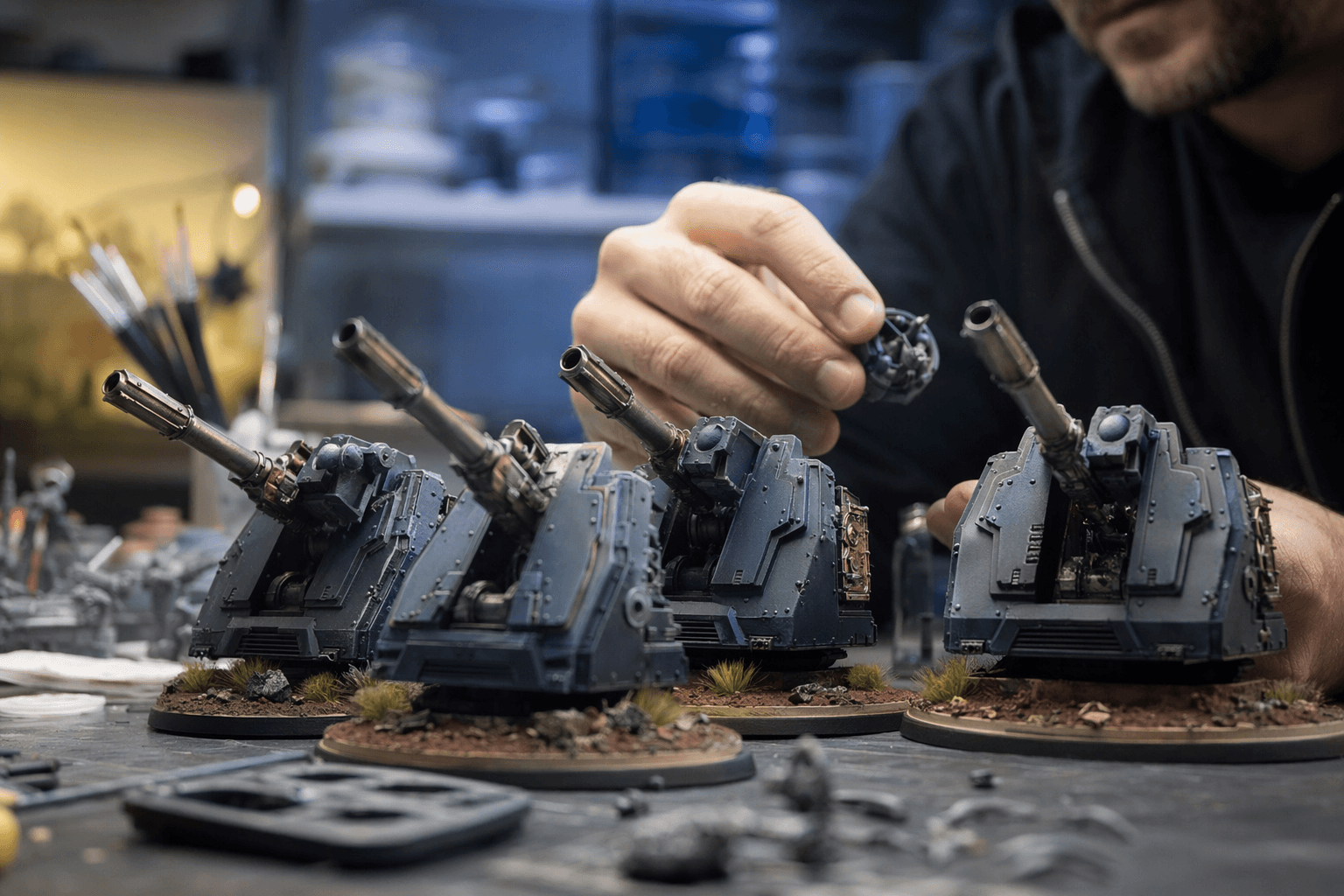
Why Rapier Batteries matter in a Solar Auxilia force
The new Rapier Batteries are the kind of kit that asks a very specific hobby question: do you want a model that looks good in a tray, or one that keeps paying you back every time your army list changes? Goonhammer’s look at the new plastic Rapier kits leans hard into that question, because the real appeal here is not just the silhouette, but the freedom to swap weapons without undoing finished work.
That matters in Solar Auxilia especially. Games Workshop has framed the faction as elite mortal troops trained for hostile atmospheres, toxic zones, and even vacuum, and it has pushed them as a major plastic range alongside Legiones Astartes and Mechanicum Taghmata. The broader release wave is already deep enough to encourage real army building, with the Solar Auxilia Battle Group containing 28 brand-new miniatures, including a Line Command section, 20 lasrifle Auxilia, a Leman Russ Strike Tank, an Aethon Pattern Heavy Sentinel, and a Dracosan Armoured Transport. In that context, a Rapier battery is not a side project. It is the sort of support unit that makes a whole force feel coherent.
What changed from resin to plastic
The size shift alone tells you how much more presence the new kit has on the table. The old resin Rapiers were 40mm wide, 50mm long excluding the gun, and 13mm high. The new plastic versions are still 40mm wide, but they stretch to 57mm long excluding the gun and rise to 27mm high. They also come on 60mm bases, where the previous version was baseless.
That is a meaningful change for both painters and players. The taller profile gives the kit more authority in a line of infantry and more room for visual layering, while the base means you are no longer solving the same awkward basing problem yourself. For a unit that sits between artillery and heavy support, that extra height helps it read as a real battlefield machine instead of a low, flat accessory. The new plastic format also makes the kit easier to clean, assemble, and convert than older alternatives, which lowers the barrier if you want a consistent look across multiple guns.
Why magnetisation is the real hobby payoff
This is where the review becomes especially useful for anyone who values both the paint job and the list. Rapier Batteries are compact enough to batch build, but each weapon option changes the visual profile of the whole unit. A good magnetisation plan means you can change loadouts later without tearing apart painted work, which is a huge deal if your Solar Auxilia force is still evolving.
The smartest approach is to think of the kit as modular from the start:
- Magnetise the weapon mount so the main gun can be swapped cleanly.
- Keep the carriage connection points consistent across the battery, so a full unit still looks unified.
- Test-fit each arm and support point before painting, because plastic is much friendlier to adjust than resin, but it still rewards dry fitting.
- Leave enough access around the joints so you can separate parts for painting, then reassemble without scraping finished surfaces.
That flexibility is what makes the kit more than a one-and-done purchase. If you like to tune your army over time, the battery becomes a tool rather than a locked sculpture. If you enjoy the visual rhythm of a line of identical support pieces, magnets let you preserve that cohesion while still experimenting with the loadout that best suits your next game.
How to paint them without flattening the detail
Small artillery kits are some of the best models in the range for painters who enjoy texture. Rapier Batteries give you a clean split between chassis, crew, weapon housings, and support gear, which means you can push contrast without the model becoming noisy. Metal barrels, painted armor panels, ammo feeds, and the base all offer separate surfaces to treat differently, and that variety is where the kit starts to sing.
A practical paint plan works especially well here because the pieces are small enough to batch, but detailed enough to reward restraint. You can keep the chassis and frame in a disciplined armour scheme, then use brighter metallics or heat staining on the barrels and feeds. The base can do some of the storytelling too, whether you are placing the battery in ash, mud, or a warzone industrial deck. Since the new kit sits higher on a 60mm base, the model has enough vertical space for those material differences to show instead of collapsing into one flat block.
The battlefield role matches the hobby role
GW’s own description of Rapier carriers helps explain why this kit feels so useful. They bridge the gap between man-portable firearms and vehicle-mounted cannons, letting infantry sections move heavy weapons to the front without dragging a tank into the job. That makes them a practical choice in a Solar Auxilia force that is built around disciplined, combined arms pressure rather than a single centrepiece.
That same practicality is what makes them attractive on the hobby desk. In a release wave with bigger, flashier models, a support battery can look modest at first glance, but it often ends up being the purchase that anchors the army. The Heresy support box context underlines that point too, since GW has also talked about Solar Auxilia heavy weapons in a way that points toward whole batteries, not isolated toys. If you are building a force meant to look unified across a shelf and a table, a Rapier unit does more work than its footprint suggests.
Why this kit lands so well for painters and players
The Rapier Battery succeeds because it solves both halves of the hobby equation at once. It has the practical flexibility that players want, especially if they are magnetising for future loadout changes, and it has enough surface variety that painters can make every material read differently. The shift from the old resin footprint to the taller, based plastic kit makes it feel more substantial without turning it into a centerpiece that demands all your time.
That is the sweet spot. You get a support unit that looks like it belongs in a proper Solar Auxilia army, paints up cleanly in batches, and keeps its value when your list changes six months later. For a hobbyist building a real force, not just a display shelf, that is exactly the kind of purchase that earns its place.
This article was produced by Prism’s automated news system from verified source data, official records, and press releases, then run through automated quality and moderation checks before publishing. The system is built and supervised by the people who set the standards it runs under. Read our full AI policy.
Did this article answer your question?