Greywater Fastness Guide Shows How to Paint Bold Yellow Cities of Sigmar
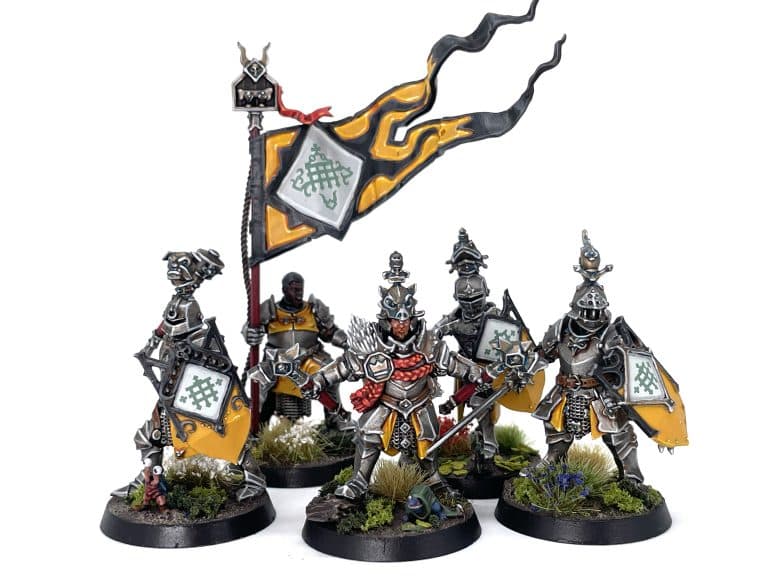
SRM’s Greywater Fastness guide turns a tricky yellow Cities of Sigmar scheme into a repeatable workflow built for speed, weathering, and disciplined industrial style.
Why Greywater Fastness is worth painting this way
Greywater Fastness is the kind of Cities of Sigmar force that rewards a painter with a clear plan. SRM’s guide leans into the hardest part first: a predominantly yellow army that can look brilliant on the table, but only if you control coverage, weathering, and placement from the start. That makes the article immediately useful if you have ever fought with bright armor or cloth that goes chalky, streaky, or flat under too many layers.
The scheme also fits the city itself. Greywater Fastness is a Free City in Ghyran, the Realm of Life, built around the Great Axle and divided into an Inner Circle of factories, forges, and mines and an Outer Circle of workers’ housing and services. It is a place defined by cannon batteries, sorcerous wards, efficiency, and defence, so a weathered yellow scheme with industrial wear does more than look striking. It tells the right story before the first model hits the tabletop.
Set up for repeatable results
SRM’s biggest strength here is that the guide treats this as an army process, not a one-model showcase. A wet palette sits at the center of that approach, because it keeps thinned paints workable and makes controlled blending much easier when you are moving across a whole force. Instead of trying to brute-force coverage, the method favors consistency, careful dilution, and practical habits that keep the paint finish smooth.
The guide also starts with the right kind of test bed: a Freeguild Gallant. That choice matters because the model carries a broad mix of surfaces and textures from across the Cities of Sigmar range, which makes it a strong stand-in for the army as a whole. If your workflow works on a Gallant, it will usually hold up once you start repeating it across rank-and-file units.
Subassemblies are part of the same logic. The shields are called out specifically, and that saves you from painting awkward recesses after the model is already locked together. Light gray or white primers are recommended as the best starting point, which is a smart call for a yellow-heavy force because it helps the brighter layers read cleanly without forcing you to fight a dark undercoat.
Build the scheme around yellow, black, and white
The key to the Greywater Fastness look is not uniformity, but controlled variation. SRM identifies yellow, black, and white as the core colors, then uses them flexibly so every unit does not wear the exact same pattern in the exact same place. One unit might carry yellow jackets and black trousers; another can flip that balance and keep the army coherent without making the whole force feel repetitive.
That approach is especially helpful for batch painting. You can set a few rules and then repeat them across the army without painting every model identically. The result is a force that feels disciplined and industrial, not parade-ground tidy, which suits a city whose identity is tied to factories, weapons, and grim defensive infrastructure rather than pristine pageantry.
The article’s real value is that it makes color placement do some of the visual heavy lifting for you. Yellow supplies the faction’s bold identity, black anchors the models, and white gives you a way to break up the scheme and create readable contrast across unit blocks. Because the distribution changes from squad to squad, your army stays lively while still looking like it came from the same forge district.
Paint in passes, not perfection
The painting order matters just as much as the palette. SRM’s method begins with basecoats, moves into washes and recess weathering, and only then pushes into layers and highlights. That sequence keeps the work efficient because you are establishing the army’s structure before chasing edge refinement, and it also helps the models read as worn and functional rather than freshly minted.
That weathering step is crucial for Greywater Fastness. The city’s surroundings are described as polluted, with smoke, barren soil, and tainted rivers, so some grime on the armor and cloth is not an accident. It is the whole point. Thinned paints and blending work here because they let you suggest use, soot, and industrial wear without making the model look dirty for the sake of it.
- Prime in light gray or white.
- Block in the yellow, black, and white areas in the same pass across multiple models.
- Use washes and recess shading to define panels and cloth folds.
- Add weathering before final highlights so the wear sits naturally under the crispest details.
For speed, keep the process simple and repeatable:
That workflow is what makes the guide practical. It gives you a route to finishing a unit quickly while preserving the bold look that yellow armies need.
Why the lore makes the paint job better
The scheme lands harder because Greywater Fastness has a long-established identity. Community coverage has described it as the city where the battle-platform and high-ground gunner combination was first pioneered, which explains why the army feels so suited to artillery-minded visuals and elevated firing positions. If you want your force to look like it belongs to a city built for pragmatic warfare, the paint recipe needs to echo that heritage.
Earlier Greywater Fastness boxed sets were marketed around heavily armored duardin from the Dispossessed and Ironweld Arsenal, which reinforces the industrial side of the aesthetic. That background helps the yellow scheme make sense alongside metal, machinery, and firepower. It is not a cheerful color choice for its own sake; it is a bold banner on a city that runs on engines, gunpowder, and defensive doctrine.
The setting’s importance also shows up beyond the battlefield. A Greywater Fastness campaign for Warhammer Age of Sigmar: Soulbound was built as a five-part story set in the city, which shows how much narrative material the location carries. The Festermere Realmgate, the Greywater Reach, and the Great Axle all contribute to a place that feels engineered, contested, and alive with purpose.
Why this guide matters now
The timing makes the article even more relevant. Warhammer Community said the October 2023 Cities of Sigmar battletome included rules for 11 different cities, giving hobbyists a wide framework for themed armies and distinct color identities. Around the same release cycle, the full Cities of Sigmar range went up for pre-order in late October 2023, and the battletome itself was released on November 11, 2023, so the faction’s modern visual identity is still a major part of the hobby conversation.
That is what makes SRM’s Greywater Fastness guide stand out. It does not just say how to paint yellow; it shows how to turn a difficult color into a disciplined, industrial army that still looks coherent from unit to unit. With a wet palette, subassemblies, light primers, and a weathering-first mindset, you get a force that finishes faster and looks exactly like Greywater Fastness should: functional, battle-ready, and built to hold the line.
This article was produced by Prism’s automated news system from verified source data, official records, and press releases, then run through automated quality and moderation checks before publishing. The system is built and supervised by the people who set the standards it runs under. Read our full AI policy.
Did this article answer your question?