Miniature painters get a guide to the best airbrush paints
The best airbrush paints are the ones that stop fighting back. Ready-to-spray bottles, high-opacity formulas, and real anti-clog behavior make the difference.
Airbrush paint only feels like a shortcut when the bottle behaves. If you are tired of thinning loops, clogged needles, and paint that beads up instead of covering, the real decision is not which brand has the loudest packaging. It is which formula actually sprays clean, holds opacity, and keeps tip-dry from turning a 20-minute basecoat into a cleanup session.
Best straight from the bottle
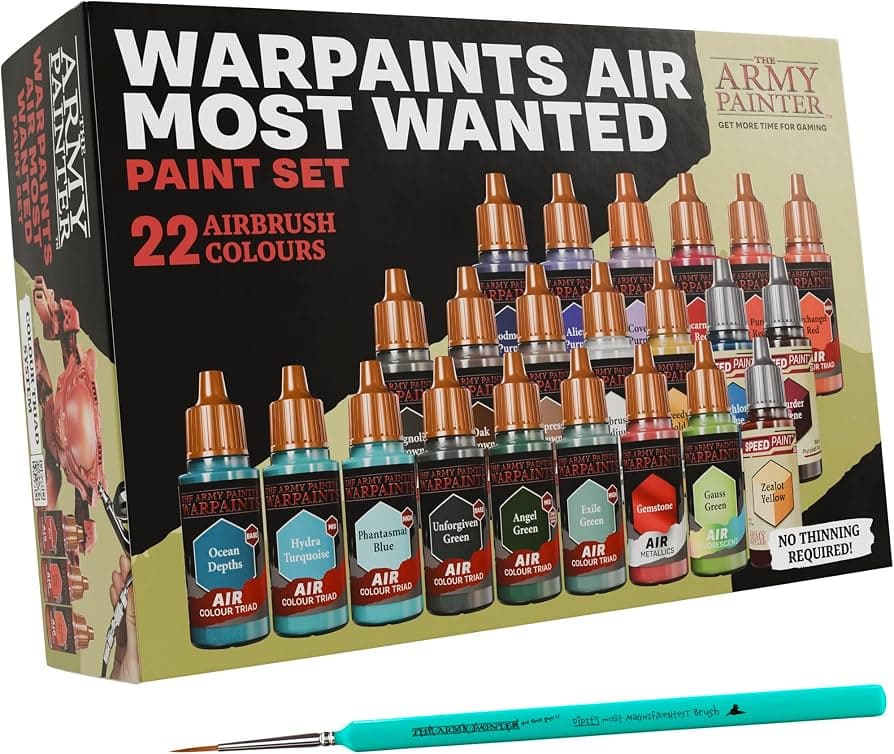
The Army Painter’s Warpaints Air is built for exactly that kind of no-drama session. The line is sold as ready to use straight from the bottle, and the company says it is designed to prevent dry-tip and clogging, which is the whole game when you want to move from primer to paint without stopping to troubleshoot the airbrush every few minutes. The complete set runs to 126 airbrush colours, so this is not a token range built around a few popular hues. Each bottle also includes stainless steel mixing balls, a small detail that matters more than it sounds when you are trying to keep pigment suspension consistent between sessions.
That same logic carries into The Army Painter’s airbrush varnishes. The matt, gloss, and satin versions are formulated for smooth, even application through an airbrush, and the line conforms to ASTM D-4236. If you like to seal miniatures the same way you basecoat them, that makes the finishing stage feel like part of the same workflow instead of another product category to wrestle into submission.
For a cheaper entry point, HOMY ARTY’s 36-color set is the kind of package that makes sense when you want coverage without a lot of setup. The guide treats it as budget-friendly and ready to spray, and the included four thinners mean you are not left improvising ratios from scratch. It is designed to spray directly on plastic or metal with little to no preparation, which is exactly what you want when your goal is to get paint onto a squad, not spend the evening testing consistency on a plastic spoon.
Best for fine-detail work
Vallejo’s new Game Color formulation is the one that reads best when you care about control more than sheer speed. Vallejo says it developed the line with experts and professional modelers for fantasy and wargame figures, and the paint is described as smoother, more fluid, highly opaque, and strongly pigmented, with matte self-leveling properties that keep brush marks from showing. In airbrush use, that combination matters because fine-detail work lives or dies on how predictably a paint settles, especially when you are trying to preserve small panels, faces, gems, and edge transitions.
Vallejo’s Airbrush Thinner also fits neatly into that workflow. The company positions it as the medium for diluting colours for use with an airbrush, which gives you a cleaner path to adjusting flow without guessing at a random mix of water, medium, and hope. Vallejo also organizes its figure-paint system into Base, Shadow, and Light groupings, which helps if you want a controlled palette for highlights and recess shading rather than building every color decision from zero. If you are painting fantasy armies with lots of layered detail, that structure makes the line feel less like a pile of bottles and more like a system.
Warhammer Community’s broader hobby framing backs up why this matters. Painting is treated as one of the most satisfying parts of the Warhammer hobby, and the site’s own guidance keeps pushing tools that give you even coverage, better recess flow, and less fight with the surface. Spray paints are described as covering miniatures in one even coat, and shade paints have been reformulated to flow better into recesses. That is the same logic behind a good airbrush paint: the less the paint resists the miniature, the more time you spend painting and less time correcting.
Best value for army-scale painting
MEEDEN’s 60-color set is the broadest of the value-oriented options in the guide, and it is pitched as a good fit when you want a larger palette with a low clogging risk. The pre-modulated paints are aimed at more general use across surfaces, which is useful when you are moving from infantry to monsters to terrain and do not want every color change to require a new thinning guess. For army-scale painting, breadth matters almost as much as elegance, because the real cost is often not the bottle price but the time spent keeping the airbrush cooperative across dozens of models.
Roizefar’s 22-color set sits at the more modest end of the spectrum, but it has a practical appeal if you want a water-based option with a reputation for safe, accessible use. That kind of line is often the right answer for painters who want to get into airbrush work without committing to a giant rack of specialized paints on day one. It is less about chasing the perfect color system and more about lowering the friction between opening the case and spraying a usable coat.
What actually matters when you buy
The useful buying criteria here are surprisingly unglamorous, and that is why they work. Look first at flow consistency, because paint that sprays unevenly forces you into constant needle-cleaning and pressure changes. Then check opacity, because weak coverage turns every basecoat into an extra pass, and extra passes are where tip-dry starts to build. If you want the least frustrating workflow, pay attention to minimal thinning requirements and ASTM D-4236 safety certification, especially if the paint is going to live on your desk and under your compressor for long sessions.
- Flow consistency: The paint should move through the airbrush without turning into a splattery mess halfway through a model.
- High opacity: Better coverage means fewer passes, which helps preserve detail and cut down on cleanup.
- Minimal thinning: The less adjustment you need before spraying, the less likely you are to create your own problem.
- ASTM D-4236: A practical safety marker to look for on products you will handle often.
In the end, the best airbrush paint is not the one with the biggest color chart or the flashiest label. It is the one that lets you stop negotiating with your airbrush and start painting the miniature in front of you.
This article was produced by Prism’s automated news system from verified source data, official records, and press releases, then run through automated quality and moderation checks before publishing. The system is built and supervised by the people who set the standards it runs under. Read our full AI policy.
Did this article answer your question?