Trench Crusade Heavy Infantry Tutorial Uses John Blanche Limited Palette
Tyler Mengel’s New Antioch Heavy Infantry shows how a John Blanche limited palette can turn Trench Crusade grit into a fast, repeatable paint recipe. The real win is controlled mud, colder shadows, and weathering that reads on the table.

John Blanche makes the palette the point
Tyler Mengel’s New Antioch Mechanized Heavy Infantry piece works because it refuses to wander. The Army Painter built the tutorial around the John Blanche Masterclass Paint Sets Volume One and Volume Two exclusively, and that restriction is the whole trick: it keeps the model locked into Trench Crusade’s dirty, devotional, high-contrast look instead of drifting into generic “grimdark” territory. If you want a usable takeaway, it is this: a narrow palette forces better decisions, especially on armor, weathering, and the transitions between them.
That matters because the Masterclass line is not a random bundle of colors. The Army Painter says it is officially endorsed by John Blanche and designed to help hobbyists master his grimdark style. Each set contains 10 paints, with Volume I packing 6 Warpaints Fanatic colors, 2 Zorn Palette-inspired colors, 2 washes, 1 metallic, and 1 unique Speedpaint, while Volume II adds 6 Warpaints Fanatic colors, 2 Zorn Palette-inspired colors, 1 wash, 1 metallic, 1 effect paint, and 1 unique Speedpaint. In other words, the system is built to steer you, not overwhelm you.
Why this tutorial fits Trench Crusade so well
Trench Crusade already asks for restraint. Its lore frames the setting as “The Official and True Annals of the Church History” as told by Melchior Gessel in 1910 AD, and New Antioch’s Mechanized Heavy Infantry are written as elite troops who advance under heavy weaponry while black-robed monks of the Mendelist order test volunteers across the Faithful nations. That combination of piety, industry, and brutality wants muddy armor, cold shadows, and hard edges, not a candy-colored showcase.
The game’s Kickstarter numbers show why this style guide matters now. Factory Fortress INC’s campaign reached 20,170 backers and $3,331,943 pledged against a $66,666 goal, with the page last updated on March 25, 2026. That is not niche curiosity anymore. It is a large, energized player base that needs a repeatable way to paint models so they look like they belong in the same brutal, alternate-history war.
The armor recipe is the part to steal tonight
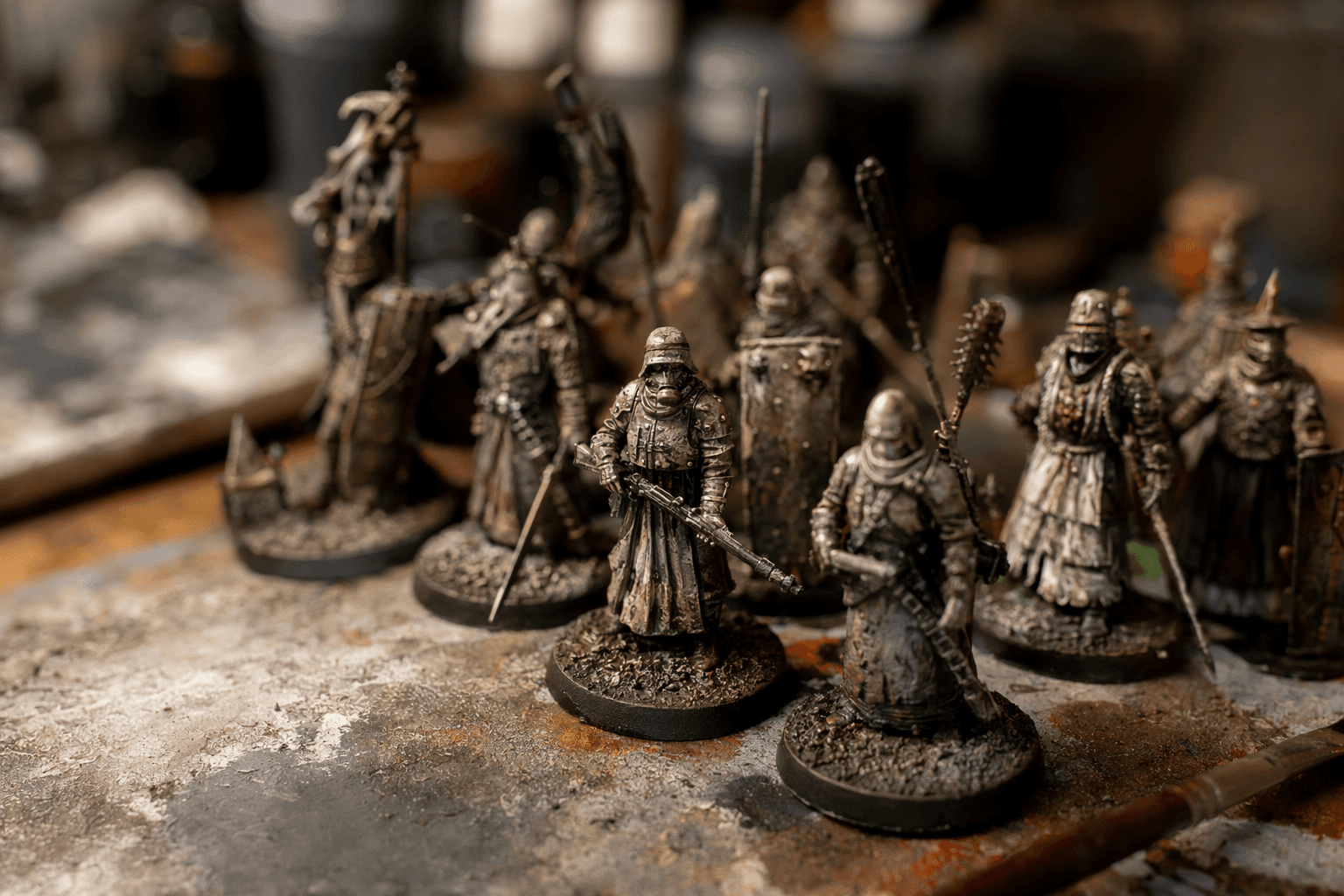
The tutorial starts exactly where it should: black primer. From there, the armor is established with Midnight Olive and Tainted Garden, using an airbrush to build controlled zenithal-style modulation. That choice is smart because it gives you shape before you ever reach for a highlight, and it keeps the armor in the same earthy family that Trench Crusade wants.
The most useful move for an intermediate painter is the under-spray from below, using a Speedpaint and Air Medium mix to add a colder, shadowed undertone. That is the kind of choice that makes armor feel like it has depth without turning it gray and dead. If you do not own an airbrush, the tutorial gives you a practical out: use glazes, wet blending, or stippling to mimic the same shift in value and temperature.
Here is the important part: do not treat the palette as a limitation, treat it as the structure.
What the armor stage teaches you
• Start from black and let the base colors do the lifting. • Use Midnight Olive and Tainted Garden as your main armor language. • Push shape with controlled modulation before you chase highlights. • Keep the cold shadow note in play so the armor does not flatten.
Weathering is where the model stops looking clean
Once the armor has value and tone, the tutorial moves into recessed shading, sponge-applied wear with Banshee Brown, edge scratches, and progressively sharper highlights. That sequence is why the model reads as battered, not just dark. The Banshee Brown sponge work is especially worth borrowing because it gives you instant chipped texture without making you hand-paint every nick like a perfectionist with too much time.
This is also where the practical brush advice matters. The article points toward specific brushes for controlled detail work, which is exactly what you need when you start adding scratches, crisp edges, and freehand details. If you are airbrushing, the note about thinning with Air Medium is equally important, because the whole recipe depends on keeping layers translucent enough to stack without clogging the surface detail.
The pitfall here is obvious: if you rush straight into bright edge highlights, you lose the grimy middle tones that make the scheme work. The tutorial’s strength is that it treats weathering as a stage, not an afterthought.
What an intermediate painter can actually take from this
This is not a beginner overview, and that is why it is useful. It assumes you already know how to basecoat, wash, and edge highlight, then shows you how to use those tools inside a deliberate visual system. The payoff is a gaming model that looks like it came from the same world as the lore: heavy, devotional, industrial, and slightly ruined before it ever hits the table.
- Limit yourself to a tight palette so the mud stays cohesive.
- Build value with airbrush work or equivalent glazes before weathering.
- Use sponge chipping with a single brown, not a rainbow of damage colors.
- Save your sharpest highlights for the final pass, not the start.
- Treat freehand and scratches as accent work, not the main event.
The biggest shortcuts worth stealing are practical ones:
That is the real value of the tutorial. It turns Blanche’s style into a process you can repeat on a squad, not a one-off display piece.
Why the collaboration feels bigger than one tutorial
The Army Painter’s broader collaboration strategy makes the tutorial more interesting than a single model showcase. The company has expanded the Masterclass line into additional volumes, which tells you this is meant to be a continuing framework for grimdark painting, not a one-shot novelty. It also ties into the wider community response, where factory team painters and hobby creators have already used the sets for Blanchitsu-style miniatures, including an Inquisitor and other grimdark projects.
That is the real story behind the New Antioch heavy infantry piece. It shows how a limited palette, a recognizable art legacy, and a setting with a huge visual identity can all line up in one recipe. If you want Trench Crusade on the table tonight, this is the kind of discipline that gets you there.
This article was produced by Prism’s automated news system from verified source data, official records, and press releases, then run through automated quality and moderation checks before publishing. The system is built and supervised by the people who set the standards it runs under. Read our full AI policy.
Did this article answer your question?