Ableton book shows how drifting loops power minimal techno
Tiny offsets, not extra parts, keep minimal techno alive. Ableton’s loop lesson shows how drift can turn a sparse grid into a hypnotic club machine.
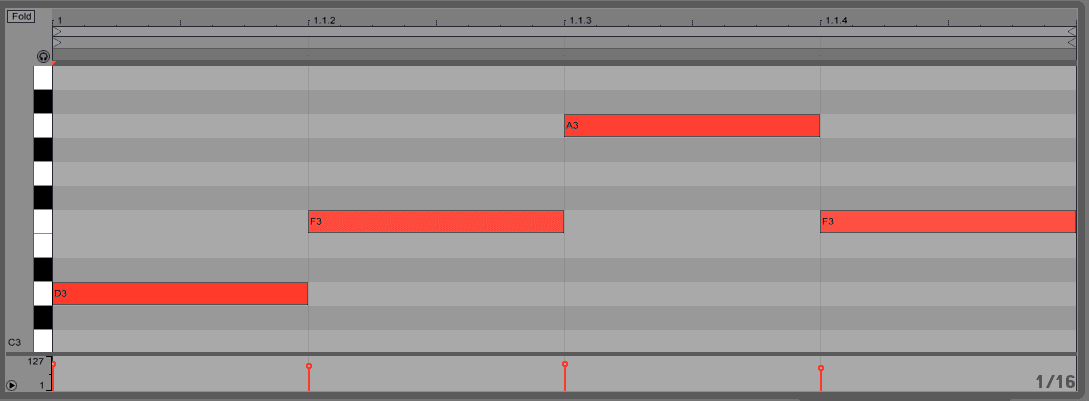
Minimal techno often sounds strongest when the grid is almost, but not quite, aligned. Ableton’s Making Music captures that tension neatly: if looped parts line up too perfectly, the result can feel static, so the fix is to let them cycle asynchronously and breathe against one another.
Why drift works in a minimal track
That idea lands hard in minimal techno because the genre is built from very little material. A kick, a hat, a pulse, maybe a muted stab, has to carry a track for six or eight minutes without collapsing into dead repetition. Ableton’s point is simple and useful: repetition is not the enemy, it is the raw material, and the music comes alive when loop lengths, accents, or rhythmic cycles do not all resolve at the same moment.
Ableton places that thinking in a longer electronic-music lineage, from musique concrète tape experiments to techno’s repeating drum-machine patterns. It also describes the bodily effect of repetition in a way every club regular understands, as “head-nodding hypnosis” and “time-dilated euphoria.” Minimal techno sits right in that space, where a controlled amount of drift keeps the groove precise without letting it freeze.
Use case 1: Let percussion lean against the kick
The cleanest way to hear asynchronous loops in minimal techno is with percussion. Keep the kick authoritative, then let hats, clicks, shakers, or a rim loop circle on a slightly different pattern so the accents never land exactly where the ear expects them. The groove stays lean, but the texture stops feeling looped in a mechanical way.
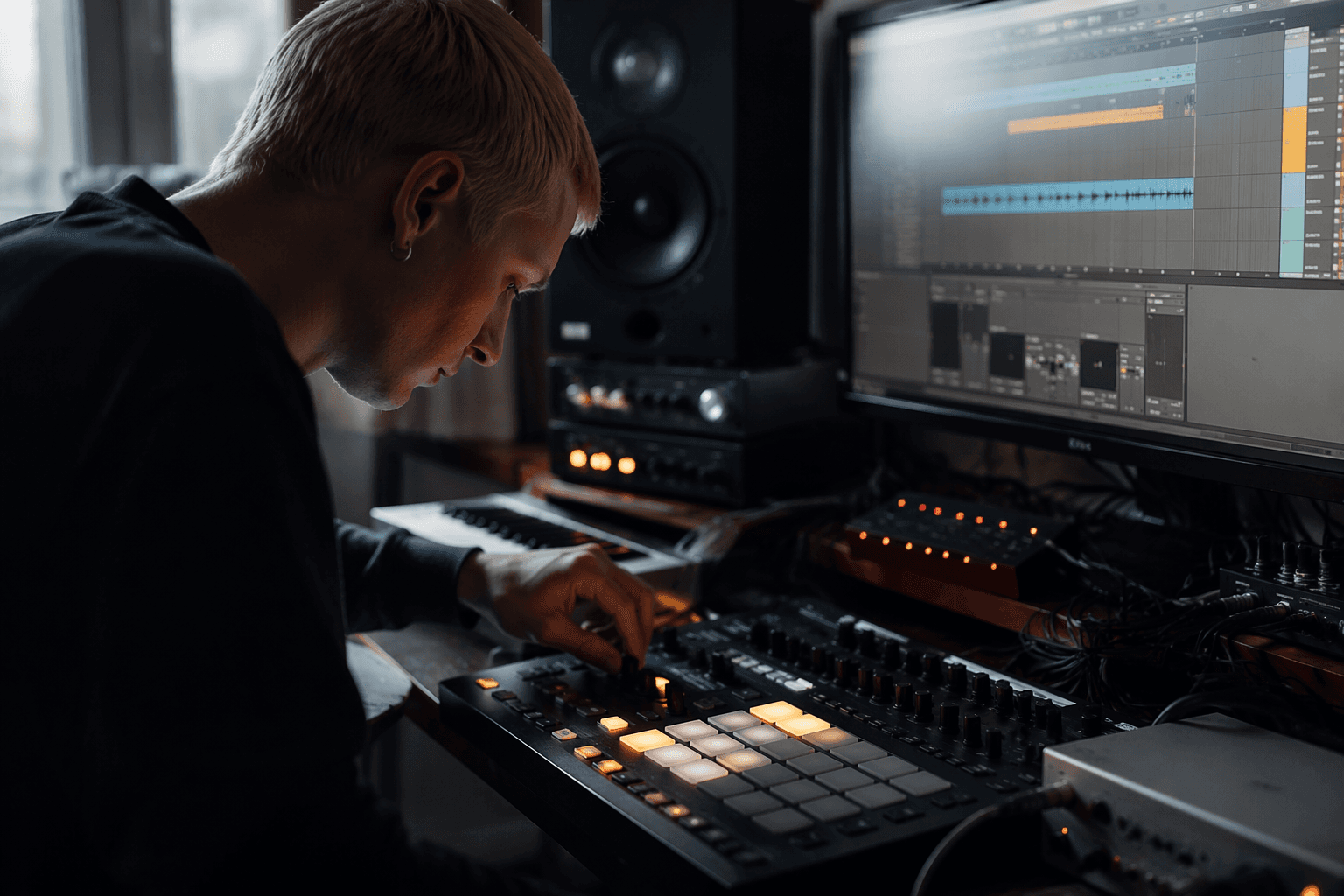
That tiny mismatch is what gives a sparse track movement without crowding the pocket. You are not adding more events, you are changing the relationship between the events already there. In a genre that often starts from only a few elements, that is enough to make the whole track feel like it is advancing instead of just repeating.
Use case 2: Separate bass motion from the main cycle
A second useful move is to let a bass figure, stab, or tonal pulse turn over against the main drum cycle rather than inside it. When one loop completes a little earlier or later than another, the ear starts to hear motion in the overlap itself. That is especially valuable in minimal techno, where the listener does not need a new melody every eight bars to stay locked in.
This is the difference between empty repetition and active repetition. The first sounds like a copy machine, the second sounds like a machine that is working with intent. Ableton’s advice fits the genre because it shows how a track can remain hypnotic even when almost nothing “happens” in the conventional sense.
Use case 3: Build a six-minute arc from micro-shifts
The third application is the one that makes asynchronous loops so valuable in club music: long-form momentum. If you want a minimal techno track to hold a room for six or eight minutes, you do not need a big breakdown every 32 bars. You need controlled instability, the sense that a loop is always precise but never frozen.
That is where subtle desynchronization does the heavy lifting. A small shift in loop length, an accent that arrives late, or a repeating pattern that resolves on its own clock can create the feeling of forward motion while the arrangement stays lean. It is a compact, club-ready statement of restraint, and it is exactly the kind of trick that keeps a stripped track from sounding inert.
Why the idea fits the genre’s history
Minimal techno did not arrive as a full production style by accident. It emerged in the early 1990s in Detroit and Berlin, and it is generally defined by a stripped-down aesthetic that leans on repetition and understated development. Richie Hawtin, born on June 4, 1970, became involved in Detroit techno’s second wave in the early 1990s and has been a leading exponent of minimal techno since the mid-1990s.
That history matters because Hawtin’s career maps onto the genre’s obsession with structure and motion. He and John Acquaviva founded Plus 8 in May 1990, and Hawtin created M_nus in 1998, a label closely associated with a future-facing minimal approach. In interviews, Hawtin has described minimal techno as “transitional” and pointed to Ricardo Villalobos, Magda, Josh Wink, and Laurent Garnier as part of the scene’s quality-driven continuum.
Robert Hood’s Minimal Nation is still treated as a foundational statement because it codified minimalist techno for decades to come. The record’s legacy helps explain why the Ableton page feels so practical: minimal techno was never only about subtraction, it was about arranging time so the few elements on the table could push against one another. That is why contemporary artist bios on Resident Advisor still reach for the same language, groove, repetition, tension, subtle movement, and hypnotic flow, to describe what this music does when it is working.
What to listen for when you try it
- A loop that feels steady on its own, but starts to move once another part enters on a different cycle.
- Accents that shift the groove without adding density, which is often more effective than stacking more sounds.
- A track that stays open and hypnotic because the parts never fully lock into the same loop length.
This is the quiet trick behind so much effective minimal techno. The strongest tracks do not crowd the groove, they let it drift just enough to stay alive, so the room feels the pulse of something precise, restless, and never quite frozen.
This article was produced by Prism’s automated news system from verified source data, official records, and press releases, then run through automated quality and moderation checks before publishing. The system is built and supervised by the people who set the standards it runs under. Read our full AI policy.
Did this article answer your question?