Anyma Debuts ÆDEN as Coachella 2026 Leans Hard Into Dance Music
Coachella 2026 has become a serious electronic-music map, with Anyma’s ÆDEN debut at the center and a livestream built for overlap-heavy weekend navigation.
Coachella’s dance-music pivot is no longer subtle
Coachella 2026 is leaning so hard into dance music that the festival now reads like a mainstream mega-event built with electronic fans in mind. Electronic and dance acts make up 45% of the lineup, and that share makes the weekend feel less like a side quest for club listeners and more like one of the festival’s defining identities. For minimal techno ears, that matters because the bill is no longer just about one or two token names. It has enough depth to reward real schedule discipline.
The festival’s 25th-anniversary edition runs April 10-12 and April 17-19 at the Empire Polo Club in Indio, California, and the first weekend is where the clearest dance-music story unfolds. The practical guide is obvious: if you care about the electronic side of Coachella, this is the year to pay attention from the first livestream hour onward.
Anyma gives the weekend its headline moment
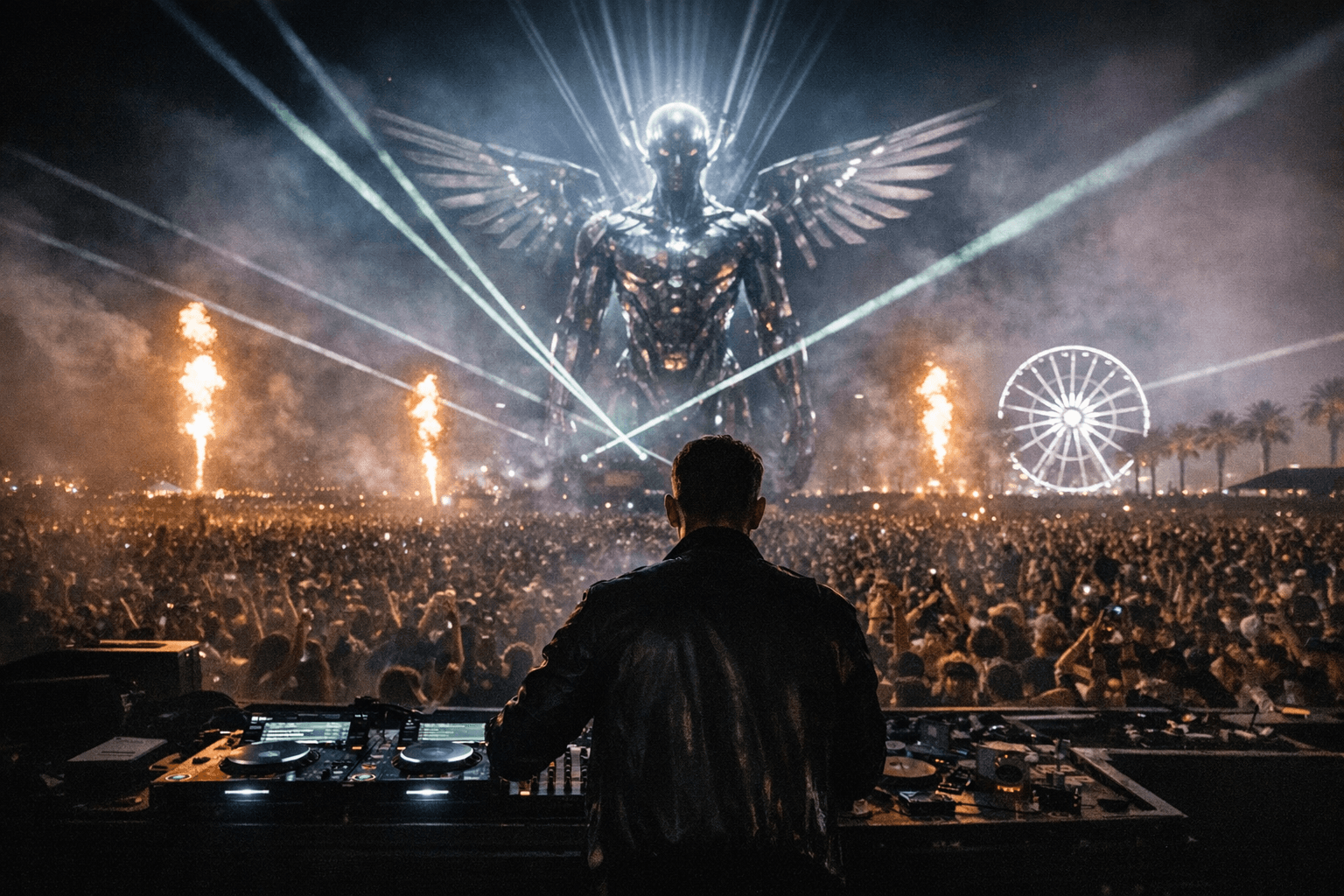
The center of gravity is Anyma, whose new audiovisual concept, ÆDEN, is set to debut on the Coachella Stage on April 10. That is the kind of booking that tells you exactly how the festival wants to frame the conversation: not as background festival EDM, but as a premium, main-stage event with cinematic scale. For listeners who follow melodic techno and the more polished end of the spectrum, Anyma is the clearest must-see name on the board.
His Coachella appearance is also the launch point for the first phase of his 2026 ÆDEN World Tour, which is set to continue after the desert debut with dates in China, Seoul, Istanbul, and Milan. That makes the Coachella performance more than a one-off premiere. It is the opening statement for a larger production cycle, which is exactly the sort of moment that tends to ripple through the wider club conversation.
The crossover names worth tracking
Anyma is the marquee pull, but the broader value for minimal techno fans sits in the names that sit around him. Fatboy Slim, Tiga, Kaskade, Solomun, WORSHIP, and Prospa all help explain why this lineup feels more like an electronic ecosystem than a single-genre showcase. The overlap matters: some acts lean toward big-room energy, but others point closer to groove, progression, and club-minded pacing.
Prospa is especially relevant for readers who follow the seam between house, techno, and the more stripped-back end of the spectrum. Their presence signals a festival that still has room for rhythmic subtlety inside a mostly high-volume environment. Tiga and Solomun bring further credibility to that lane, even as the larger Coachella machine keeps pushing dance music into bigger, broader, more brand-friendly territory.
The takeaway is not that Coachella has become a minimal techno festival. It has not. The point is that it now has enough dance-music density to make the electronic lanes worth mapping carefully, especially when the schedule starts forcing hard choices.
Why the livestream matters more than ever
Coachella is streaming performances from seven stages simultaneously on YouTube, and that alone changes how electronic fans can use the festival. The official setup turns the stream into a real navigation tool rather than a consolation prize, especially when the on-site schedule gets crowded and the best sets overlap. Beatportal notes that Weekend 1 livestreams begin at 4 p.m. on April 10, which gives the opening night a very specific starting gun.
Three stages, Coachella, Outdoor Theatre, and Sahara, will be streamed in 4K for the first time. That detail matters more than it sounds like it does, because electronic performances often depend on lighting, visuals, and crowd scale as much as track selection. A cleaner stream makes it easier to judge whether a set is merely loud or genuinely dialed in.
The official site says the livestream is only on YouTube and that seven stages will be live, which makes the broadcast feel unusually complete for a festival of this size. For electronic fans, that means the stream is not just a recap tool. It is the cleanest way to keep tabs on multiple lanes at once, from the Coachella Stage spectacle down to the smaller-stage pressure points.
Coachella TV adds useful context for electronic fans
Alongside the live stages, Coachella TV will run with classic performances, documentaries, interviews, and behind-the-scenes clips from the festival’s 25-year history. That gives the weekend a second layer of programming that is less about the current set times and more about the festival’s long arc as a culture machine. For dance-music followers, it also reinforces how Coachella is packaging itself as an archive as well as a live event.
That history matters because the festival’s current electronic push did not happen in a vacuum. It reflects a broader shift in what major U.S. festivals think sells, what crowds respond to, and what kind of production can command the biggest stages. The archive content helps underline the point that the present-day festival is not merely booking more dance acts. It is recasting its identity around them.
The agency breakdown explains the shape of the bill
The lineup’s structure becomes clearer when you look at the agency breakdown from Booking Agent Info. Wasserman leads with 33% of the lineup, followed by UTA at 12%, while CAA and WME are tied at 11%. That distribution tells you which power centers are shaping the booking, and it helps explain why the roster feels so stacked across pop, dance, and crossover lanes.
CAA represents Anyma, while WME represents Solomun, Teddy Swims, and PinkPantheress. That mix is useful context because it shows how electronic names now sit inside a broader talent web that also feeds pop and genre-blending acts. For readers watching how festival programming gets assembled, the agency map is part of the story. It shows how dance music is being placed inside the highest tiers of the mainstream festival economy, not off to the side.
What this says about the wider festival landscape
EDM.com notes that electronic acts account for 45% of Coachella’s 2026 lineup, up from 39% in 2025, and argues that the festival reflects a bigger trend in which electronic music has overtaken rock as the most-represented genre across major U.S. festivals over the last decade. That is the larger frame around everything else here. Coachella is not just offering more dance sets. It is mirroring where the live-music market has gone.
For minimal techno listeners, the significance is practical as well as cultural. Coachella has become a place where the difference between mainstream dance spectacle and club-rooted taste is visible in real time. Anyma’s ÆDEN debut, the presence of Prospa and Solomun, the seven-stage YouTube stream, and the 4K treatment for Coachella, Outdoor Theatre, and Sahara all point in the same direction: dance music is no longer being treated as decoration. It is part of the festival’s core architecture now, and this year’s desert schedule makes that impossible to miss.
Know something we missed? Have a correction or additional information?
Submit a Tip