Chicago House Pioneer Gene Hunt Drops Minimal Techno Four-Tracker on DBH-Music
Gene Hunt's "Then & Now EP" on HOTMIX Records runs from 131 down to 121 BPM across four sides, giving DJs a two-gear minimal tool on a single 12-inch.
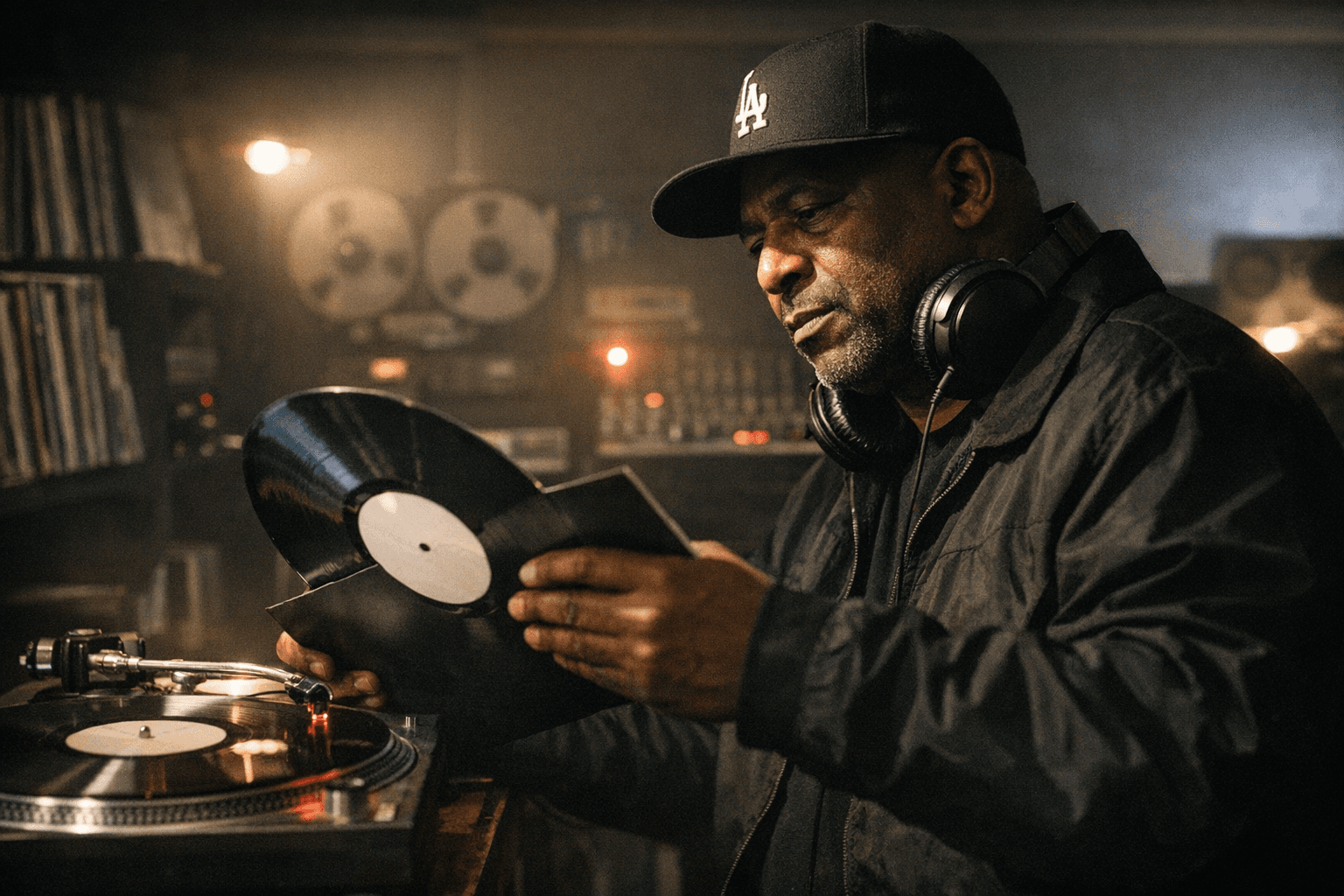
The title "Then & Now EP" earns its keep on this one. As HM036, it's the 36th entry in Nick Anthony Simoncino's HOTMIX Records, an Italian imprint distributed through DBH Music's Frankfurt operation, and Gene Hunt brings to it a structural logic built over forty-plus years of programming rooms where house and techno weren't separate bins.
Side A runs hot. "Spray Paint," the 131-BPM opener, clocks in at over six minutes, giving you the runway to bring it in properly. That tempo sits at the high end of what reads as house and the low end of what reads as techno, which is exactly the grey zone Hunt has occupied since his teenage years under Ron Hardy at The Music Box. His documented production approach is 909-heavy, and at 131 BPM the kick lands with more insistence than swing, pushing the groove forward rather than rocking it sideways. Anything arriving from 128-130 BPM will sit cleanly against it. For pairing: Cari Lekebusch (a documented Hunt collaborator) or the harder side of Robert Hood's Floorplan catalog bracket it naturally.
"Madd Kapp" at 129 BPM is the A2 companion, two BPM of relief that registers as a gear shift without requiring a pitch correction. If "Spray Paint" opens the sequence, "Madd Kapp" commits to it. The A-side as a two-track block sits well in any minimal or deep techno set running 128-132 BPM, and the length of each cut means you're not scrambling for a quick exit.
The B-side drops the template. "MS. Mikaya In Place Of" at 121 BPM is a ten-beat-per-minute descent from the A-side peak, landing squarely at classic Chicago house tempo, the pace Ron Hardy ran at The Music Box in the early 1980s. Functionally, it recalibrates the room. Use it as a pivot after a harder stretch, or as a bridge into deeper, more atmospheric material. The Chain Reaction catalog or the quieter side of Plastikman's early work sits on the same horizontal plane.
"Somebody Shake It," the B2 closer at 125 BPM, is the release valve: up four BPM from the B1, and the title signals exactly what it's built to do. It restores motor function after the depth of "MS. Mikaya In Place Of" without abandoning the restraint. At mid-tempo house territory, it's also the track that earns the record's "Chicago" tag most explicitly.
What makes HM036 a reliable DJ tool is the internal architecture. Side A at 129-131 provides a two-track techno-leaning block for peak time. Side B at 121-125 traces the controlled descent, still holding the floor but cooling the room by degrees. That 10-BPM span across the 12-inch is structural design, not coincidence.
Hunt came up playing 909-based acid tracks alongside disco and house at the Hyatt Park Athletic Club, under Ron Hardy's mentorship, in rooms where tempo and texture were programming decisions rather than genre markers. His debut EP "Living in a Land," co-produced by Armando Gallop on Housetime Records, came out of the same Chicago orbit as Trax Records. HM036 arrives on an Italian imprint distributed out of Frankfurt, but the mechanics that make it mix-ready trace straight back to that source. Forty years of room-reading is audible in the sequencing alone.
This article was produced by Prism’s automated news system from verified source data, official records, and press releases, then run through automated quality and moderation checks before publishing. The system is built and supervised by the people who set the standards it runs under. Read our full AI policy.
Did this article answer your question?