Steve Stoll’s polyphony maps hardware-heavy minimal techno process
Seven tracks called 1 through 7 turn Steve Stoll’s hardware route into the lesson: commit early, resample hard, and let arrangement do the talking.
The point of polyphony
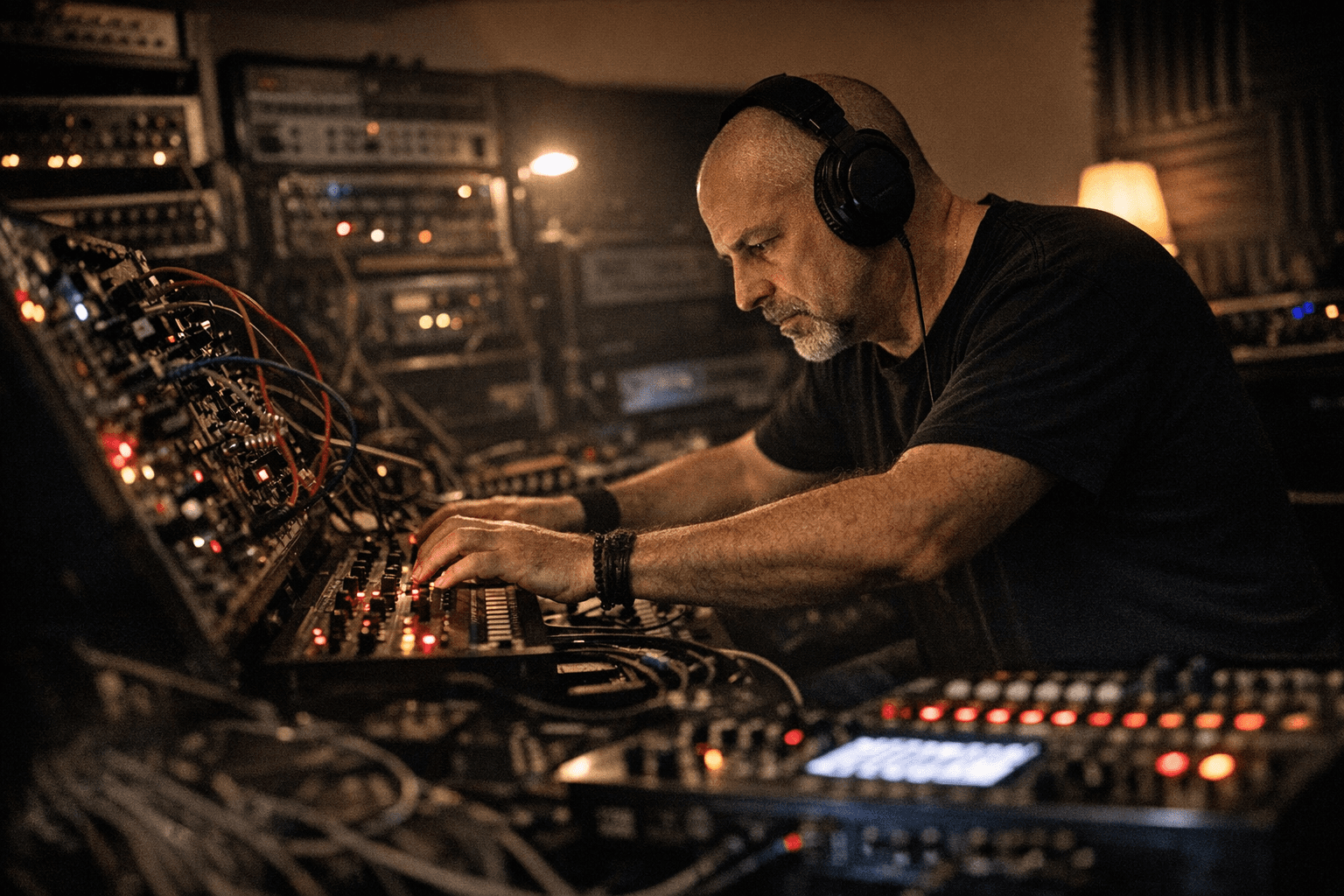
Steve Stoll’s polyphony lands like a process document disguised as a minimal techno record. Released on April 11, 2026 under LAMENT on his Bandcamp page, it strips away the usual styling games and makes the workflow the story: seven tracks, simply titled 1 through 7, built from live DAWless tracking to digital two-track, then pushed back into hardware for resampling, editing, layering, combining, rearranging, playback rerecorded through a hardware chain, and final dub mastering in Ableton.
That chain is the whole lesson. In a scene where a lot of minimal techno can blur together on paper, Stoll gives you a record that feels physically handled at every stage. Nothing about it suggests a template or a preset bank. It sounds like someone committed to sound, then committed again, then kept going until the arrangement itself became the proof.
Why the track naming matters
Seven tracks with no descriptive titles could look austere for austerity’s sake, but here the simplicity fits the method. The names 1 through 7 tell you not to hunt for a concept album narrative or a scene report; they tell you to listen for variation inside restraint. That matters because the tracks mostly run in the five-to-nine-minute range, which gives Stoll room to work with slow transformation instead of immediate payoff.
That is where the title polyphony starts to make sense. The word points to multiple lines moving together, not a single loop hammered into submission. For producers, that means the interest comes from interactions, not just density. A kick, a metallic layer, a low pulse, a rearranged playback pass, each element can stay simple if the relationships keep shifting.
What the workflow teaches you about arrangement
Stoll’s stated method is useful because it separates performance, capture, and sculpting instead of pretending they are the same thing. The live DAWless pass gets the idea down with real movement. The return to hardware for resampling, editing, and layering gives the material friction. Rerecording playback through a hardware chain adds another pass of coloration before Ableton finishes the mastering job.
- Record an initial performance with the groove intact, rather than drawing every note by hand.
- Resample the result back into hardware so the sound changes while the structure stays recognizable.
- Edit and rearrange after the first pass, when the arrangement can still surprise you.
- Rerecord playback through a hardware chain so the final mix keeps a trace of contact and circuitry.
- Treat finishing as translation, not rescue, with dub mastering used to tie the parts together.
If you make minimal techno, that sequence is worth stealing in pieces:
The big takeaway is restraint with intention. polyphony does not feel busy, even though the process behind it is layered and iterative. That balance is the sweet spot in minimal techno: enough repetition to lock the floor, enough mutation to keep the ear from flattening out.
The tags place it in the right lineage
The tag set matters too. 90s techno, analog, industrial techno, minimal techno, and Fort Wayne are not just metadata, they are a map. The 90s techno tag pulls the release toward a tougher era of machine music. The analog and industrial tags tell you to expect texture over polish. The minimal techno tag keeps the arrangement philosophy clear and deliberate, while Fort Wayne gives the release a geographic anchor that keeps the record from feeling placeless.
That combination helps explain why the record reads as both local and universal. Fort Wayne is specific, but the method is legible anywhere someone is working with hardware, bounce files, resampling, and a few disciplined decisions about what not to include. Stoll is not offering a new software trick. He is showing how much mileage you can still get from an old-school chain when every pass is treated as part of the composition.
Why Stoll’s backstory gives the record weight
This is not an anonymous newcomer trying on a stripped-down aesthetic. Steve Stoll’s Bandcamp profile says he has been making electronic music since the late 1980s, is based in Fort Wayne, Indiana, and owns the labels Proper NYC and 212 Productions. It also notes releases on Novamute, Profile, Synewave, Djax, Trax, Music Man, and others. That history matters because polyphony sounds like the work of someone who has already learned which details can carry a track and which ones only add clutter.
Resident Advisor fills in the arc behind that discipline. Stoll began as a drummer with Wax Trax, was raised in Brooklyn, served five years in the Army including during the Gulf War, played drums for Sister Machine Gun, studied jazz, and debuted on Sm:)e with Pacemaker in 1995. That is a lot of mileage before the techno discography even fully opens up, and you can hear that background in the way polyphony handles time. The record does not rush its edits or overstate its transitions. It behaves like it trusts repetition, then works the repetition hard.
The label history behind the minimal pressure
Proper NYC adds another layer of context. Resident Advisor says Stoll founded the label in 1994, and that its catalog has included Cari Lekebusch, Damon Wild, Freddy Fresh, and Woody McBride, with releases ranging from harder techno to modern minimal techno. That history places polyphony inside a longer New York lineage rather than a standalone experiment.
Taken together, the label work and the new release point to the same core idea: minimal techno is strongest when the method is audible. Stoll’s latest seven-track statement is not trying to win by scale, and that is exactly why it lands. The record shows that if the recording path is disciplined enough, the finished groove can carry the whole story, and the engineering becomes part of the emotion rather than the thing hidden behind it.
This article was produced by Prism’s automated news system from verified source data, official records, and press releases, then run through automated quality and moderation checks before publishing. The system is built and supervised by the people who set the standards it runs under. Read our full AI policy.
Did this article answer your question?