Monopoly Go’s Simpsons crossover turns Springfield into a long-form event
Springfield is becoming a two-month Monopoly Go season, with Episode Sets, new boards, and special minigames built to keep players logging in.
This is not a one-and-done cameo
Monopoly Go is not treating The Simpsons like a quick brand skin. The crossover runs from June 3 to July 29, 2026, and it is built as a full-season event with new boards, collectibles, minigames, and community beats that stretch across the calendar instead of vanishing after a day or two.
That cadence matters because Monopoly Go already lives and dies on repeat engagement. A long-form collaboration gives Scopely a much bigger runway to turn Springfield into a habit, not just a headline, and the structure here is clearly meant to keep players checking back in.
How the season is laid out
The core of the event is a rolling series of limited-time Episode Sets. Every two weeks, a new one arrives, and each set brings 9 stickers plus Simpsons-themed cosmetics and collectibles.
That matters for two reasons. First, the pacing creates a steady trickle of fresh content rather than a single launch spike. Second, the Episode Sets are optional and do not affect main Album progression, which is smart design for a live game that already has its own collection economy. Players who want the Springfield flavor can chase it without feeling forced into a separate progression track that hijacks the base game.
Scopely is also folding the collaboration into the broader seasonal shell it knows best. The official rollout frames the event as “packed with chaos, donuts, rivalries,” and that is exactly the right energy for Monopoly Go, where spectacle is the product as much as the dice rolls.
What changes on the board
The most important part of the crossover is not the character art, it is the way the board itself gets reworked. The season includes two new Springfield-themed boards, with familiar locations and environments pulled into the Monopoly Go format. Expect spots like the Nuclear Power Plant and Krustyland to show up in the mix, alongside a Springfield Monorail treatment for the railroad tiles.
That is a stronger move than simply dropping Homer or Bart into a sticker album. It makes the collaboration feel like a temporary game mode built around Springfield’s geography, which gives the crossover real identity. When the board changes, the event stops feeling cosmetic and starts feeling like a place you are actually playing in.
- The Simpsons Run places a Springfield resident on the Free Parking tile and turns it into a character-driven mini-experience.
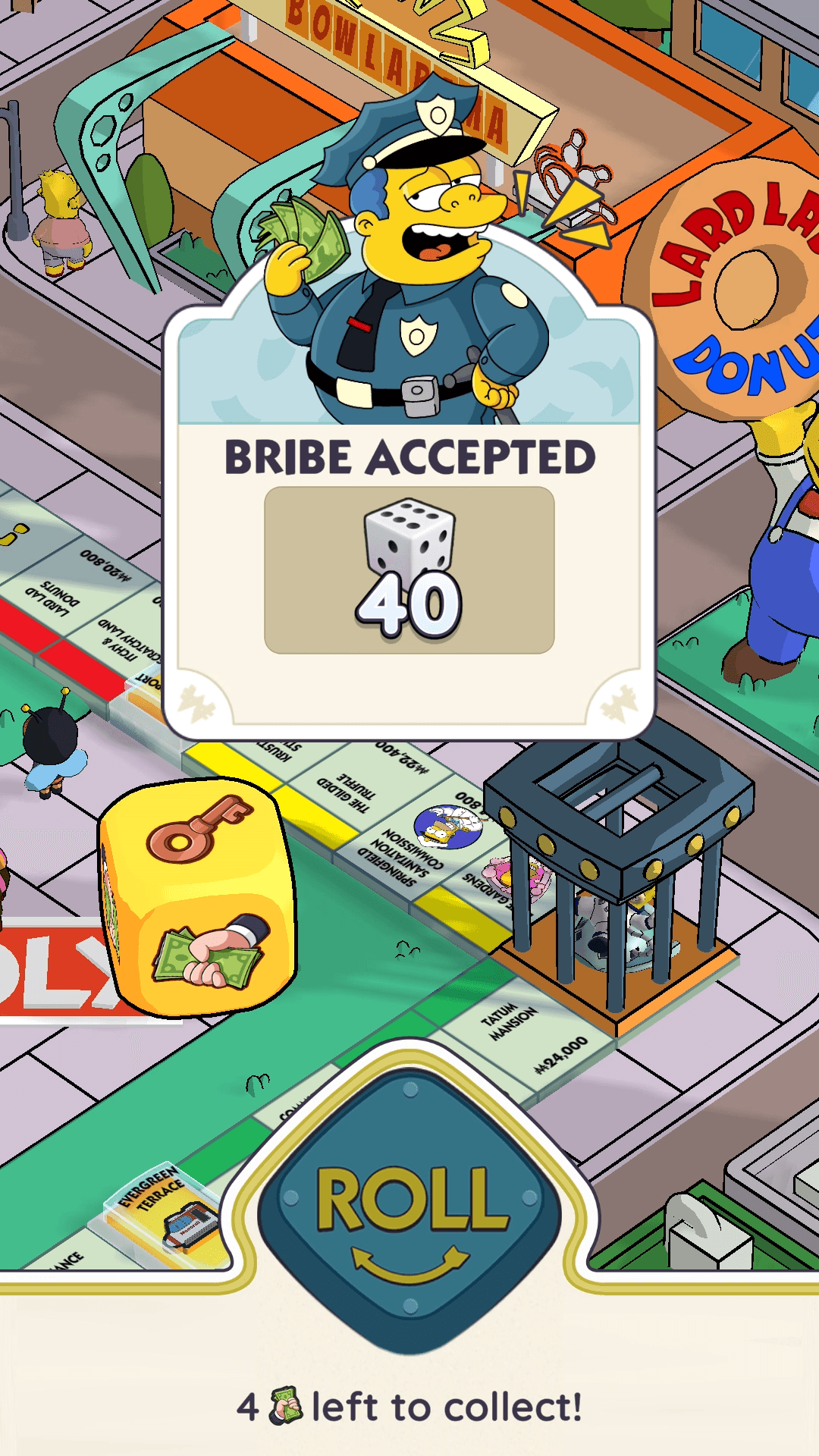
- Bribe Wiggum adds a jail mini-event where you gamble for rewards by bribing Chief Wiggum.
- Shutdowns, heists, and Mega Heists get Simpsons-themed treatment, which plugs the crossover directly into Monopoly Go’s existing loop of competition and loot.
The new seasonal mechanics push that idea even further:
That is the important design choice here. Instead of inventing a separate minigame universe, Scopely is remixing the systems that already keep people playing.
Why this crossover is built for retention
Victor Diaz-Roig, Scopely’s president of games, said the two properties share a love of “mischief” and not following rules, and said the team wanted to build “an entirely new shared universe,” not just place Springfield inside the game. That is the right framing for Monopoly Go, because the game has already proved that licensed events work best when they feel like part of its own rhythm.
This is also where the collaboration’s monetization logic becomes obvious. A two-month event with biweekly Episode Sets, special cosmetics, collectible stickers, and themed board variants gives Scopely repeated reasons to surface fresh offers and keep players engaged across multiple beats. It is not a single purchase moment, it is a sustained engagement machine.
For a mobile game as sticky as Monopoly Go, that kind of cadence is the real prize. Shareable event spectacle performs here because it gives players a reason to come back, a reason to show off, and a reason to keep chasing the next drop.
The Simpsons side is not treated like decoration
This crossover was not assembled as a lazy brand swap. IGN reported that Scopely worked in regular communication with The Simpsons writers’ room, and the event includes deep-cut references such as the monorail and Mr. Sparkle. That kind of detail is what keeps a licensed event from feeling like a mass-market sticker pack.
The animated short also signals that this is being treated like marquee entertainment, not just mobile content. Will Ferrell voices Mr. Monopoly, while Harry Shearer voices Mr. Burns, which gives the rivalry a proper comic-punchline frame. That animated setup leans into the long-running tension between Mr. Monopoly and Mr. Burns instead of using the crossover as a random mash-up.
There is also a deeper layer of authenticity behind the scenes. The Simpsons creative team included veteran character designer Eric Keyes, who has worked on the show since its first season, and other reporting says Matt Selman, John Drake, and Joe Zanetti all helped shape a version of Springfield that still feels like The Simpsons, even while it is being bent to fit Monopoly Go’s heists, shutdowns, cosmetics, and collectibles.
Why the 13-year gap matters
This is The Simpsons’ first dedicated return to a mobile game in 13 years, and that alone gives the crossover extra weight. IGN linked that return to the delisting of The Simpsons: Tapped Out in 2025, which helps explain why this launch feels less like a throwaway promotion and more like a real re-entry into mobile.
That gap matters because fans have not just been waiting for another Simpsons mobile tie-in, they have been waiting for one that actually looks built for the current mobile market. Monopoly Go already knows how to turn licensed chaos into a repeatable event structure, and The Simpsons bring a library of jokes, settings, and character beats that fit that machine unusually well.
That is why this crossover reads bigger than a cameo. Monopoly Go is using Springfield as a long-form engagement engine, with enough cadence, collectibles, and board-level spectacle to keep the event alive well beyond launch day.
This article was produced by Prism’s automated news system from verified source data, official records, and press releases, then run through automated quality and moderation checks before publishing. The system is built and supervised by the people who set the standards it runs under. Read our full AI policy.
Know something we missed? Have a correction or additional information?
Submit a Tip