Athearn announces Santa Fe GP7u models spanning multiple eras
Athearn's Santa Fe GP7u release stretches one rebuilt road unit across the 1970s to BNSF-era layouts. Detail choices and paint schemes make it a flexible roster slot.

Athearn's July 13, 2026 HO GP7u announcement leans on one of Santa Fe's most useful rebuild stories: a first-generation diesel that stayed relevant long enough to fit several eras and several kinds of trains. Launched in 1972, the GP7u program kept EMD GP7s working for years after their original appearance, which gives modelers a road unit that can belong on a 1980s branch, a 1990s local, or a BNSF-era survivor without looking forced.
The release is built around the details that make that flexibility believable. Santa Fe GP7u rebuilds featured chopped short hoods for better visibility, upgraded prime movers, and new components, with some units that had dynamic brakes seeing that equipment deactivated during the rebuild. Athearn's detail set includes blanked-dynamic or non-dynamic brake hatches, a three-chime horn placed per prototype, a Stratolite beacon that flashes in DCC mode, all-weather cab windows where applicable, fuel tank skirts, drop steps, and road-number-specific differences in handrails, MU stands, and pilots. Earlier GP7u releases also highlighted late low-nose cab interiors, anti-glare shields, vapor air conditioners, and antenna arrangements, the sort of parts that separate a one-off repaint from a believable roster piece.
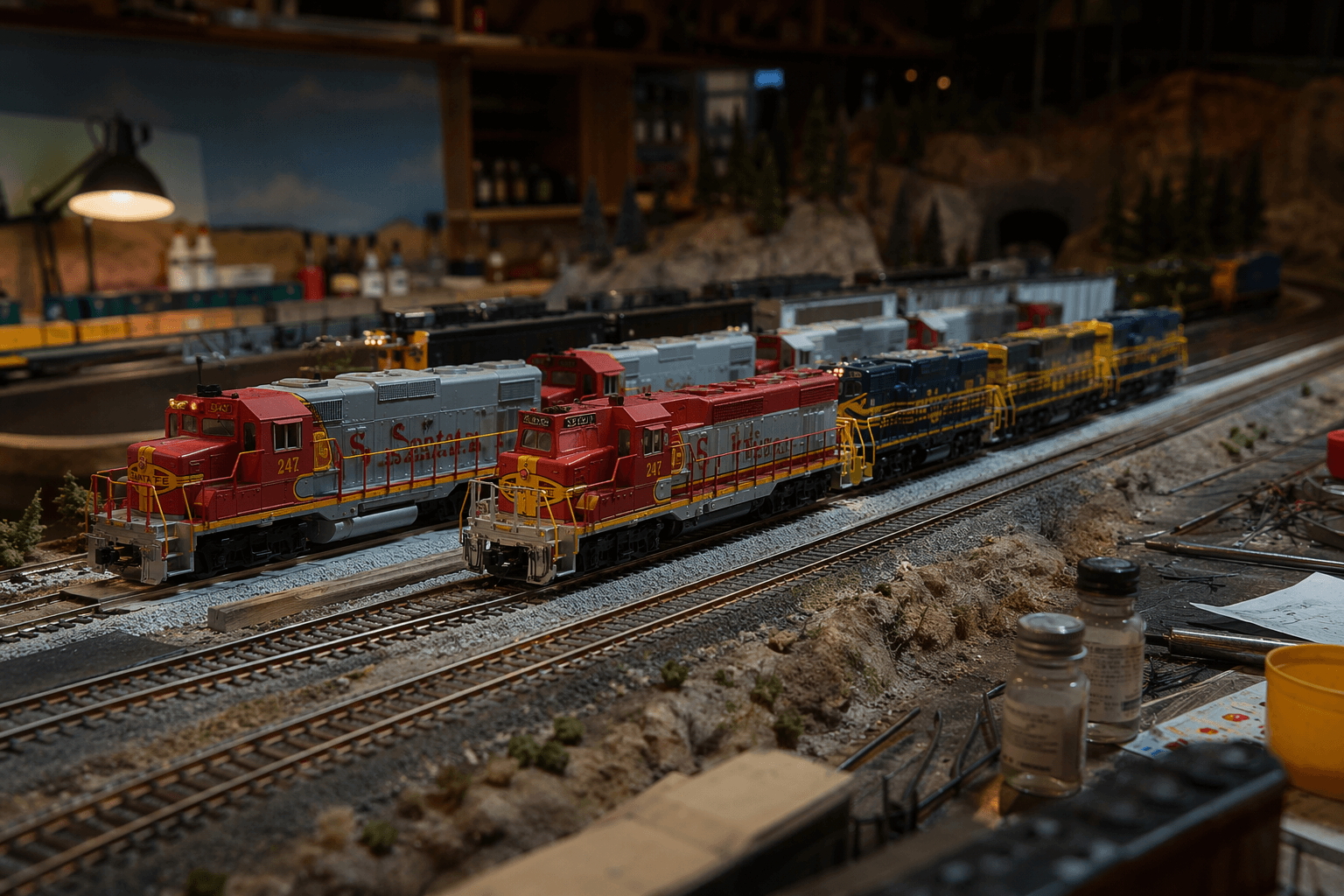
Santa Fe's own rebuild history gives the model its range. Most Santa Fe GP7s were rebuilt to GP7u between 1972 and 1981, and the visual changes were not uniform. Early rebuilds retained a round cab roof, while later units received the angled Topeka cab with rooftop air conditioners. One Santa Fe GP7 rebuilt in August 1974 received a Topeka cab at Cleburne, Texas, while another became ATSF 1323 after a November 1981 rebuild at Cleburne. Reference rosters also show GP7s renumbered into multiple classes, including the 1310, 2000 and 2050 groups, which underscores how broad the program became across the fleet.
That breadth is what makes the GP7u such a practical buy for HO layouts. The same locomotive can handle a branchline freight, switch a terminal yard, or cover commuter and local freight service after its first-generation peers have disappeared. A BNSF roster example identifies GP7u 3827 as former Santa Fe 2822, built in December 1952, proof of how far Santa Fe stretched the life of a single road unit. With black-and-yellow Santa Fe paint, the red-yellow-black Kodachrome scheme, and later patched BNSF versions, the GP7u slots naturally into transition-era and early BNSF scenes while giving operators enough variation to justify different assignments and weathering.
This article was produced by Prism’s automated news system from verified source data, official records, and press releases, then run through automated quality and moderation checks before publishing. The system is built and supervised by the people who set the standards it runs under. Read our full AI policy.
Did this article answer your question?