How to model an embankment with polystyrene, plaster and grass
A believable embankment starts as a simple foam rise, then earns its realism with plaster bandage, layered grass and careful slope work.
Whenever a railway has to climb above the surrounding ground, the embankment becomes part of the story, not just the background. Built well, it gives a layout a convincing rise, a clean edge and that grounded, settled look that makes track feel like it belongs.
Start with the landform
The core shape is the first job, and the simplest version is also the most dependable: cut and stack expanded polystyrene until the embankment has the rise you want, then refine the profile before any scenic finish goes on. The method works across all scales, from NG7 to OO and N, because the principle stays the same even when the dimensions change. The key is to avoid a wedge that looks like a ramp dropped onto the baseboard. Real embankments spread out, soften at the toe and taper naturally into the surrounding ground.
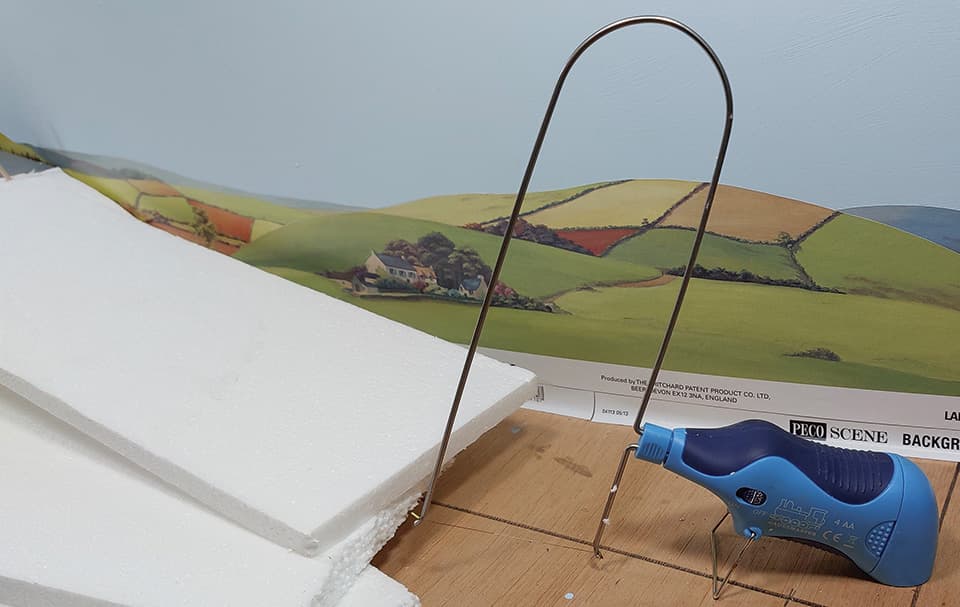
A hot wire cutter does the heavy lifting here, especially if you want clean, controlled cuts rather than torn foam edges. A surform is the follow-up tool that turns blocky foam into something with a gentler slope, and a palette knife helps where you need to shave, press or adjust small sections. If the face of the embankment looks too straight, work it back in shallow passes until it stops reading as a simple triangle.
What goes on the bench
The practical build list is refreshingly unglamorous, which is usually a good sign in scenery work. For this method, the useful kit includes:
- Hot wire cutter
- Scissors
- Surform
- Palette knife
- Old paintbrushes
- Bits of sponge
- Vacuum cleaner
- Static grass tool
- Puffer bottle
- Expanded polystyrene
- Ready-mix wall filler
- Plaster bandage
- Several shades of electrostatic grass
- Lots and lots of PVA glue
That combination tells you a lot about the build sequence. Foam gives the bulk, plaster bandage gives the skin, filler smooths the joins, and grass supplies the final texture. The old paintbrushes and sponge pieces are not there for decoration; they are the everyday tools that let you spread filler, work around awkward corners and tidy the surface before the grass stage starts. Keep the vacuum close, because static grass overspray and loose fibres are part of the game.
Skin it before you scenic it
The outer shell matters because plaster bandage does two jobs at once: it stiffens the foam and it gives the whole structure a more natural surface to work from. Scale Model Scenery describes plaster bandage, or Mod Roc, as one of the most tried and tested ways to form hills and embankments, and that long-standing use is part of why it still works so well. Once the bandage is on, ready-mix wall filler can take out the last foam seams and hard edges that would otherwise show through the grass.

This is where a lot of embankments fail visually. If the slope is too abrupt, the eye reads it as a man-made block rather than a landform. If the edges are weak, they crumble into a ragged line that looks unfinished. If the transition to the ballast is wrong, the track bed appears to float above the landscape. The fix is to build the shape in layers, check it from normal viewing angles and keep every change gradual, especially where the embankment meets the track shoulder.
Grass gives the embankment its life
Static grass is the finishing move, and it is doing more than adding colour. Model Rail points out that modellers value static grass because it creates a realistic three-dimensional effect that older scatter materials struggle to match. That depth matters on an embankment, where the surface is all about subtle variations in height and texture rather than one flat green blanket.
World of Railways uses several shades of electrostatic grass on its own example, which is exactly the right instinct. A single colour can flatten the whole scene, while mixed tones suggest sun, wear and uneven growth. An electric static grass applicator is the faster option, but a puffer bottle still has a place if you are working more slowly or keeping to a tighter budget. The trade-off is time, not quality. Whichever tool you use, apply the fibres in layers and let the first pass establish the base texture before adding the finer shades on top.
Keep the order sensible, then stay flexible
The cleanest sequence is simple: shape the polystyrene, skin it with plaster bandage, smooth it with filler, then add the grass. That order helps you avoid one of the common layout headaches, which is discovering that scenic finish is getting in the way of infrastructure work. On a show layout, World of Railways had to juggle the order because the embankment needed to appear on the stand, and that meant grass ended up going on before the road in places. The fix was touch-up work rather than starting over, which is a useful reminder that scenery is judged by the eye, not by the timetable.
That same attitude keeps the embankment believable when the layout throws a curveball. Modelling is art as much as construction; if the slope looks right, the slope is right. A roadbed, a cutting face or a ballast shoulder can all be adjusted later, but the big read of the landform has to feel settled from the start. Once that happens, the embankment stops being a strip of foam under grass and starts doing what it should have done all along: anchoring the railway in the landscape.
Beyond the embankment itself
World of Railways folds this kind of work into a broader techniques section that also covers scenery, track, weathering, kit building and DC/DCC skills. That matters because an embankment is never really isolated from the rest of the layout. The better the landform sits against the track, the ballast and the surrounding ground, the more convincing the whole scene becomes. Built with foam, bandage and layered static grass, it is one of those jobs where the structure underneath matters just as much as the finish on top.
This article was produced by Prism’s automated news system from verified source data, official records, and press releases, then run through automated quality and moderation checks before publishing. The system is built and supervised by the people who set the standards it runs under. Read our full AI policy.
Did this article answer your question?