Rapido’s HO Magor Army flatcar fills Cold War military freight gap
Rapido’s Magor Army flatcar closes a long-missing Cold War niche, giving HO modelers a believable 100-ton military hauler for tanks, heavy equipment, and realistic Army consists.
A military flatcar that finally earns its keep
Rapido’s HO scale Magor Army flatcar is more than another new freight car. It fills a gap that has lingered for decades: a believable, highly detailed U.S. Army flatcar for modelers who want Cold War military freight to look right, not merely approximate. The prototype was a 1953 order for 650 six-axle, 100-ton flats built to move the heavier Patton-series tanks and other large military loads that made older two-tank loading plans impractical.
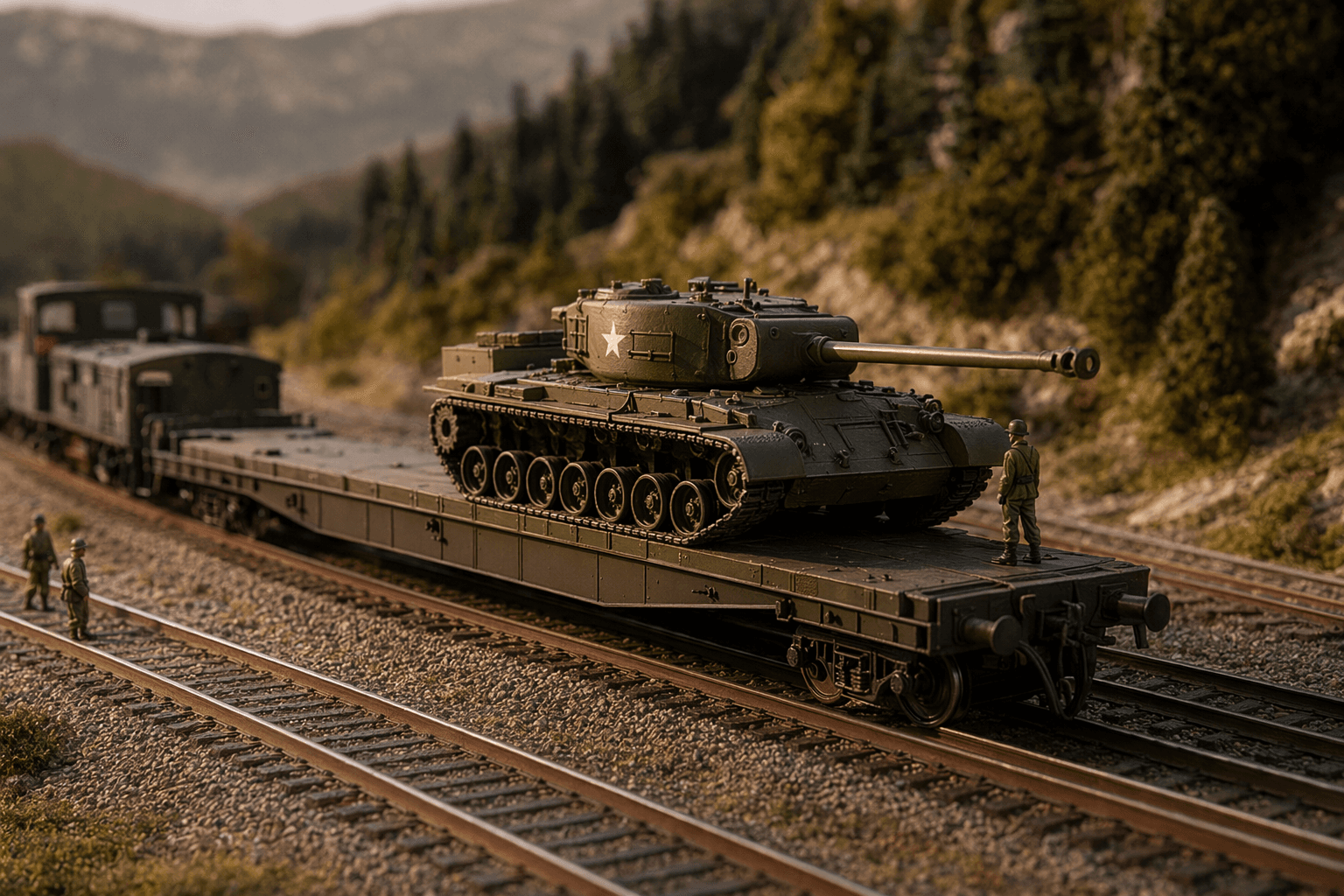
That is why this release stands out on a layout. It is not generic military hardware dressed up with olive drab paint. It represents a real transportation solution from an era when the U.S. Army still relied heavily on rail to move oversized armor and equipment.
Why the prototype mattered
The Magor fleet arrived between April and July 1953, right in the middle of the Korean War era, when the Army still treated railroad movement as a serious operational tool. The U.S. Army Transportation Corps has noted that the Korean War was the last conflict in which railroad battalions were deployed and the railroad in theater was supervised, which helps explain why purpose-built equipment like this flatcar existed at all.
The practical problem was simple: tanks got heavier. The Age of Steam Roundhouse ties these cars directly to the M48 Patton, explaining that more than 600 identical cars with six axles and twelve wheels were built to carry two tanks. That detail matters on a model railroad because it gives you a specific loading logic. This is not a flatcar for random machinery or a modern intermodal substitute. It is a Cold War military hauler that makes sense under a Patton, a bulldozer, a missile component, or a heavy support vehicle when you want the train to look grounded in real logistics.
What Rapido captured in HO
Rapido says its model was drawn from original blueprints, measurements, and 3D scans, and that level of care shows up where serious modelers look first: underneath. The prototype’s deep fish-belly side sills give the car a muscular profile, and the six-axle Buckeye truck sideframes make it look unlike the standard flatcars most layouts already have. That unusual structure is part of the appeal. It is the kind of car that catches the eye in a manifest, a military move, or a heavy-haul scene because it has visible purpose.
The company also points to a wood deck, a detailed underframe, non-cushion draft gear, and extensive brake rigging. Those are the details that separate a shelf piece from a true operating car. Flatcars often lose credibility beneath the deck, where simplified brake gear and generic truck arrangements can flatten the whole model. Here, the deck and underbody treatment are exactly what make the release feel like a serious answer to the prototype rather than a compromise.
Rapido’s own notes add useful dimensions to the story: the cars carried a 100-ton load and weighed about 36 tons empty. That combination helps explain the model’s visual heft. It is supposed to look substantial because the real thing was built for serious weight.
A prototype with documented real-world use
One of the strongest signs that this release has legs is that preserved examples still exist and confirm the numbers. The Pacific Southwest Railway Museum Association identifies DODX USAX #38128 as a Magor Car Corporation build from April 1953. The museum gives it a length of 54 feet, an empty weight of 71,000 pounds, a load-carrying capacity of 200,000 pounds, and a load limit of 259,000 pounds. It also notes six-wheel Buckeye-type trucks and Brenco roller bearings, along with the car’s later relettering from USAX #38128 to DODX #38128.
That kind of documentation matters because it gives modelers a reliable road map for spotting the car in photos and reproducing it accurately on the layout. It also reinforces why Rapido chose this prototype. The car was not obscure in service, but it has been underrepresented in plastic for years.
The fleet’s reporting marks changed over time as well. Rapido says the cars began receiving DODX markings around 1961, but the conversion was gradual and USAX-lettered cars were still in service as late as 1974. That creates a wide operating window for modelers. You can slot the car into early Cold War scenes, mid-career Army movements, or later service trains without stretching credibility.
How to use it on a layout
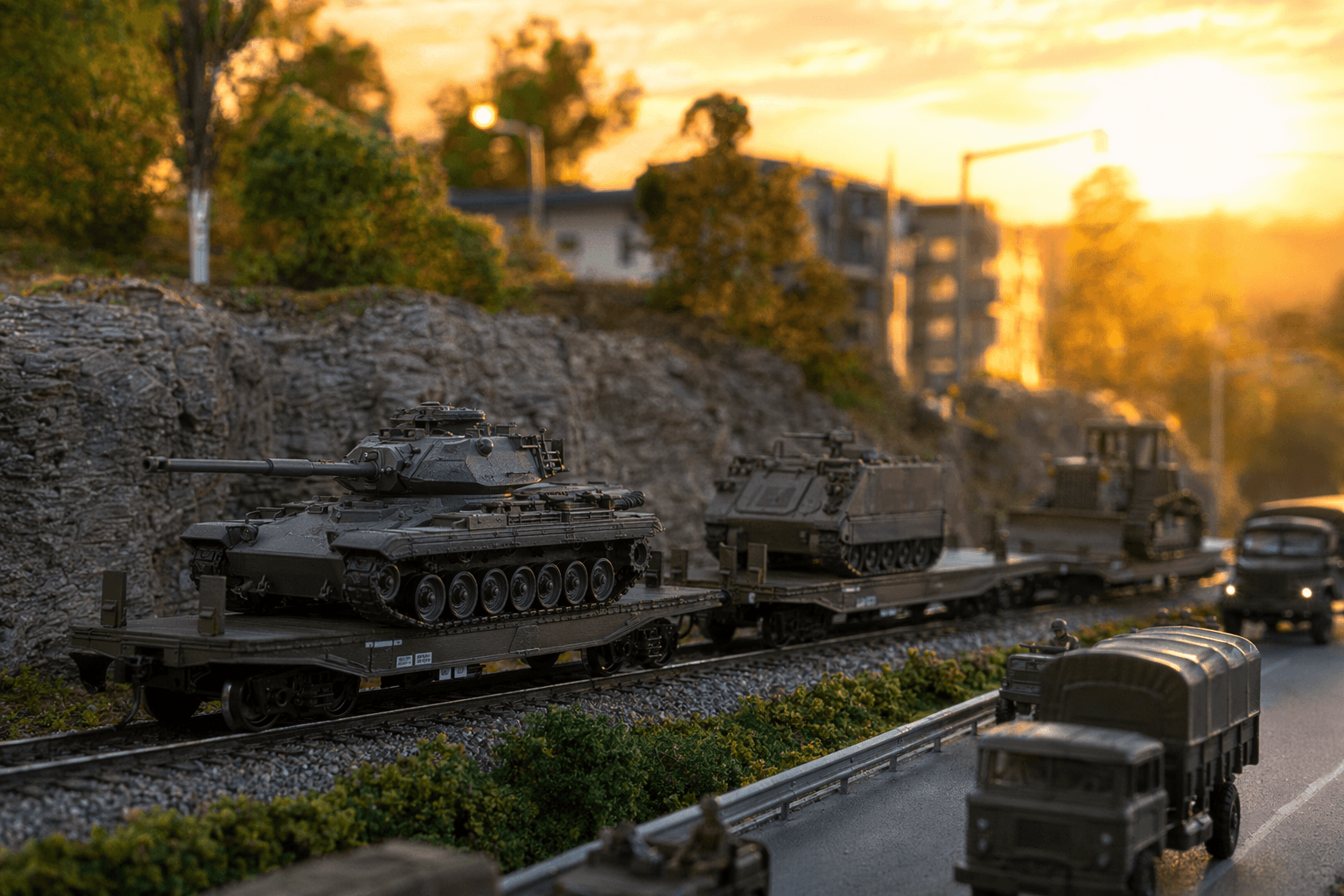
The best thing about the Magor flatcar is that it solves a visual and operational problem at the same time. A single car can anchor a military movement, add scale to a heavy-haul train, or break up a long string of otherwise repetitive freight. It also works well in industrial or transload settings where oversized equipment needs a believable carrier.
Practical layout uses include:
- Army equipment trains with tanks, trailers, or support gear
- Heavy-haul consists where a massive flatcar adds contrast and weight
- Industrial scenes with machinery or oversized components
- Transitional eras where USAX and DODX markings can both appear correctly
Because the prototype had a clearly defined mission, it naturally improves the realism of consists. A Magor flatcar behind a pair of tanks or mixed into a military movement says something specific about the era and the load. That is exactly the kind of detail that gives a freight train a story.
How it compares with older attempts
Modelers who remember the older AHM/Roco effort from the 1960s will know why this matters. That earlier model existed, but it suffered from Talgo-style trucks and other shortcomings. Rapido’s version is described as a complete re-do, and that is the right way to think about it. This is not a cosmetic refresh of an old compromise. It is a modern attempt to model a difficult prototype with the benefit of better tooling, better reference material, and better expectations from today’s HO crowd.
That difference will matter to collectors of U.S. Army equipment and to operators who want the right car at the right moment. A rare prototype can be interesting; a rare prototype that is also usable on a layout is what makes a purchase feel justified.
A rare model that actually broadens the fleet
Rapido’s Magor Army flatcar lands well because the history, the engineering, and the modeling utility line up cleanly. The prototype solved a real problem in the Korean War era, the surviving examples back up the dimensions and hardware, and the model itself aims squarely at the parts of a flatcar that most often get ignored. For HO modelers building believable military freight, this is not just a new release. It is the car that finally makes the scene feel complete.
This article was produced by Prism’s automated news system from verified source data, official records, and press releases, then run through automated quality and moderation checks before publishing. The system is built and supervised by the people who set the standards it runs under. Read our full AI policy.
Did this article answer your question?