Stout Auctions Founder Greg Stout on Building a Toy Train Empire
Greg Stout built America's top toy train auction house from a college habit, setting a world-record $253,000 sale and drawing worldwide bidders across 29,000 square feet.
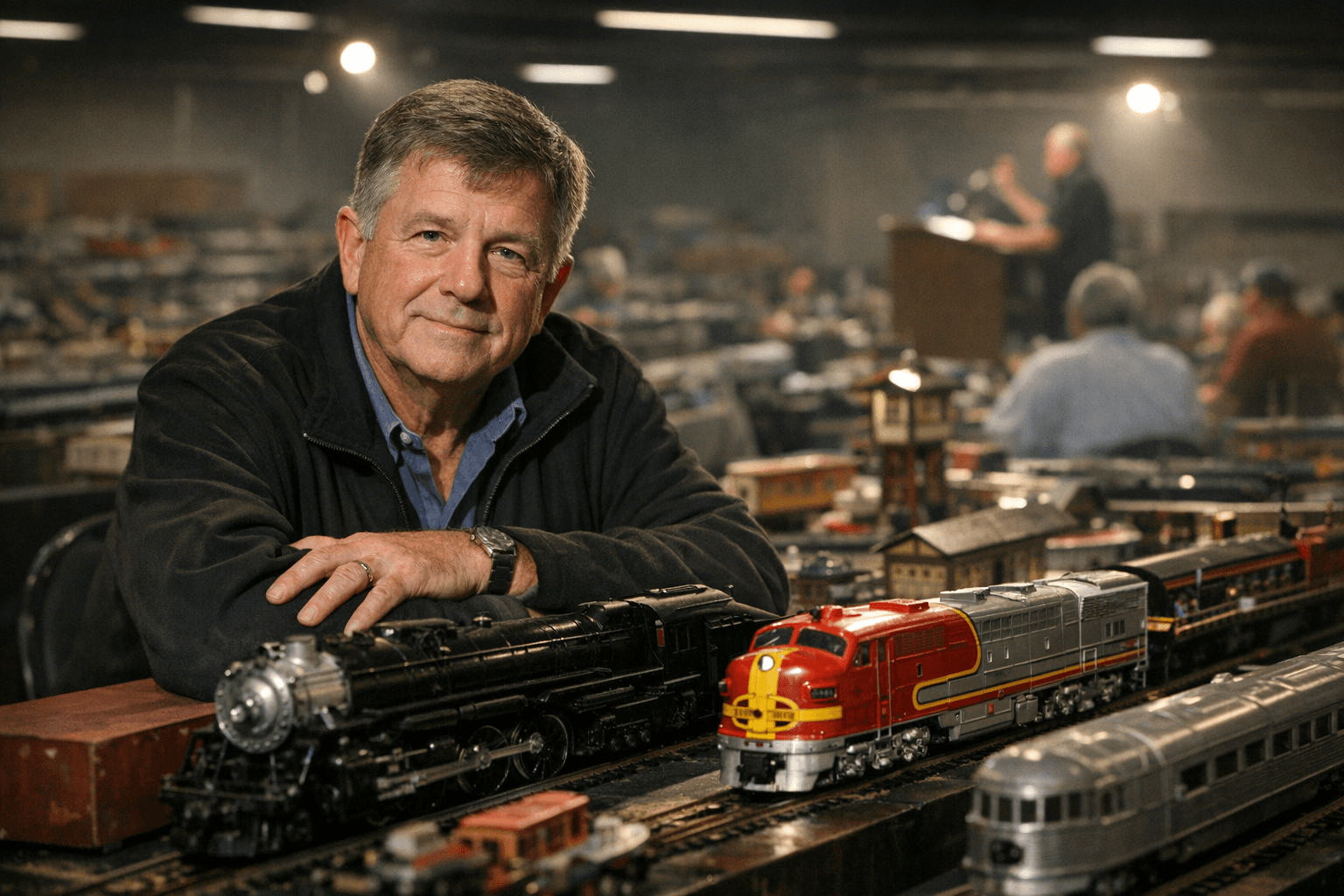
Stout Auctions holds the world record for the highest price ever paid for a single train set in a public auction: $253,000 for a Lionel standard-gauge passenger outfit cataloged across three years in the early 1930s, a set the manufacturer itself once called the finest steam train it ever produced. That number tells you something about the caliber of material that passes through Greg Stout's Indiana warehouse and the depth of the market he has cultivated since founding the company in 1993. In a long-format interview with Lucas Iverson for Trains.com, Stout traced the full arc from his college days buying and selling trains to the two-warehouse, international-bidder operation that Stout Auctions is today.
"Once It's in Your Blood"
Stout didn't start with a business plan. He started with what most collectors start with: a fixation. Buying trains in college, moving pieces on when the right deal appeared, gradually building expertise and relationships across the market. That informal apprenticeship hardened over time into a formal business, and 1993 marked the official founding of Stout Auctions. Thirty-plus years later, the company is recognized as the leading U.S. auction house for Lionel toy trains, American Flyer, Marx, and Ives, and also leads the field in G scale, HO brass, American Flyer S gauge, and Railroadiana.
"Once it's in your blood, it's in your blood," Stout told Iverson, and that phrase does a lot of work. It explains the persistence of specialist auction houses in a market where general-purpose platforms and online resellers compete for the same inventory. Stout Auctions isn't a generalist marketplace that happens to list trains; it was built by someone who spent his career inside the hobby and carries that knowledge into every lot.
Two Warehouses, One National Footprint
The physical infrastructure behind Stout Auctions is substantial. The Indiana operation is headquartered at 529 State Road 28 East in Williamsport, in a 29,000-square-foot facility purpose-built for the display, cataloging, and sale of toy trains. The layout includes dedicated areas for shipping, cataloging, and photographing collections; the space is climate-controlled and designed for the kind of high-volume, high-value throughput that large estate collections demand. A sister facility in West Middlesex, Pennsylvania handles additional volume and extends the company's reach to the East Coast, accessible by interstate or airport for consignors and in-person bidders alike.
Together, the two warehouses support both physical preview events and simultaneous online bidding. In-person buyers can inspect lots directly before a sale; registered online participants from multiple countries bid in real time against the room. At one recorded auction, more than 1,900 online bidders signed in from across the globe, a figure that illustrates how far a well-run specialist sale can reach when the underlying catalog is strong enough.
The Full-Service Consignment Model
One of the most practically useful passages in the Trains.com interview is Stout's explanation of how collections move through his operation. For owners who want a completely hands-off process, Stout Auctions offers turnkey estate handling: intake, transport, cataloging, photography, condition assessment, marketing, and sale. Collectors who don't need the full package can engage the company at whichever point suits their situation and their level of involvement.
That flexibility matters because no two collections are the same. A modest accumulation of postwar Lionel from a single owner is a very different intake project than a multi-room estate with prewar tinplate, brass imports, and decades of paper ephemera. Stout's team has the experience to handle both ends of that spectrum. Consignor education is part of the service: Stout explained that helping sellers understand realistic market valuations is a core part of what his company provides, managing expectations before the auction rather than after the hammer falls.
The Global Flow of Trains
The international dimension of Stout Auctions is one of the more counterintuitive aspects of the business. Brass models and fine scale equipment manufactured overseas attract disproportionate interest from international buyers, including collectors in the very countries where those models were originally produced. Items built in Japan or Europe enter American collections, cycle through the secondary market for years or decades, and eventually find their way back to buyers closer to their points of origin. Stout addressed this directly in the interview, framing it as a natural expression of a genuinely global collector market rather than an anomaly.
For consignors, that international bidder pool is a concrete advantage. A niche item with limited North American demand might find a highly motivated buyer in Germany, Australia, or Japan. Stout Auctions ships worldwide and has the logistics infrastructure to handle the customs, packaging, and documentation that cross-border transactions require.
Reading the Terms and Conditions
One area Stout covered that rarely gets enough attention in hobby coverage is the contractual reality of auction participation. A bid at a Stout sale is a legal commitment; winning bidders are bound by the Terms and Conditions of the sale, and settlement is not optional. Stout walked through these mechanics in the interview as part of what both buyers and sellers should understand before engaging with any auction house, reputable or otherwise.
For collectors who have grown up with casual online buying and easy returns, that's a genuine shift in expectations. The auction format provides access to rare, out-of-production, and otherwise unavailable pieces, but it operates under different rules than a retail transaction. Reading the T&C before bidding isn't perfunctory; it's how you avoid an expensive misunderstanding on a piece that might be worth thousands.
The Market Mechanism the Hobby Depends On
Vintage rolling stock, prewar tinplate, rare tooling from manufacturers that no longer exist: none of that can be ordered from a catalog. For club treasurers stocking a layout, new collectors building their first serious acquisition, and experienced operators chasing hard-to-find pieces, specialist auctions are one of the few mechanisms that reliably move those items from estate holdings into active collections, at prices set by an informed market rather than guesswork.
Stout Auctions has been running that mechanism since 1993, and the record prices it has achieved, from a $77,000 Lionel Hudson to the $253,000 standard-gauge landmark, reflect a genuine and durable demand. Greg Stout built the business from a college habit. The trains are still moving.
This article was produced by Prism’s automated news system from verified source data, official records, and press releases, then run through automated quality and moderation checks before publishing. The system is built and supervised by the people who set the standards it runs under. Read our full AI policy.
Did this article answer your question?