Global fungal map reveals vast underground networks beneath grasslands
The new fungal map puts grasslands at the center of the underground world, where the mycelium behind prized mushrooms runs deeper than most foragers imagine.

Grasslands, not rainforests, are emerging as the planet’s hidden fungal strongholds. The new global map of arbuscular mycorrhizal fungi shows that the mushrooms you find above ground are only the visible fruiting bodies of a vast system working below your boots, moving nutrients, carbon, and water through soil.
What the map actually measures
The study, published in Science on June 11, 2026, focuses on arbuscular mycorrhizal fungi, or AM fungi, the symbiotic partners of most plants on Earth. Researchers estimate about 110 quadrillion kilometers of these fungal filaments in topsoil worldwide, a number so large it is easier to feel in the field than to picture on paper.
The team built the map from more than 16,000 soil samples gathered at over 4,000 locations, then combined that field data with machine-learning and geospatial modeling plus environmental variables to fill in the gaps across the planet. SPUN released an interactive visualization alongside the paper, giving the public a way to see hyphal density instead of just reading about it.
The scale matters because these networks are not a new ecological footnote. The Science paper says AM fungi and land plants form one of the most widespread and ancient mutualistic partnerships on Earth, one that has shaped global vegetation structure and biogeochemical cycles for more than 450 million years. Coverage of the study adds another striking frame: the global AM fungal network may contain carbon equivalent to about five times the mass of all living humans combined.
Why grasslands should change how you read a patch of ground
One of the most important takeaways for mushroom hunters is where the densest networks showed up. The biggest concentrations were found beneath wild grasslands, not in the dramatic rainforest settings many people might guess first. That matters because it reminds you that productive habitat is not just about what grows above the soil, but about the living infrastructure below it.
AM fungi trade resources with roots, so a patch that looks ordinary from the surface can be a bustling exchange zone underneath. Healthy soil, stable moisture, intact plant communities, and undisturbed root systems all help that exchange continue. In practical foraging terms, that means the best-looking fruiting spots are often the ones that have been least disrupted, where the fungal web still has a strong reason to push mushrooms up through litter and duff.
Disturbed woods often produce differently for that reason. Compaction, heavy disturbance, and repeated soil damage do not just change the surface pattern you walk through, they alter the underground network that decides where fungi can spend energy on fruiting. When the mycelium is intact, the cap you harvest is only a brief above-ground event in a much larger cycle of nutrient flow.
How the new map changes the foraging conversation
Earlier global work on fungal diversity was built on far thinner sampling. One major study relied on 1,014 plant-root samples worldwide, and later global diversity work used more than 4,000 topsoil samples across all continents. The new map expands that baseline dramatically, turning scattered local evidence into a worldwide picture with named hotspots, threat zones, and conservation value.
That shift matters because the map is not just a scientific trophy. The authors designed it to help scientists and policymakers identify where underground fungal networks are thriving and where they are threatened, especially in ecosystems that have been undersampled. For foragers, that means the map can sharpen your sense of which landscapes deserve caution, which need patience, and which are likely to reward careful observation over brute-force searching.
It also helps explain why the same species can behave so differently from one forest to another. A site with strong fungal networks, steady tree health, and intact soil moisture can flush more reliably than a nearby stand that has been logged, compacted, or repeatedly disturbed. The fruiting body is the giveaway; the network underneath is the reason it appears at all.
What Oregon foragers should know
Southern Oregon still stands out as a serious mushroom country, and the list is familiar to anyone who has walked those woods in season: matsutake, porcini, coral mushrooms, porcupine mushrooms, morels, golden chanterelles, and more. The Rogue River-Siskiyou National Forest’s mushroom page says American matsutake are most abundant in Washington, Oregon, and Northern California, which places the region squarely inside one of the country’s most important matsutake zones.
That same Forest Service guidance also puts hard rules around harvest. A permit is required before removing any amount of American matsutake on that forest, and the forest’s permit page was updated June 12, 2026. Oregon’s Department of Forestry likewise says permits are required in some districts for special forest products such as mushrooms, including both personal and commercial use depending on volume.
There is also an economic reality behind the mushroom pull. The Rogue River-Siskiyou guidance says 90% of commercial American matsutake are exported to international markets, primarily Japan. That makes the stakes larger than one basket or one campfire meal, because the same forest floor that feeds recreational hunters also supports a commercial system with real value attached to each fruiting flush.
Harvest in a way that protects the system
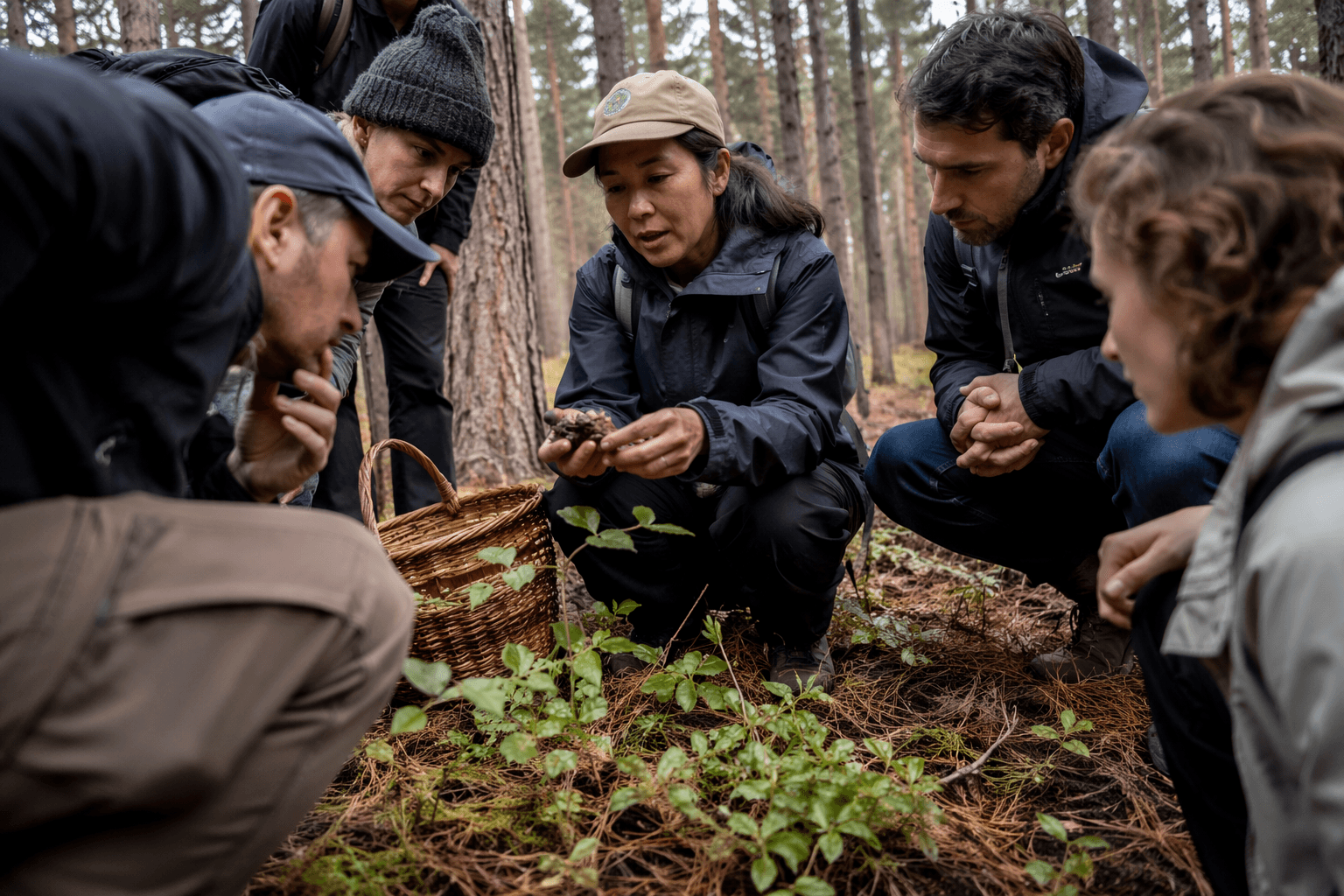
The clearest rule from the science and the field guidance is simple: take the mushroom, protect the network. The Forest Service says responsible collection means harvesting only the fruiting body and avoiding damage to the mycelium beneath the soil, which is exactly the infrastructure this new map is trying to make visible.
- Cut or lift cleanly without tearing up the surrounding soil.
- Keep an eye on wildlife use in the area.
- Avoid spreading forest diseases such as Sudden Oak Death and Port-Orford-cedar root disease.
A few practical habits keep that promise intact:
That last point matters because mushrooms do not exist in isolation. A healthy site is a balance of roots, soil, moisture, and host plants, and once disease moves through that system, the odds of future flushes change with it.
The new global map makes the underground world harder to ignore, and that is good news for anyone who forages with more than a knife and a basket. The grassland surprise is the reminder to take nothing above ground at face value: where a mushroom appears, there is already a much larger system at work below it.
This article was produced by Prism’s automated news system from verified source data, official records, and press releases, then run through automated quality and moderation checks before publishing. The system is built and supervised by the people who set the standards it runs under. Read our full AI policy.
Did this article answer your question?