4-metre Godzilla robot deployed at ITER to validate tokamak assembly tools
A 4-metre robot nicknamed Godzilla has been installed in ITER’s Tokamak Assembly Preparation Building to validate more than 30 specialized tools ahead of in‑vessel assembly.
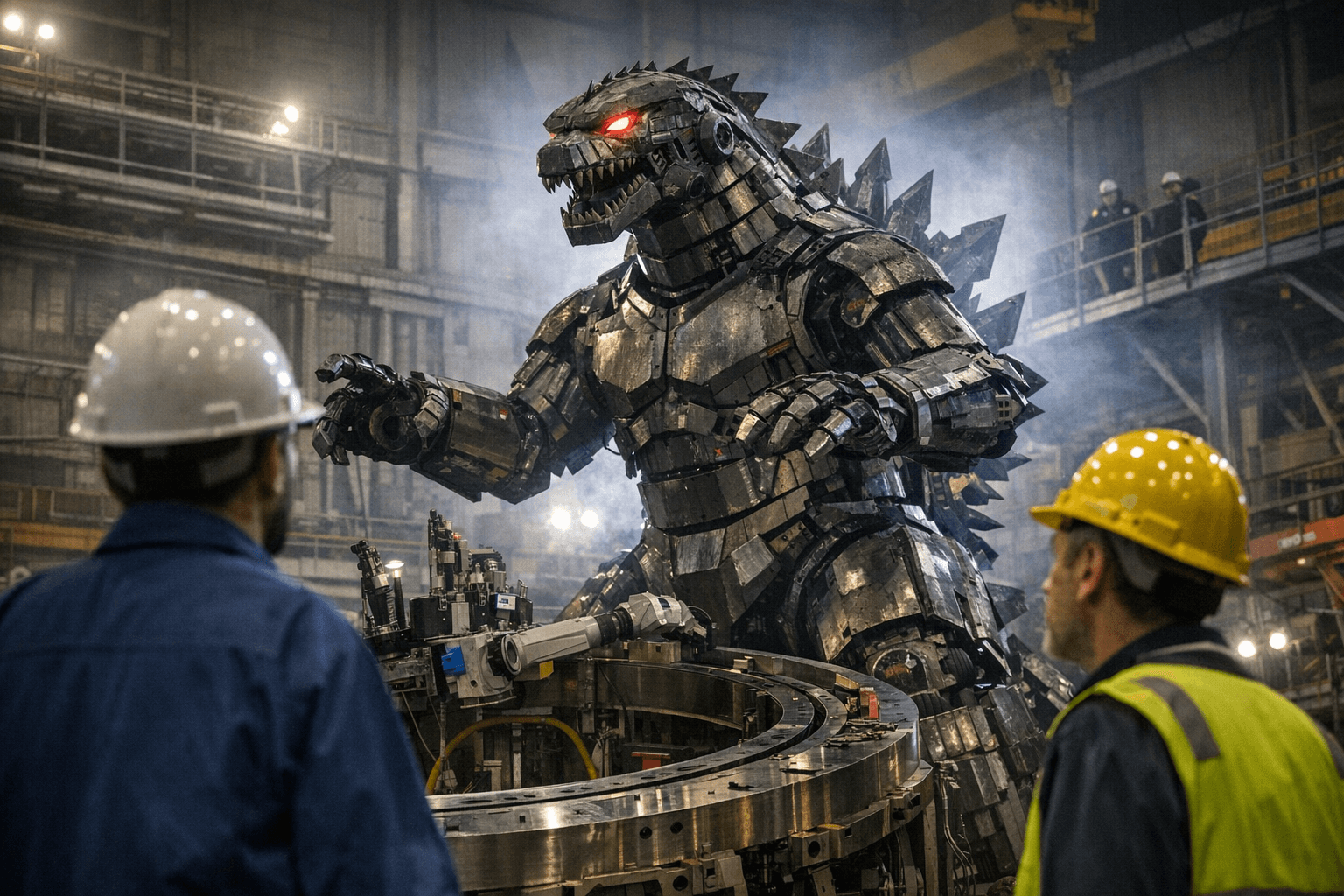
A 4-metre-tall industrial robot nicknamed Godzilla has been installed in the basement of ITER’s Tokamak Assembly Preparation Building in southern France to act as a mobile testbed for the tools that will assemble the tokamak vacuum vessel. The platform stands roughly 4 metres tall, has an arm reach of about 5 metres, and will host validation work on handling, bolting, welding, inspection and cutting devices needed for in-vessel assembly.
ITER’s own release describes Godzilla as “capable of lifting and moving loads of up to 2.3 tonnes.” Some press and social posts reported a 2.5 tonne capacity instead, and several outlets described Godzilla as the most powerful industrial robot currently available on the market. ITER’s materials and outside coverage also note that Godzilla is not intended to mount the heaviest in-vessel parts, with some reports indicating those components exceed 4 tonnes and others specifying weights above 4.4 tonnes.
The primary mission for Godzilla is tool development, integration and validation. ITER and other coverage say more than 30 distinct tool types will be needed for in-vessel work, and a partial prototype of a “tool changer” is already being exercised on the platform. As ITER described that capability, “a partial prototype of a ‘tool changer,’ which, as its name indicates, will enable assembly robots to quickly and safely switch from one tool to another in accordance with work sequences.”
Perception upgrades and force control are central to the program. Raphaël Hery, an expert in remote handling and robotics quoted in project materials, said: “In the restricted and densely packed environment the assembly robots will be operating in, the sense of sight and touch will be essential to ensuring precise and secure movement that does not damage the vacuum vessel or nearby components.” Final in-vessel robots will pair vision systems from Fusion for Energy with force and torque sensing to deliver that sight and touch.
Testing on Godzilla is scheduled to start in March, when ITER teams plan to run tools on mockups and representative interfaces before integration into dedicated in-vessel manipulators. The validation path runs from Godzilla to the bespoke robots that will work inside the plasma chamber; ITER notes tools developed in-house or by the Japanese Domestic Agency will follow that route.
Godzilla sits amid a much larger logistics program. ITER describes a blanket assembly transporter of roughly 36 tonnes currently in detailed design, to be fabricated by Larsen & Toubro Ltd in India, while some outlets reported a 39 tonne figure. An in-vessel tower crane produced and delivered by CNIM will be adapted and optimized for in-vessel use. Coverage also points to the scale of the assembly campaign: roughly 20,000 components to install inside the vacuum vessel and an assembly tempo that some social posts estimate at 24 hours a day, six days a week for about two years.
ITER’s overall milestones remain ambitious: full magnetic energy is targeted by 2036 and deuterium-tritium operations by 2039. Godzilla’s task is narrowly practical - validate the toolset and control schemes so the rolling waves assembly plan can proceed with lower risk and higher throughput.
This article was produced by Prism’s automated news system from verified source data, official records, and press releases, then run through automated quality and moderation checks before publishing. The system is built and supervised by the people who set the standards it runs under. Read our full AI policy.
Did this article answer your question?