AI Framework Links Neutron Star Observations to Nuclear Force Constraints
An AI framework built by Los Alamos and TU Darmstadt turns neutron star merger data into near-instant nuclear force constraints that once took thousands of CPU cores hours to compute.
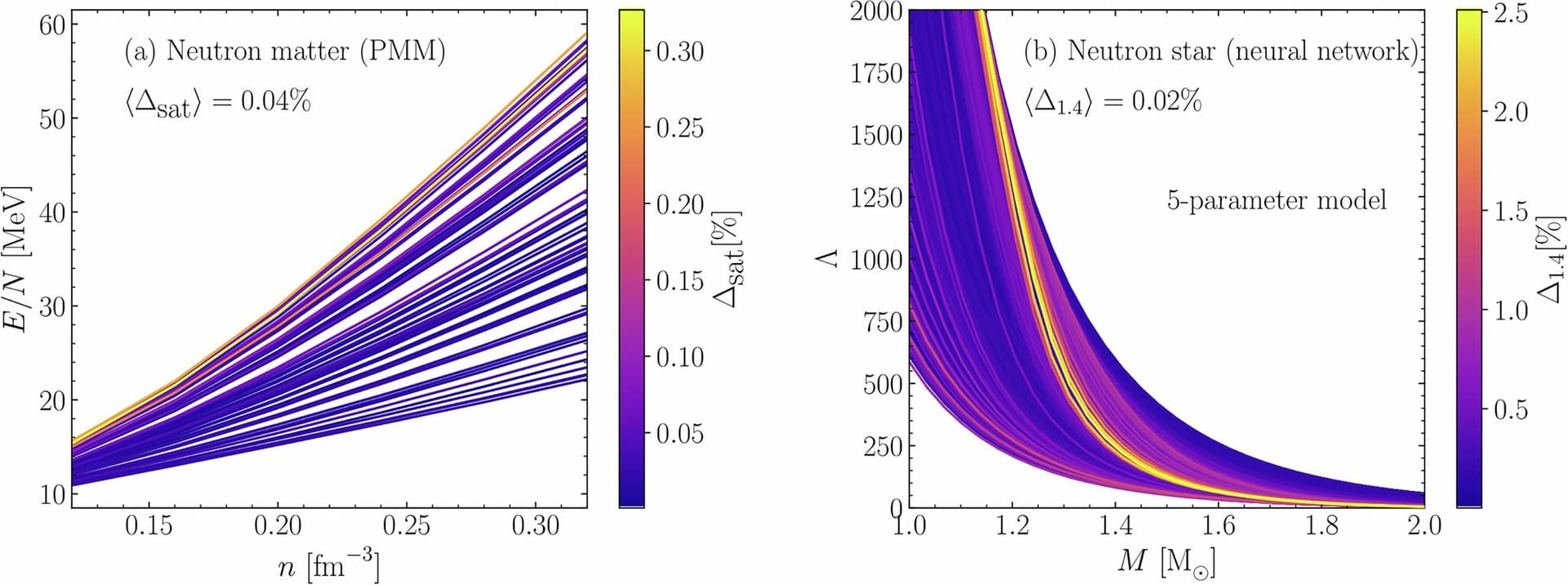
Getting from a neutron star collision to a constraint on the strong nuclear force used to mean running computationally brutal models for hours across thousands of CPU cores, and even then only for a single set of interaction parameters. A multi-institution team led by researchers at Los Alamos National Laboratory and the Technical University of Darmstadt has now built a machine-learning framework that does the same mapping almost instantaneously, opening a direct channel between astrophysical observation and nuclear physics.
The team fed the AI framework two categories of observational data: measurements from the 2017 detection of gravitational waves produced by a binary neutron star merger, and X-ray emission data from a telescope dedicated to studying neutron stars. From those inputs, the framework derives constraints on nuclear couplings, the parameters that encode the strength of forces between neutrons and protons packed together at the extreme densities inside a neutron star.
"Our approach opens a new window into the strong-force physics of neutrons and protons and its effects on neutron stars," said Isak Svensson, scientist at the Technical University of Darmstadt and a co-lead author. "Our framework allows us to go from neutron star observations to the interactions in dense matter."
The computational motivation behind building the framework is straightforward: applying many models of interacting neutrons to neutron-star conditions would be "computationally intractable" under conventional methods. The AI sidesteps that wall entirely, connecting nuclear interaction parameters to neutron-star properties in what the team describes as near-instantaneous fashion.
Rahul Somasundaram, a Los Alamos scientist and co-lead author alongside Svensson, said the results exceeded internal expectations. "The tools we developed performed remarkably well, much better than we anticipated," he said. For present-day observational data, the framework's output lands in familiar territory: "For astrophysical data from recent events, our framework offers constraints that are consistent with what we know from terrestrial experiments, albeit with larger uncertainties."
That caveat about larger uncertainties is partly a function of current detector sensitivity rather than a flaw in the AI approach itself. Somasundaram pointed toward next-generation gravitational-wave observatories as the real test case: "For future observations by next-generation detectors, such as Cosmic Explorer, our approach will provide even better constraints that will be really powerful."
Cosmic Explorer, a proposed successor to current interferometers, would dramatically increase the volume of detectable neutron star mergers and the precision of individual measurements, giving the framework far richer input data to work from. The Los Alamos and TU Darmstadt team has positioned their AI infrastructure to be ready when that data arrives, having already demonstrated that the architecture holds up against what terrestrial nuclear experiments independently tell us about the strong force. The bridge between the cosmos and the nucleus, long theoretical, now runs on a trained model.
This article was produced by Prism’s automated news system from verified source data, official records, and press releases, then run through automated quality and moderation checks before publishing. The system is built and supervised by the people who set the standards it runs under. Read our full AI policy.
Did this article answer your question?