BARC Finds Thorium Fuel Concept Incompatible with India's Three-Stage Nuclear Programme
BARC's K.P. Singh finds HALEU-thorium fuel causes a 26% drop in shutdown rod effectiveness in India's 220 MWe PHWRs, killing the "drop-in" pitch.
A new scientific assessment by researchers at the Bhabha Atomic Research Centre has raised serious technical and strategic concerns about a proposal to introduce a U.S.-developed thorium-based fuel blend into India's existing nuclear power reactors, concluding that the HALEU-thorium combination cannot be directly used in India's Pressurized Heavy Water Reactors without significant design changes. The finding cuts straight at one of the fuel's central selling points: developers had presented it as a potential "drop-in" replacement for the natural uranium currently used in Indian PHWRs, suggesting it could allow earlier utilization of thorium while improving fuel efficiency and reducing spent nuclear fuel volumes.
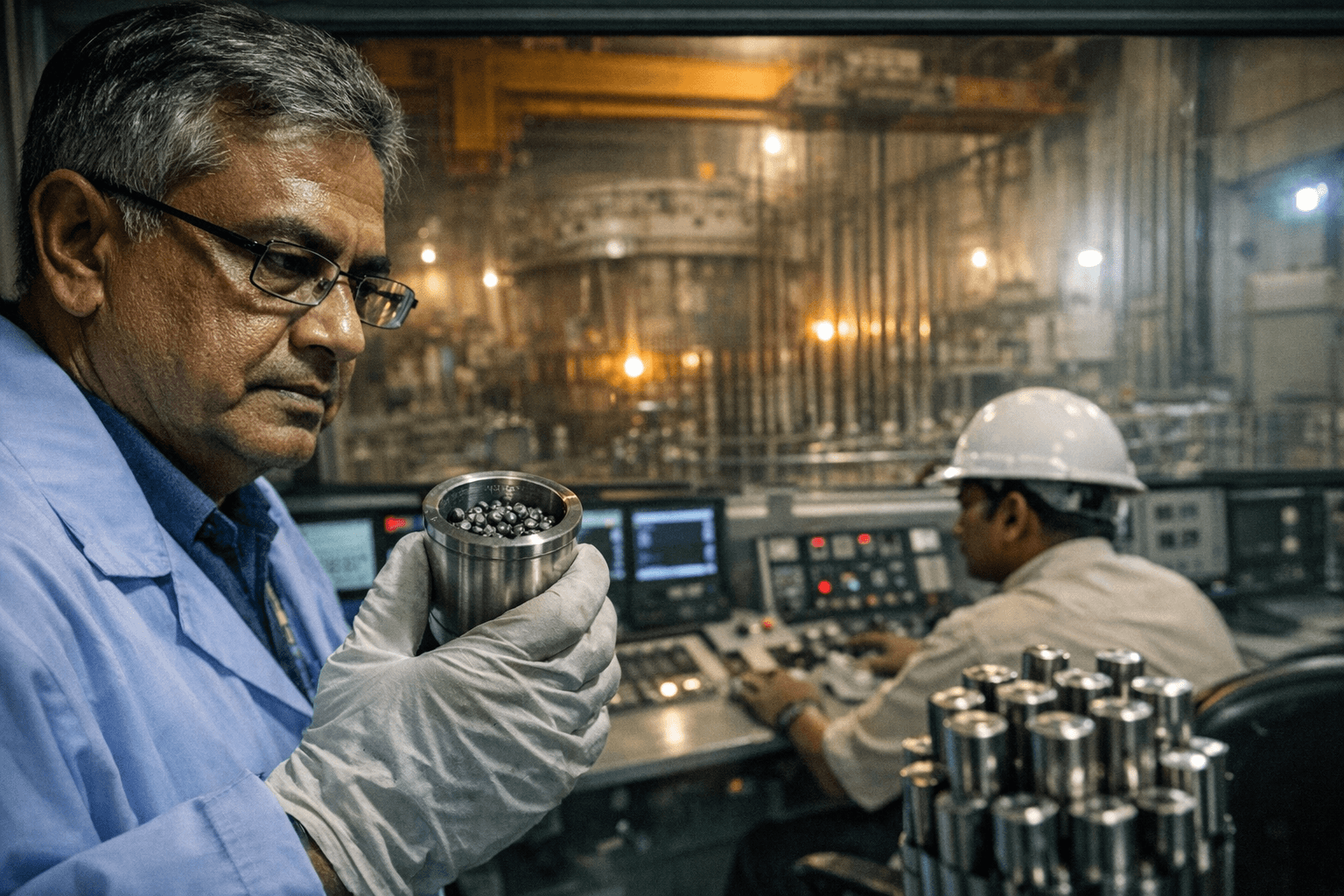
The detailed performance evaluation was carried out by K.P. Singh and associates, scientists at the Reactor Research Division of BARC, with results published in the journal Current Science. The study evaluates the performance of a HALEU-thorium fuel mixture intended for India's standard 220 MWe PHWR reactors, which form a major part of the country's nuclear power fleet. The specific fuel variant under scrutiny is ANEEL, Advanced Nuclear Energy for Enriched Life, a commercial version developed by U.S.-based company Clean Core Thorium Energy (CCTE).
The simulation methodology was thorough. Most prior fuel cycle studies toward thorium utilization in PHWRs had been limited to cluster-level analysis; this work took earlier studies to the next level through comprehensive cluster-level optimization along with inclusive core-level analysis with regard to HALEU-thorium fuel. Using advanced Monte Carlo and deterministic codes, the team compared natural uranium, slightly enriched uranium at 1.1% U-235, and HALEU-thorium at 19.75% U-235 across reactivity coefficients, burnup, plutonium yield, and shutdown margins.
The shutdown margin result is the number that should get attention in every control room in India's PHWR fleet. BARC scientists found the fuel could reduce the effectiveness of shutdown rods by 26%, requiring structural modifications to reactors. Analysis of design and operational aspects, including fuel bundle design and configuration, feasibility of on-power refueling with the present fuel handling system in PHWRs, existing reactivity control and shutdown systems, fuel loading patterns, and in-core fuel management, shows that only a moderate increase in burnup from the natural uranium fuel cycle with slightly enriched uranium fuels, with discharge burnup of about 20 GWd/t, can be accommodated.
The strategic incompatibility goes deeper than hardware. While thorium-based fuels remain central to India's long-term nuclear strategy, the specific HALEU-thorium configuration is not compatible with current PHWR designs without significant modifications and could affect the fuel cycle structure underlying the country's three-stage nuclear programme. That programme, planned by physicist Homi Bhabha in the 1950s to secure the country's long-term energy independence, is built on a precise sequencing logic: Indian nuclear energy grows to about 10 GW through PHWRs fueled by domestic uranium, then above that through Fast Breeder Reactors until about 50 GW, after which the third stage, using thorium as fuel, can be brought online only once that capacity has been achieved.
The issue is not India's commitment to thorium. It is whether HALEU-thorium shortcuts the process in a way that undermines the architecture. India holds only around 1-2% of global uranium reserves but one of the largest shares of global thorium reserves, at about 25% of the world's known thorium deposits, which is precisely why any fuel strategy that disrupts the pathway to Stage III breeder reactors carries real strategic weight. BARC had the highest number of publications in the thorium area across all research institutions in the world during the period 1982-2004, during which India ranked second overall behind the United States in thorium research output.
The corporate momentum behind ANEEL had been building before this study landed. Following the first successful test run with the fuel in 2024, which demonstrated the physical integrity of HALEU-thorium fuel pins at a burnup of 25 GWd/t, Larsen and Toubro and NTPC signed MoUs with CCTE, L&T in October 2024 and NTPC in December 2024. NTPC, the country's largest power generation company, had explored potential collaboration with CCTE for possible deployment in domestic reactors, subject to approval by the Government of India and the Department of Atomic Energy.
BARC scientists also calculated that producing HALEU at 19.75% enrichment would increase the total amount of mined natural uranium required per unit of energy generated when compared with India's current natural uranium fuel cycle. Though spent nuclear fuel from HALEU-thorium is only a seventh of that from natural uranium, the high radioactivity and decay heat of the former means one must contend with the problem of interim and long-term storage or disposal, an issue absent in the natural-uranium-based closed cycle strategy for thorium utilization, where spent fuel is reprocessed and recycled.
Siegfried Hecker, former director of Los Alamos National Laboratory from 1986 to 1997, once assessed that "India has the most technically ambitious and innovative nuclear energy programme in the world." The K.P. Singh team's willingness to publish a systematic core-level rejection of a heavily promoted foreign fuel concept, backed by Monte Carlo simulation rather than political posture, is consistent with that reputation. Whether NTPC and L&T revisit their CCTE agreements in light of the Current Science findings is now the open question.
This article was produced by Prism’s automated news system from verified source data, official records, and press releases, then run through automated quality and moderation checks before publishing. The system is built and supervised by the people who set the standards it runs under. Read our full AI policy.
Did this article answer your question?