China installs reactor vessel at Zhangzhou 3, advancing Hualong One build
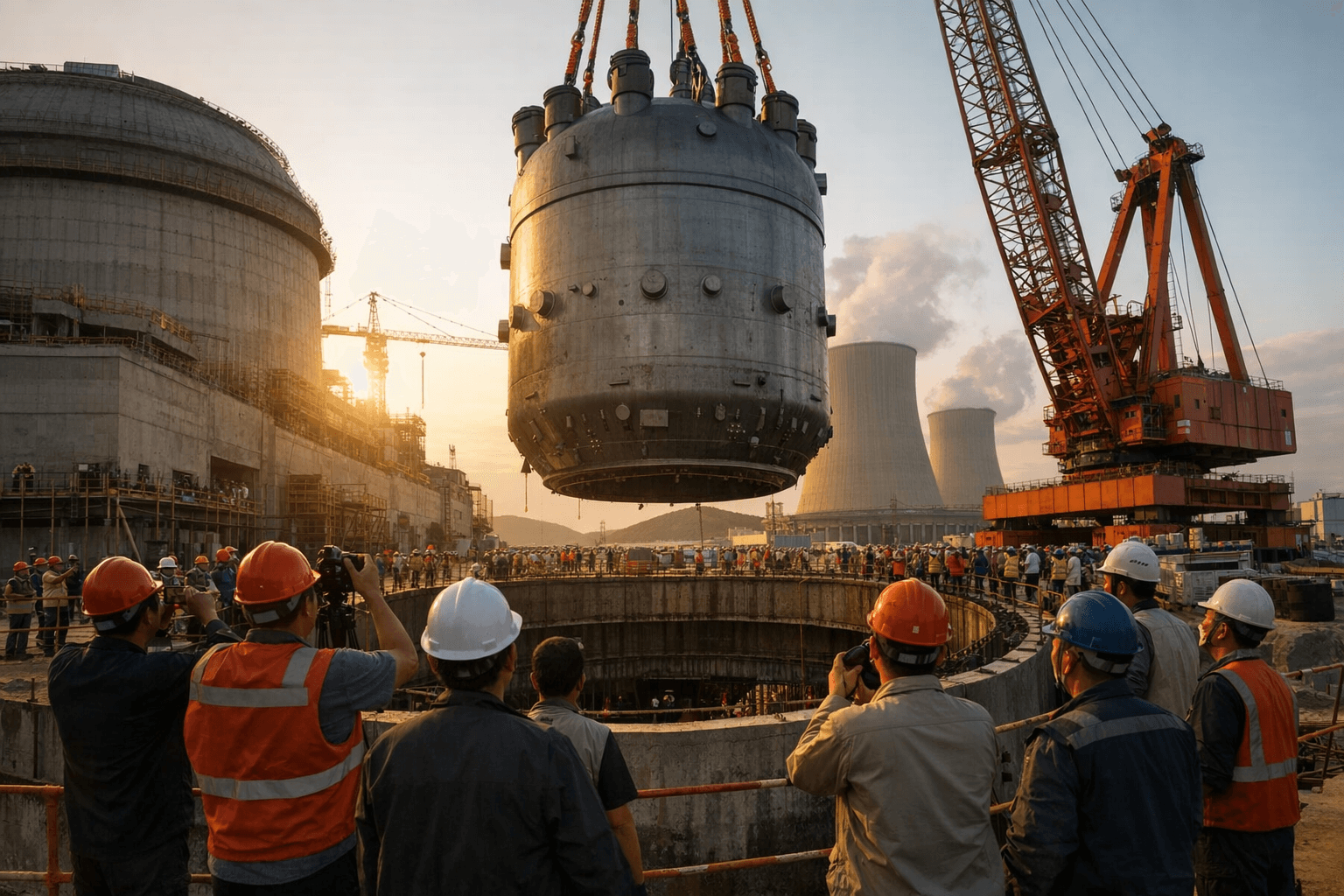
A 316-ton reactor vessel is now in place at Zhangzhou 3, pushing China’s biggest Hualong One base deeper into serial-build territory. Main pipeline welding comes next.
_71848.jpg&w=1920&q=75)
A 316-ton reactor pressure vessel is now in place at Zhangzhou 3, pushing China’s biggest Hualong One base in Fujian province into the next stretch of construction. The lift matters because the vessel is the heart of the unit, the steel cylinder that will hold the reactor core and internals, support and stabilize the core, carry the coolant flow path and guide control rod movement.
China National Nuclear Corporation said the installation on April 23 marked another clean handoff from heavy lifting to fit-out work at the Zhangzhou site in Lieyu Town, Yunxiao County. The next major step is main pipeline welding, which follows a run of major equipment placements that has already moved the project well beyond foundational civil works. The third and final steam generator for unit 3 was hoisted into position on January 26, and the inner safety dome went in during February, confirming that the unit has entered the equipment installation phase.
Zhangzhou 3 is the third of six Hualong One units planned for the site, which is being built in three phases of two reactors each by CNNC-Guodian Zhangzhou Energy Company, the joint venture between China National Nuclear Corporation and China Guodian Corporation. The Ministry of Ecology and Environment issued construction licences for units 1 and 2 in 2019. Unit 1 began construction in October 2019 and unit 2 followed in September 2020. The State Council approved the next two Hualong One units as Phase II in September 2022, then first concrete for unit 3’s nuclear island was poured on February 22, 2024, with unit 4 starting in September 2024.
That sequence is what makes Zhangzhou important beyond Fujian. Unit 1 entered commercial operation on January 1, 2025, and unit 2 followed on January 1, 2026, giving China a fresh example of how repeat builds can move from licence to steel, from concrete to commissioning, with less friction on each step. CNNC said Zhangzhou-1 had already generated 10.2 billion kilowatt-hours of electricity by mid-January 2026, while its operating reactor count rose to 26 and installed capacity to 24.962 GWe.
The broader pay-off is scale. CNNC says a fully completed six-unit Zhangzhou plant could produce more than 60 billion kilowatt-hours of clean electricity a year, enough to meet about 75% of the electricity demand of Xiamen and Zhangzhou in southern Fujian. A single Hualong One unit is also credited with producing more than 10 billion kilowatt-hours annually, while cutting standard coal consumption by 3.12 million tonnes and carbon dioxide emissions by 8.16 million tonnes. In a global market where many projects still stumble over cost and schedule, Zhangzhou is showing how standardization, supply-chain depth and repetition can keep a build moving, one major lift at a time.
This article was produced by Prism’s automated news system from verified source data, official records, and press releases, then run through automated quality and moderation checks before publishing. The system is built and supervised by the people who set the standards it runs under. Read our full AI policy.
Did this article answer your question?


