COHERENT posts 2026 update on CEvNS status, datasets, plans at SNS
COHERENT posted a 2026 update outlining released CsI and LAr CEvNS datasets, detector status, and near-term plans for experiments sited at ORNL’s Spallation Neutron Source.
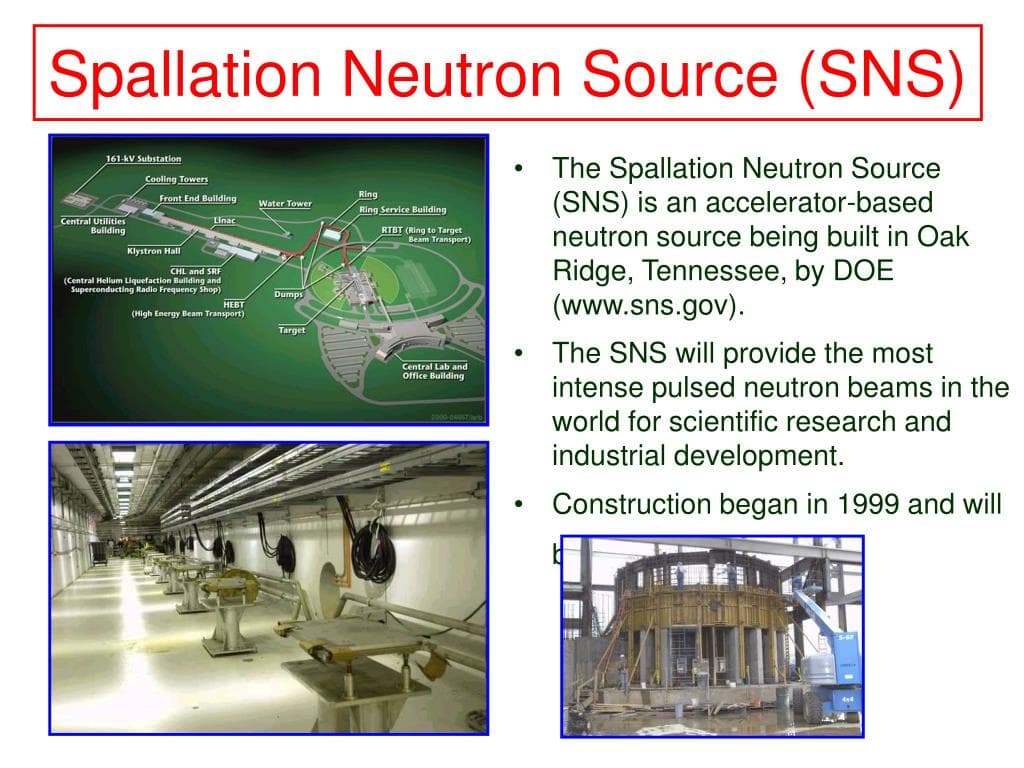
COHERENT posted a 2026 update summarizing the experiment’s status, datasets, and near-term plans for its CEvNS program at the Spallation Neutron Source (SNS) at Oak Ridge National Laboratory. "INTRODUCTION This document was first prepared in response to a request from the Neutrinos & Cosmic Messengers section of the Update of the European Strategy for Particle Physics and then updated at the beginning of 2026," the collaboration notes in the update.
The history and measurement record appear prominently in the document: "The first detection of CEvNS was achieved at the SNS in 2017 by the COHERENT collaboration with CsI scintillating crystals at room temperature." COHERENT later "subsequently detected CEvNS on two more targets with a single-phase liquid argon detector and high-purity germanium spectrometers (HPGe)." The collaboration confirms data releases: "The COHERENT collaboration has released the data from the CsI [63, 64] and LAr CEvNS results."
The SNS facility and neutrino source are central to the update. "The COHERENT experiment is sited at the Spallation Neutron Source (SNS) of Oak Ridge National Laboratory (ORNL) in Tennessee, USA," the document states, and it highlights the SNS neutrino production: "The SNS provides a pulsed beam of stopped-pion neutrinos, as detailed in Section III." Annual Reviews language reproduced in the update frames the beam as an experimental asset: "The Spallation Neutron Source (SNS) at Oak Ridge National Laboratory provides an intense, high-quality source of neutrinos from pion decay at rest."
COHERENT positions its CEvNS program in the broader neutrino and astrophysics context by quoting specific science drivers. "Because CEvNS is flavor-blind to a good approximation, it enables a complete estimate of all emitted neutrinos, while multi-kilotonne-scale experiments such as DUNE, Hyper-K, and JUNO will be primar-ily sensitive to only the νe and ¯ νe flavor components of the supernova flux." The update adds that "Cross-section measurements at SNS will vastly improve the interpretation of supernova neutrinos in large-scale experiments using the well-understood “artificial supernova” stopped-pion source at the SNS." It also notes detector reach: "Additionally, COHER-ENT’s tonne-scale detectors can also directly observe nearby supernovae with O(10) events expected from a core-collapse supernovae at 10 kpc."
Technical status and community activity in Neutrino Alley figure in the document and supporting conference records. Indico Global listings preserved in the update reference a suite of detector efforts, including "Status of the COHERENT NaI[Tl] Detector" (Contribution ID: 62), a poster "Differential measurement of coherent-elastic neutrino-nucleus scattering using isotopically enriched Ge detectors" (Contribution ID: 65), and "A D2O detector for COHERENT" (Contribution ID: 71). Presenters and authors named in those records include Mr AWE, Connor (Duke University); RICH, Grayson (University of Chicago); Dr XU, Jingke (Lawrence Livermore National Laboratory); DENT, James and Prof. WALKER, Joel (Sam Houston State University).
The update also records the collaboration makeup: Original Report phrasing identifies "Adhikari et al. plus more than 100 coauthors," while the ArXiv text states "The COHERENT collaboration includes approximately 120 members from institutions in six countries." Taken together, the document frames COHERENT’s next steps at ORNL’s SNS as data-driven and multi-target, with released CsI and LAr datasets and ongoing detector development feeding the European Strategy review and the community planning for supernova, nuclear, and dark-matter-related measurements.
This article was produced by Prism’s automated news system from verified source data, official records, and press releases, then run through automated quality and moderation checks before publishing. The system is built and supervised by the people who set the standards it runs under. Read our full AI policy.
Did this article answer your question?