Elliptical-choke 500 MHz TM020 cavity suppresses parasitic modes, limits leakage to 1.5%
A 500 MHz TM020 cavity with an elliptical choke reduces operating-mode leakage to about 1.5% and suppresses harmful parasitic modes for STCF high-current rings.
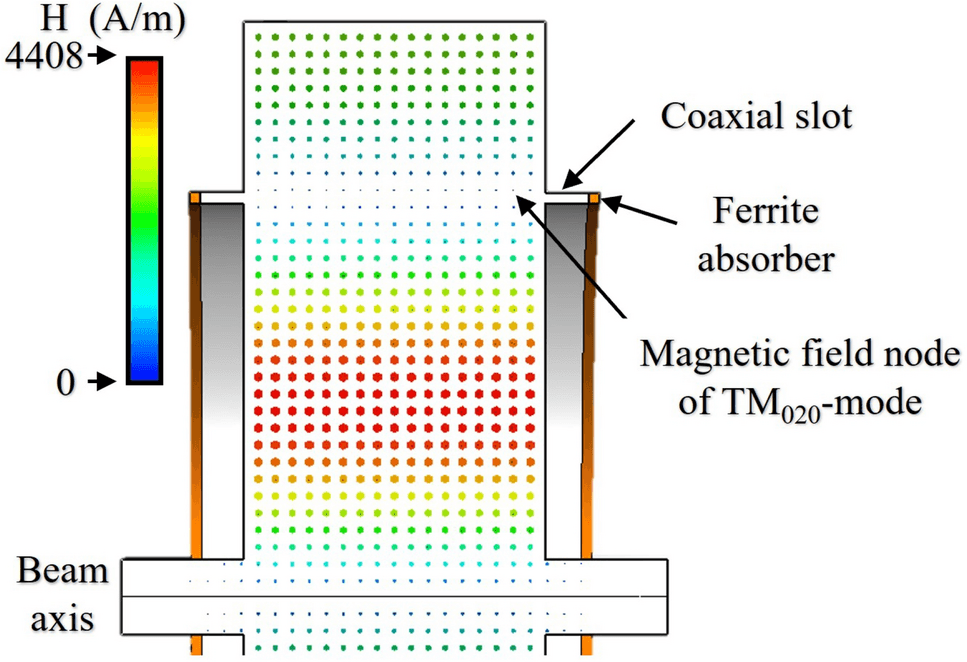
Engineers at the National Synchrotron Radiation Laboratory in Hefei have detailed a compact 500 MHz TM020-mode RF cavity that uses an elliptical choke to protect the accelerating mode and drive parasitic modes into absorbers. The design, by C. Wang, Y. Wei, L. Sun, Z. Huang and M. Hosaka, reports a simulated eigenfrequency of 499.7 MHz, an unloaded quality factor Q0 of 64,320 and a leakage ratio for the operating mode of roughly 1.5%.
The cavity addresses a persistent limitation in prior TM020 proposals: leakage of accelerating-mode power into coaxial slots. The paper notes that "A compact TM020-mode radiofrequency (RF) cavity has been proposed and studied by KEK and RIKEN for storage ring of Nanoterasu facility" and that "the leakage power of the accelerating mode into the coaxial slots is an issue to limit its performance." To solve this, the authors introduce an elliptical choke around the waveguide input coupler so the operating mode is reflected while unwanted modes are routed to loads. The team summarizes the underlying physics simply: "The principle is that the choke reflects the accelerating mode, while harmful parasitic modes pass through the choke and are absorbed by the load."
RF performance numbers in the reported parameter set include R/Q = 77.3 ohms, Epeak/Eacc = 2.11 and Bpeak/Eacc reported as 2.48 with the unit string shown in the extracted table. The design is described in the supplied materials as a normal-conducting cavity. Impedance behavior was evaluated with both Eigenmode and Wakefield solvers to produce longitudinal and transverse impedance curves and to check thresholds relevant to high-current storage rings.
Beyond RF gains, the elliptical-choke approach also targets fabrication practicality. The authors observe that prior coaxial-coupler schemes raised manufacture hurdles: "The complexity of this design brings significant challenges to mechanical processes." The choke-plus-waveguide input coupler is pitched as a simpler mechanical route that still retains strong damping of parasitic modes.

For the STCF high-current rings, lower leakage and deeper parasitic-mode damping can translate to more stable beam conditions and reduced coupler heating, easing operational limits that otherwise constrain current and lifetime. A SciDB dataset associated with the work records the cavity design and optimization data for the 500 MHz TM020 normal-conducting cavity, and the published excerpt includes figure captions and a parameter table that document the numerical claims.
What comes next is validation and community follow-up: full figure sets and mechanical drawings will clarify impedance thresholds and fabrication tolerances, and beam tests will confirm how the choke performs in a powered, high-current environment. For now, the elliptical choke is a practical, measured step toward taming TM020-mode leakage while keeping fabrication within reach.
This article was produced by Prism’s automated news system from verified source data, official records, and press releases, then run through automated quality and moderation checks before publishing. The system is built and supervised by the people who set the standards it runs under. Read our full AI policy.
Did this article answer your question?