Hierarchical Bayesian Analysis Tightens Constraints on Symmetry‑Energy Slope from Neutron Skins
Learn how a hierarchical Bayesian synthesis of neutron‑skin data sharpens constraints on the symmetry‑energy slope L and why that narrows uncertainties for nuclei and neutron stars.
1. What the paper sets out to do
Azizi, Bertulani, and Davila present a hierarchical Bayesian framework to combine heterogeneous neutron‑skin measurements and infer implications for the symmetry‑energy slope L; the preprint appears on arXiv with adjacent dates reported as February 4–5, 2026. The goal is practical: bring disparate experiments and astrophysical inferences into a single probabilistic model so the community can trade down model biases and extract a tighter, more defensible constraint on L. This synthesis explicitly targets Δr_np (neutron‑skin thickness) as the bridge between laboratory nuclei and neutron‑star observables.
2. Why neutron skins are the right observable
“Neutron‑skin thicknesses provide a sensitive probe of the isovector sector of the nuclear equation‑of‑state and its density dependence,” and that sensitivity makes skins far more responsive to the slope parameter L than to the symmetry energy at saturation J. Practically, measuring Δr_np in medium‑heavy nuclei yields an empirical lever on the pressure of neutron‑rich matter near ρ0, which in turn links to neutron‑star radii and tidal deformabilities. For the community, that means nuclear experiments at Jefferson Lab and reaction facilities are not just table‑top physics, they directly inform astrophysical models.
3. Which measurements feed the analysis
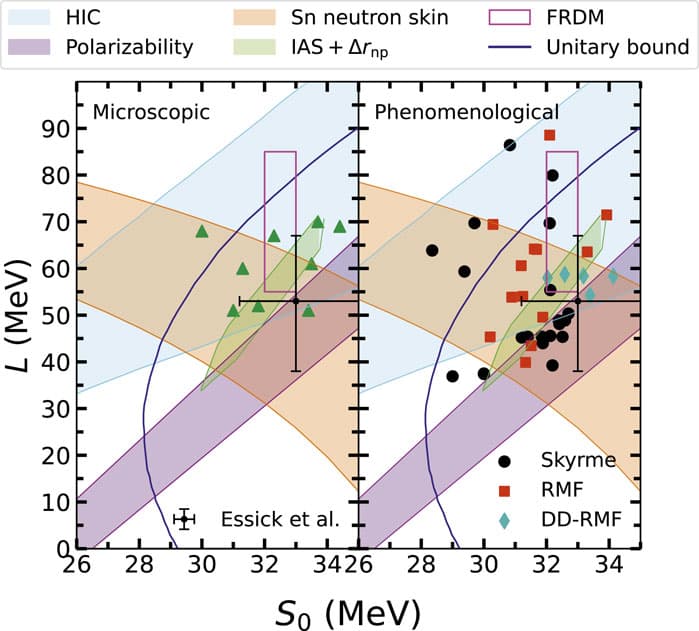
The hierarchical framework is built to accept a range of inputs: parity‑violating electron scattering on 208Pb (PREX‑I & PREX‑II) and 48Ca (CREX), electric dipole polarizability α_D of 208Pb, neutron skins in Sn isotopes, isospin diffusion bands from heavy‑ion collisions, finite‑range droplet model (FRDM) estimates, and isobaric analog state (IAS) phenomenology. Each probe carries different systematics and model conversions, so assembling them into a single posterior requires both careful error modeling and an explicit route for heterogeneity. That breadth is the point: you tighten L only when you reconcile multiple, independent constraints.
4. The core parametrization for latent neutron skins
The authors model latent neutron‑skin thickness with an explicit, compact form: ∆r_np(A, Z, N) = β0 + β1 I + β2 A^(1/3) + β3 I A^(1/3), where I = (N − Z)/A is the isospin asymmetry. This parametrization “captures the leading dependence on bulk asymmetry and surface geometry while remaining sufficiently flexible for global inference.” The I‑dependent terms encode response to symmetry pressure (hence connect to L), while A^(1/3) pieces encode finite‑size and Coulomb physics important for rms‑radius definitions, a practical compromise between physics insight and statistical tractability.
5. How the hierarchical Bayesian approach works in practice
Hierarchical Bayes lets you nest measurement‑level uncertainties under a global model for latent skins and for the β parameters, so instrument biases and theoretical conversions are handled explicitly rather than swept under the rug. The paper is guided by droplet‑model considerations and geometric scaling arguments to keep the model physically informed; however, the supplied excerpt does not list explicit priors or posterior βi values, so follow‑up with the authors is warranted for reproducibility. For practitioners, this approach means you can propagate experimental systematic errors all the way to L in a single posterior distribution.
6. How other reanalyses compare, numbers that matter
Independent reanalyses with ensembles of energy density functionals show how sensitive L posteriors remain to input choice: reanalyses report Lsym ≈ 110 +50 −72 MeV from PREX, 27 +65 −26 MeV from CREX, and 81 +59 −61 MeV from 208Pb dipole measurements. Those three central values span a wide range and come with large, asymmetric uncertainties, so the hierarchical synthesis is intended to reconcile such tensions rather than replace them. In short, different probes currently pull L in different directions, and a principled combination can show which tensions are data‑driven and which are model‑driven.

7. The dominant systematics you must watch
“When translating the parity‑violating asymmetry to the neutron‑skin thickness, this theoretical uncertainty is quantified at 0.012 fm for R208 skin and at 0.024 fm for R48 skin.” When determining α_D, “systematic uncertainties can arise from the calibration of excitation energies and the offset for the scattering angle.” These are not bookkeeping details: sub‑0.02 fm differences in Δr_np map into tens of MeV in L. Practically, that means experimentalists need to push calibration and theory conversions down while analysts must include those error floors in the hierarchical model.
8. Why that tightened L matters for astrophysics
The slope L is directly linked to the pressure of pure neutron matter at saturation via ppnm(nsat) = 1/3 nsat Lsym, which makes L a direct handle on neutron‑star structure. A narrower posterior on L reduces uncertainty on predicted neutron‑star radii and tidal deformabilities, helping gravitational‑wave and x‑ray analyses converge with laboratory constraints. For the community, that’s the payoff: better nuclear constraints feed cleaner inferences about compact objects and dense‑matter physics.
9. How to read the relevant figures and what they show
Frontiersin’s composite plots map L versus S0 with colored bands from HIC, α_D, Sn skins, FRDM, and IAS to show where different methods overlap or conflict, and an EDF ensemble figure shows posteriors of Esym vs Lsym for PREX‑II, CREX, and 208Pb dipole measurements. “FIG. 6. Posterior of the symmetry energy at saturation density Esym and its slope Lsym as inferred from the PREX‑II (blue line), CREX (red line), and 208Pb dipole measurements (orange line). Contours are shown at 95% credibility. HAUKE KOEHN et al.” Read these visualizations as tension maps: overlapping 95% contours indicate mutually consistent constraints, while separated contours flag real disagreement to be resolved by better data or improved theory.
- For experimentalists: prioritize reducing conversion uncertainties (calibrations, angle offsets) and publish covariance information so hierarchical models can ingest full error structure.
- For modelers: provide ensembles of EDFs with transparent priors and make available mappings from observables to symmetry parameters so posteriors can be consistently compared.
- For analysts: request the βi posteriors from Azizi et al. and insist on end‑to‑end propagation of systematics when combining PREX, CREX, α_D, and astrophysical priors.
10. Practical takeaways and next steps for the community
Tightening L is less about a single flashy number and more about stitching a consistent probabilistic story from many imperfect probes, skinning the problem cleanly will tighten EOS constraints for both nuclei and neutron stars.
Closing wisdom: combine diverse measurements, respect conversion uncertainties, and use hierarchical models to keep error bars honest, the slope L will sharpen not by cherry‑picking experiments but by knitting them together with physics‑aware statistics.
This article was produced by Prism’s automated news system from verified source data, official records, and press releases, then run through automated quality and moderation checks before publishing. The system is built and supervised by the people who set the standards it runs under. Read our full AI policy.
Did this article answer your question?