Ir-192 Source Disconnects From Drive Cable During Nebraska Industrial Radiography Operation
A failed auto-lock and broken 550-connector stranded an 18-curie Ir-192 source in York, Nebraska, triggering a five-hour recovery and mandatory safety standdown.

A failed auto-lock and spiking survey meters were the first signals that something had gone wrong for a radiography crew at a York, Nebraska manufacturing facility. What followed was a five-hour emergency recovery operation, after their 18-curie Ir-192 source disconnected from its drive cable inside a QSA Global 880 Delta exposure device, serial number D17550, on March 9.
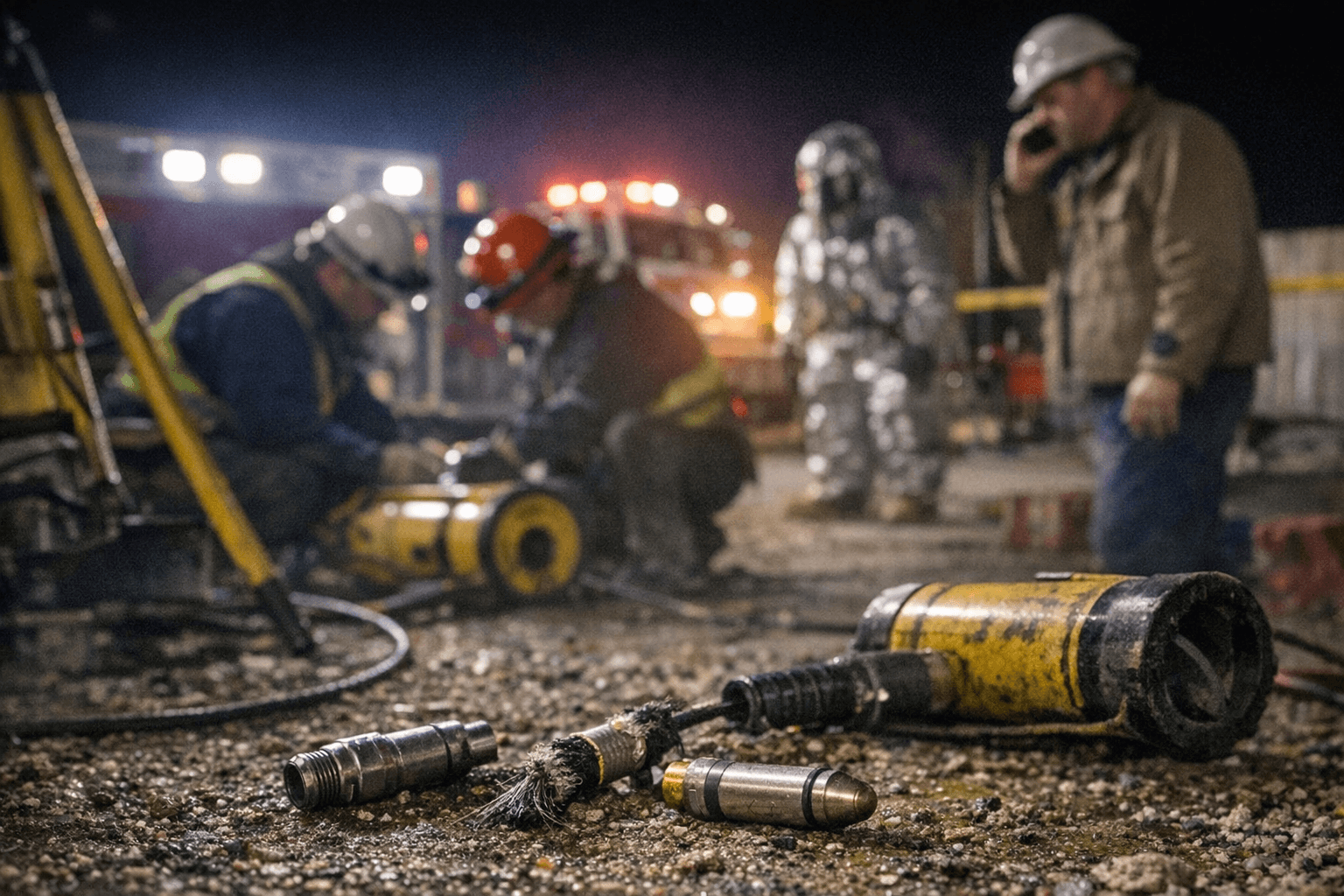
In standard industrial radiography, a sealed Ir-192 source rides inside a heavily shielded camera and extends to the exposure position through a flexible guide tube when the operator cranks the drive cable. The source capsule connects to the cable's leading end via a 550-connector, a locking coupler that must hold through repeated extensions and retractions. In this incident, that connector sheared from the cable and stayed attached to the source pigtail, meaning the cable retracted while the source remained in the exposure assembly with no mechanical path back to the shielded housing. The camera's auto-locking feature, which verifies full source retraction before transport, was the crew's first diagnostic: it didn't engage. Survey meters confirmed elevated readings around the device, and the crew established emergency boundaries to contain the hazard zone while specialists were summoned.
The regional radiation safety officer (RRSO) was notified at 2:37 p.m. CST, thirteen minutes after the crew identified the problem at 2:24 p.m., and instructed the crew to hold the restricted area. Nebraska's RSO arrived on site at 3:58 p.m., performed direct inspection of the drive cable, and confirmed the 550-connector's location on the source pigtail. The corporate RSO (CRSO) and RRSO arrived together at 7:03 p.m. Following PROtect's source retrieval procedures, the three-person RSO team returned the source to the 880 Delta housing at 7:34 p.m.
The retrieval team's recorded doses illustrate how well emergency boundaries and procedural discipline contain exposure. The RRSO received 1.6 mR, the CRSO 2 mR, and the Nebraska RSO 8.1 mR. That highest individual dose is roughly equivalent to a single chest X-ray and represents less than 3% of the 310 mR the average American absorbs from natural background radiation in a year. No member of the public received a dose above regulatory limits.
This is where the regulatory architecture matters as much as the physics. Nebraska operates its radiation control program as an Agreement State, meaning the Nebraska Department of Health and Human Services holds primary jurisdiction over the licensee's safety response and any potential enforcement, not the NRC. The April 7 Event Notification functions as a national knowledge-transfer mechanism, giving other radiography licensees and state programs access to the incident details, including device model, connector failure mode, retrieval timeline, and dose outcomes, before Nebraska DHHS completes its final characterization.
The licensee's corrective response moved quickly. Mandatory in-person safety standdown training for all employees was completed by March 31, and certified site RSOs began a systematic inspection of all crank assemblies, drive cables, guide tubes, and related components. All three personnel present during the March 9 event were carded radiographers. Whether further root cause analysis or enforcement action follows will depend on Nebraska DHHS's findings as the 30-day reporting cycle closes.
This article was produced by Prism’s automated news system from verified source data, official records, and press releases, then run through automated quality and moderation checks before publishing. The system is built and supervised by the people who set the standards it runs under. Read our full AI policy.
Did this article answer your question?