Toroidal Plasma Rotation Solves Tokamak Divertor Asymmetry Mystery, Study Finds
Plasma spinning at 88.4 km/s inside DIII-D turned out to be the hidden variable that decades of tokamak divertor simulations were missing.
Divertor plates are among the most thermally stressed consumable components in a fusion reactor: they absorb the particle bombardment from escaping plasma, and they wear. Engineers designing them for ITER, Commonwealth Fusion Systems' SPARC, and DEMO-class reactors need to know exactly where the heat and particle load will land. For decades, their simulations were giving them the wrong answer, systematically misrepresenting the particle flux hitting the inner target relative to the outer, and giving false confidence to divertor designs built on incomplete models.
New research from the Department of Energy's Princeton Plasma Physics Laboratory resolved that modeling gap with one missing variable: toroidal plasma rotation. A team led by Eric Emdee, an associate research physicist at PPPL, ran SOLPS-ITER simulations of the DIII-D tokamak in California under four controlled scenarios, varying whether cross-field drifts and rotation were each included. The models only matched experimental measurements when the team fed in the machine's measured core rotation of 88.4 kilometers per second, a value that generates parallel flow along magnetic field lines and drives plasma preferentially toward the inner target. The finding was published in Physical Review Letters.
"There are two components to flow in a plasma," Emdee said. "There's cross-field flow, where particles drift sideways across the magnetic field lines, and parallel flow, where they travel along those lines. A lot of people said cross-field flow was what created the asymmetry. What this paper shows is that parallel flow, driven by the rotating core, matters just as much."
The mismatch had persisted because cross-field drifts were the dominant term in edge-plasma codes. Those drifts are real and matter, but they proved insufficient on their own. The combined effect of rotation and drift exceeded what either produced in isolation, which explains why earlier simulations couldn't recover the measured asymmetry regardless of how precisely the drift physics was tuned.
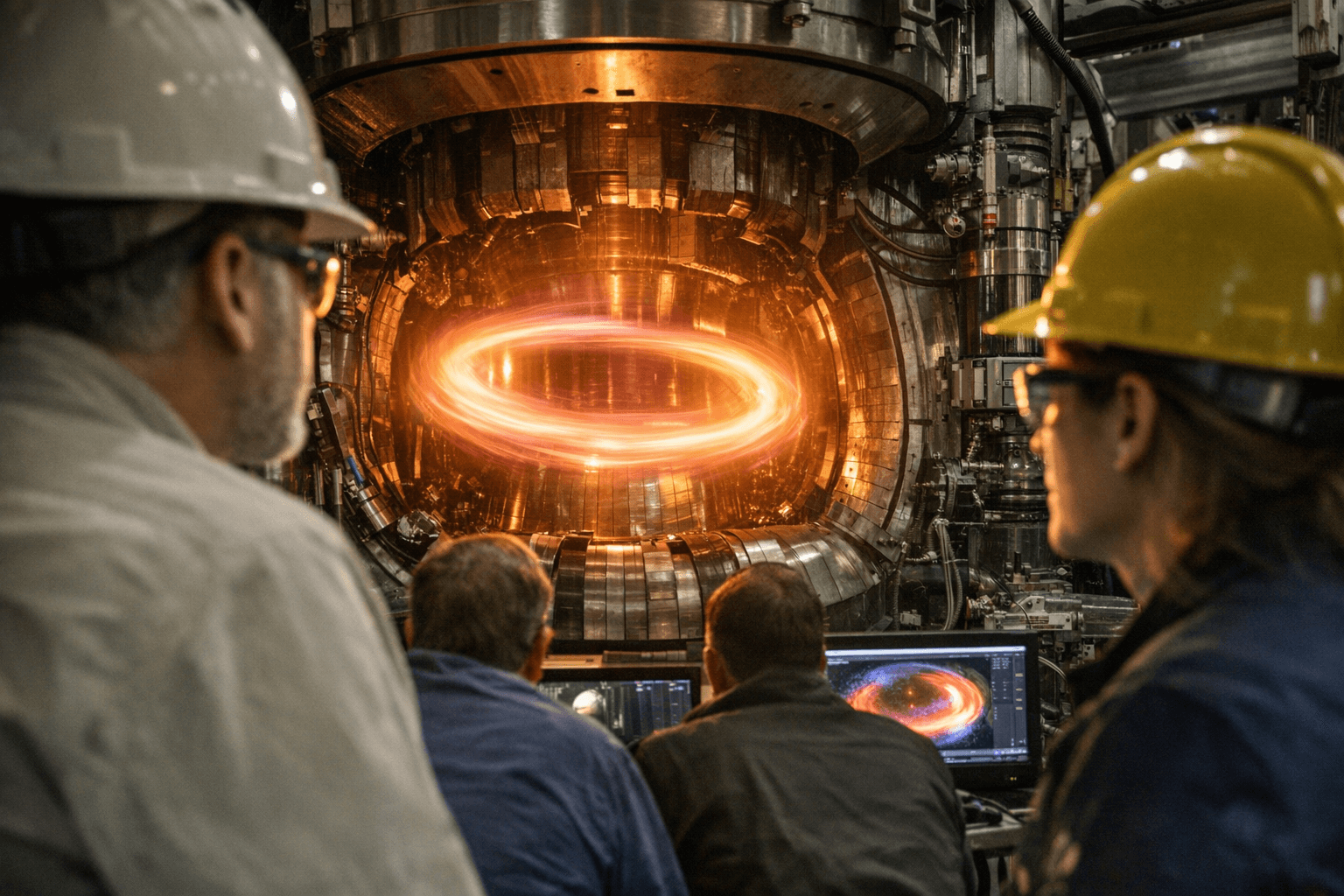
The operational consequence is concrete. Toroidal rotation in tokamaks can be driven and measured through neutral beam injection, which means it is an adjustable, trackable parameter, not an exotic unknown. Future divertor design workflows in SOLPS-ITER, already the code of record for SPARC divertor modeling, must now include rotation as a required input alongside the drift parameters that have anchored edge-plasma simulations for years. That update ripples into materials selection and cooling geometry for the inner target, where the actual load is concentrated.
The most direct test of the new explanation would be experiments that deliberately vary neutral beam-driven rotation at otherwise constant plasma conditions, then track whether the inner-to-outer strike asymmetry scales accordingly. The team used DIII-D's measured 88.4 km/s as a single benchmark; if the asymmetry proves rotation-independent under systematic variation, the framework would need revision. Multi-machine validation across different rotation regimes is the logical next step.
The research team also included Laszlo Horvath, Alessandro Bortolon, George Wilkie, and Shaun Haskey from PPPL; Raúl Gerrú Migueláñez from MIT; and Florian Laggner from North Carolina State University. The work was supported through the DOE's Office of Fusion Energy Sciences via DIII-D, a DOE Office of Science user facility. Emdee, who joined PPPL as a graduate student in 2016 and received the Kaul Foundation Prize in 2023 for earlier thesis work on lithium vapor box divertor design, has spent his career on the field's most operationally consequential modeling problem. The answer, it turns out, was spinning in the plasma the whole time.
This article was produced by Prism’s automated news system from verified source data, official records, and press releases, then run through automated quality and moderation checks before publishing. The system is built and supervised by the people who set the standards it runs under. Read our full AI policy.
Did this article answer your question?


