JINR's NICA Collider Achieves First Stable Counter-Rotating Xenon Ion Circulation
NICA achieved stable simultaneous circulation of counter-rotating xenon ion beams for tens of minutes during the night of 12 February 2026 at JINR's Dubna complex.
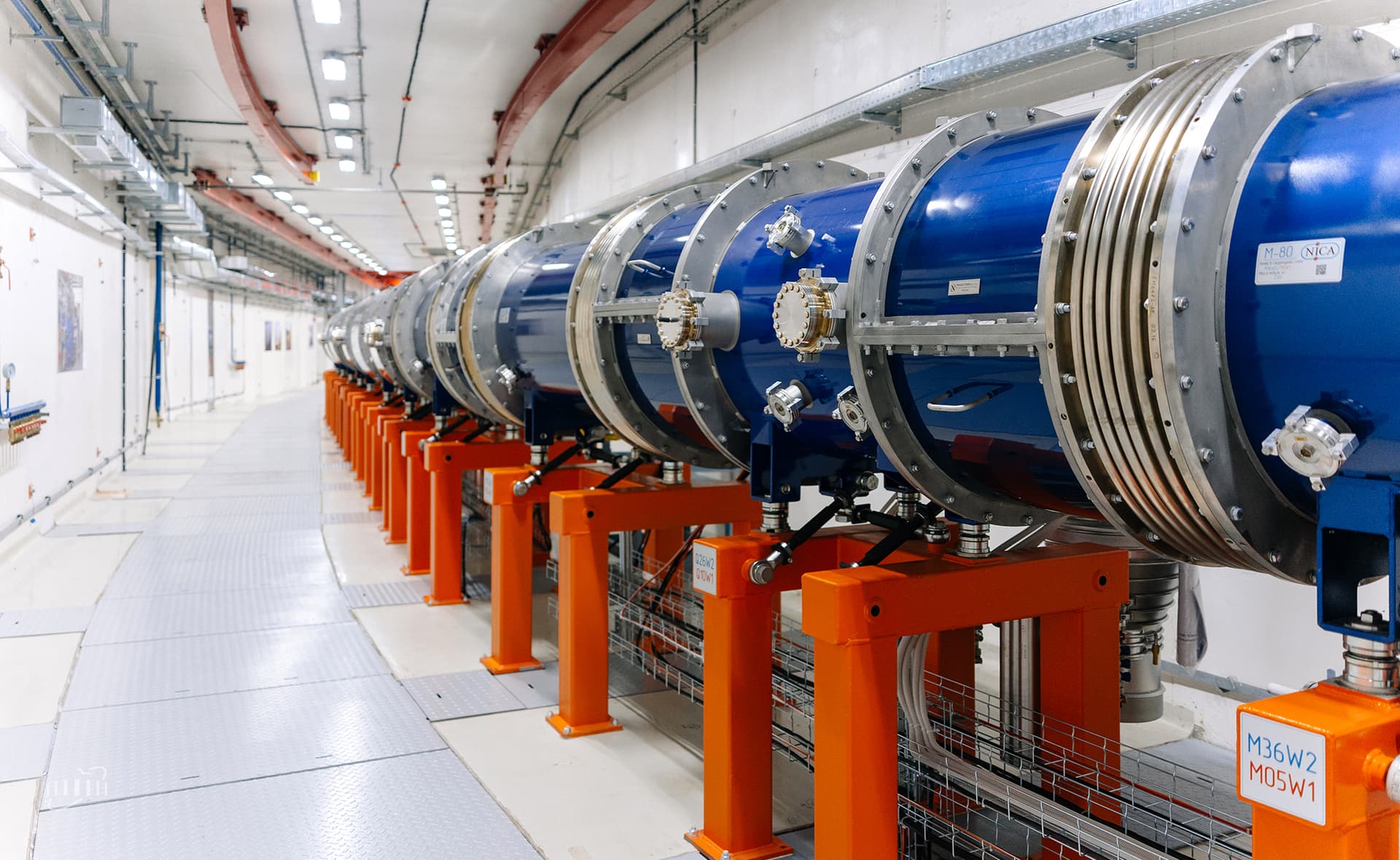
Engineers and accelerator physicists at the Joint Institute for Nuclear Research in Dubna reported that the NICA collider achieved stable simultaneous circulation of counter-rotating xenon ion beams in its two storage rings during commissioning on the night of 12 February 2026. Specialists from JINR’s Laboratory of High Energy Physics carried out sequential injections into the upper and lower rings and maintained stable circulation in each ring for “tens of minutes,” a milestone the institute reported on 13 February 2026.
The commissioning team achieved the two-beam configuration by ensuring the same bunch frequency in both rings and synchronizing the passages at the interaction point in the Multi-Purpose Detector (MPD) area. JINR described the operation in its announcement: “Achieving the colliding beam circulation mode indicates the correct and synchronous operation of the most intricate engineering systems of the entire complex.” The institute further characterized the two-beam run as building on earlier single-beam progress: “Achieving the two‑beam mode is a logical development of January's success with a single beam.”
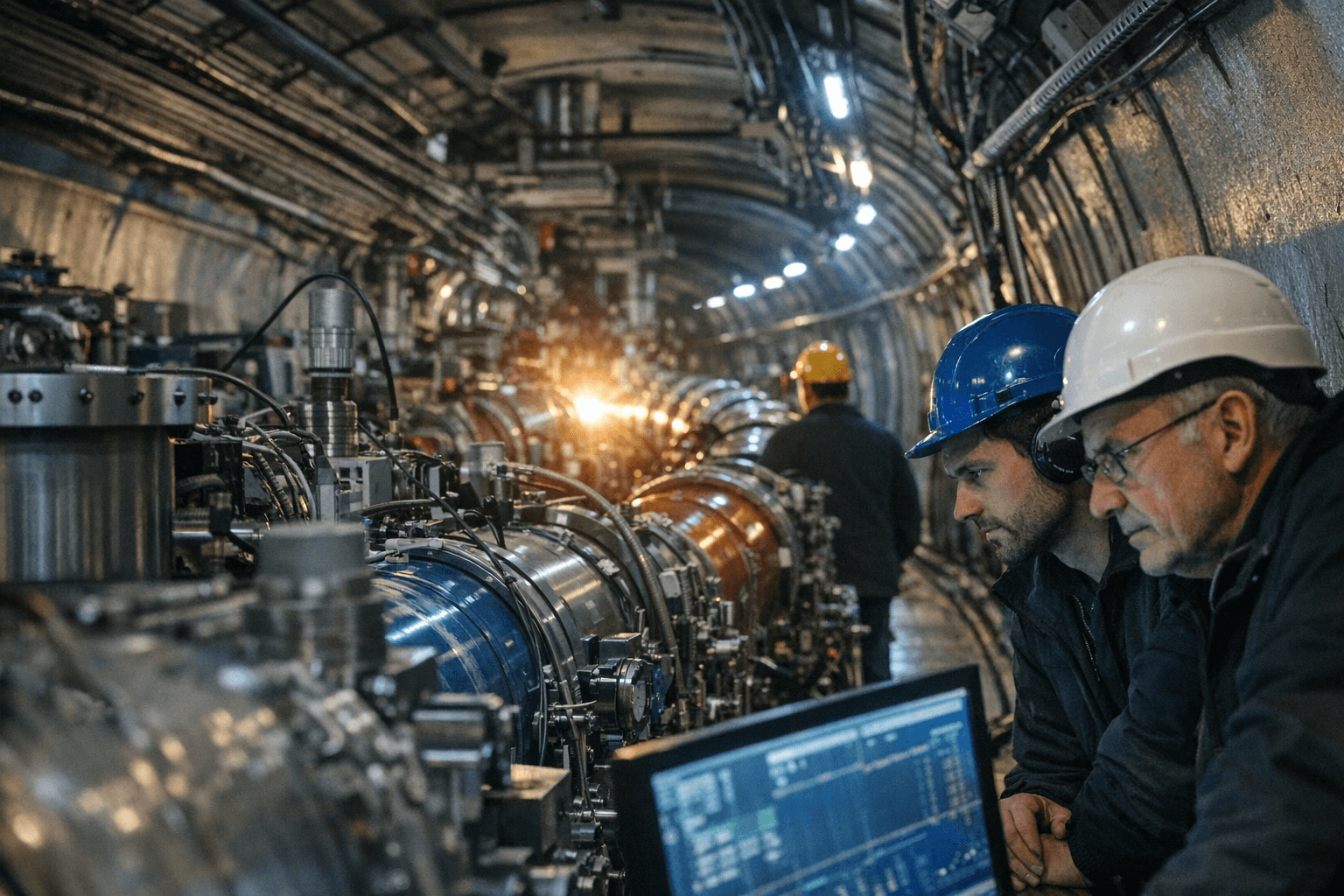
Technically, the run used xenon nuclei as the beam species injected into the paired storage rings; the two rings are operated sequentially as upper and lower orbits so their counter-propagating bunches can be synchronized at the MPD interaction point. Background technical materials for the NICA project list each storage ring with a circumference of 503 m and describe supporting systems including a linac rated at 6 MeV/amu and a booster to 600 MeV/amu, with Nuclotron magnetic rigidity around 45 T·m at a field near 2 T. A cryogenic subsystem developed by BMSTU, circulating liquid neon at 28.5 K through a high-temperature superconducting energy-storage module (SMES), was placed into operation at the end of 2025 to support stable operation and energy efficiency.
JINR framed the milestone as a gateway to collision physics and further accelerator tuning. The laboratory listed three immediate technical steps: precise measurement and correction of the rings’ magnetic optics, increasing beam intensity, and bringing particle bunches together to register the first collisions with the MPD. The project’s scientific envelope remains heavy-ion physics in the center-of-mass energy range √sNN = 4–11 GeV, targeting studies of quark-gluon plasma, hot dense baryonic matter, spin physics, and multidisciplinary applications across nuclear, medical, and information technologies.
Historical project milestones remain part of the record: archival material notes a booster circumference of 211 m and earlier stable circulation of injected helium ions at 3.2 MeV on a 19 December commissioning run (excerpted historical context does not specify the year). First experimental sessions at NICA began in spring 2025. For technical queries or follow-up, contact Prof. V. Kekelidze at kekelidze@jinr.ru; JINR’s Laboratory of High Energy Physics will be the operational lead as the team moves toward higher intensities and the first registered collision events at MPD.
This article was produced by Prism’s automated news system from verified source data, official records, and press releases, then run through automated quality and moderation checks before publishing. The system is built and supervised by the people who set the standards it runs under. Read our full AI policy.
Did this article answer your question?