Microscopic Theory Calculates Neutron-Capture Cross Sections for Neutron-Rich Nuclei
Saito and Matsuo published a continuum QRPA framework in Phys. Rev. C to compute neutron-capture cross sections for neutron-rich nuclei.
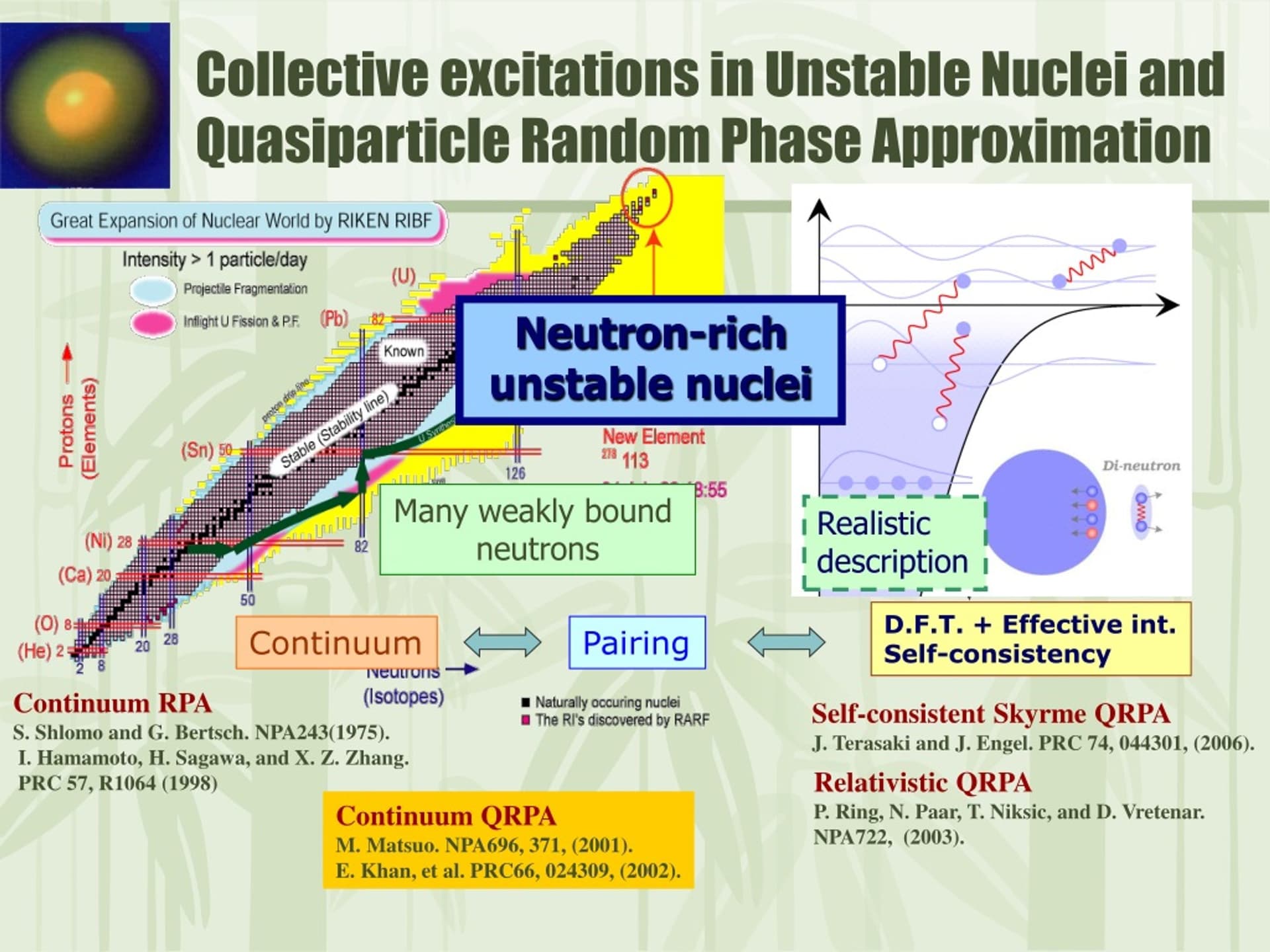
A new theoretical framework for calculating radiative neutron-capture cross sections on neutron-rich nuclei appeared in Physical Review C on March 13, 2026, authored by Teruyuki Saito and Masayuki Matsuo.
The paper, titled "Continuum quasiparticle random-phase approximation for (n,γ) reactions on neutron-rich nuclei: Collectivity and resonances in low-energy cross sections," centers on the continuum quasiparticle random-phase approximation, known in nuclear theory circles as continuum QRPA. The authors state directly: "We formulate a microscopic theory to calculate cross section of the radiative neutron capture on neutron-rich nuclei using the continuum quasiparticle" approach.
The core challenge this work addresses is well-known to anyone tracking neutron-capture reaction theory: neutron-rich nuclei are difficult to measure experimentally, which puts enormous weight on theoretical predictions for their (n,γ) cross sections. The continuum QRPA framework Saito and Matsuo develop is explicitly microscopic, meaning it builds cross-section predictions from nuclear structure rather than relying on phenomenological parameterizations.
The article's subtitle signals two specific physical phenomena that the theory engages: collectivity and resonances. These are not incidental features. Collective excitations, where many nucleons move coherently, and resonant states in the compound nucleus both have the potential to strongly shape low-energy (n,γ) cross sections, the energy regime most relevant for astrophysical reaction networks and for understanding nucleosynthesis in neutron-rich environments.
Full details on which specific nuclei were studied, the numerical cross-section values obtained, and how the continuum QRPA results compare with experimental data or alternative theoretical approaches have not yet been made available through accessible summaries. The complete paper in Physical Review C carries those specifics, along with any conclusions Saito and Matsuo draw about the broader applicability of the framework.
For theorists and nuclear astrophysicists working the neutron-rich frontier, this kind of microscopic treatment is precisely the direction the field has been pushing toward, replacing statistical model inputs with calculations that reflect the actual quantum structure of exotic nuclei.
This article was produced by Prism’s automated news system from verified source data, official records, and press releases, then run through automated quality and moderation checks before publishing. The system is built and supervised by the people who set the standards it runs under. Read our full AI policy.
Did this article answer your question?