Microsoft and NVIDIA Partner to Accelerate Nuclear Energy Development With AI
Microsoft and NVIDIA's "AI for nuclear" targets the real chokepoint: thousands of pages of licensing docs and iterative rework that delay new builds for years.
The hardest problem in new-build nuclear has never been the physics. It's the paper. Nuclear projects routinely generate tens of thousands of pages of licensing documentation, and each engineering change ripples through that record, triggering reviews, revisions, and rework cycles that can stretch timelines by years. That bottleneck is precisely what Microsoft and NVIDIA set out to attack when they unveiled their "AI for nuclear" collaboration at CERAWeek 2026 on March 24.
Microsoft President Brad Smith and energy executive Darryl Willis positioned the program as a direct response to chronic industry frictions: lengthy permitting, bespoke one-off engineering that resists replication, fragmented data silos, and manual regulatory review cycles. Smith told the CERAWeek audience that the approach "hopefully will play an important role in expanding the construction of nuclear power … in part by pursuing processes that are more repeatable."
That word, "repeatable," is doing a lot of work. The entire value proposition rests on whether AI tools can turn what has historically been a custom-built, document-heavy process into something standardized enough to execute at scale, particularly for the SMR pipeline that demands exactly that kind of throughput.
NVIDIA's contribution centers on high-performance simulation stacks and accelerated model training. That's where physics-backed credibility enters: rather than relying on purely data-driven pattern recognition, the architecture envisions AI tools grounded in validated simulation models, which matters enormously once a licensing authority starts asking for traceability and reproducibility of any AI-assisted output.
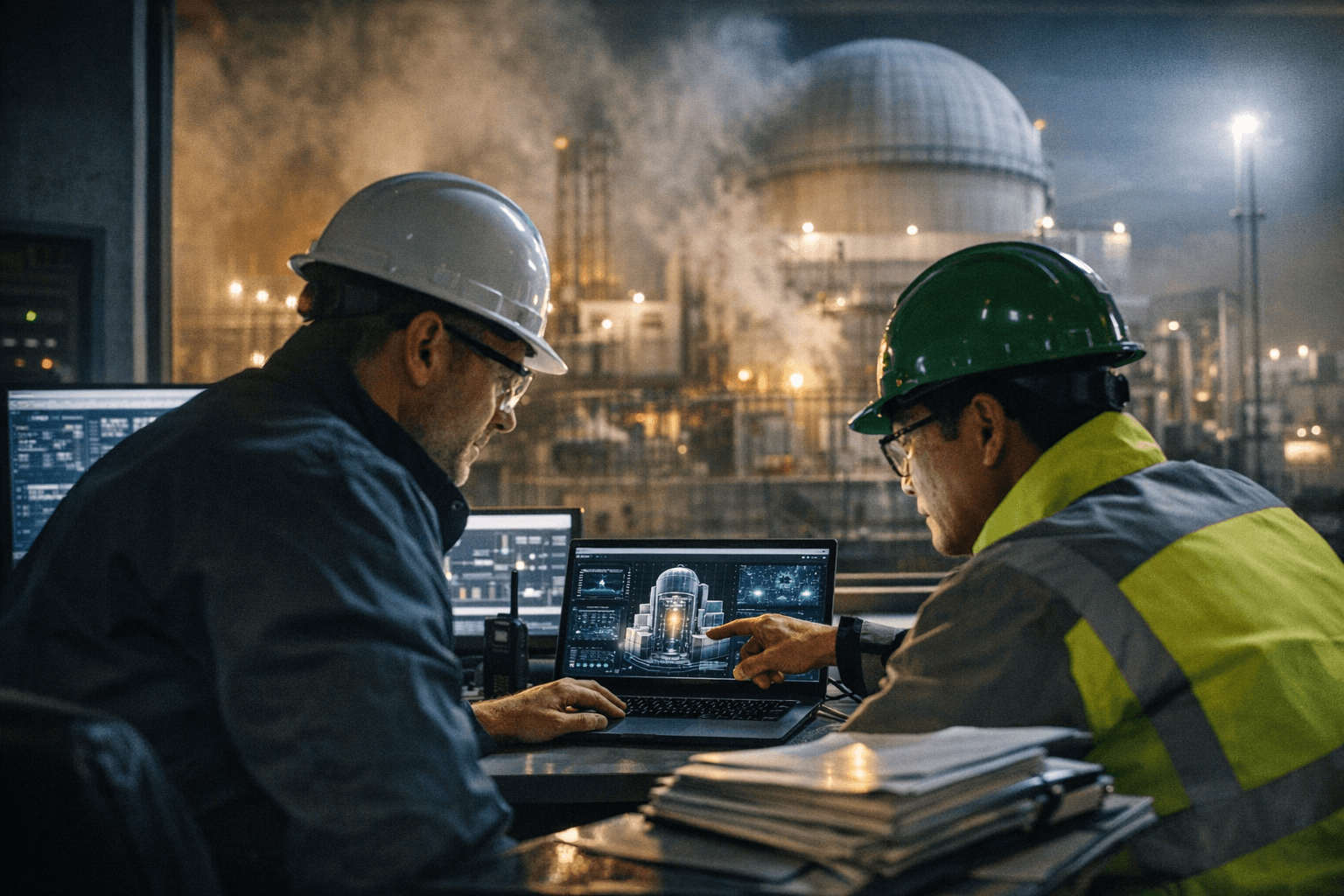
Three use cases are worth watching most closely: document ingestion for licensing, digital twins for design iteration, and predictive maintenance in operations. On the licensing side, the program proposes automated gap analysis, an AI that reads a draft submission package and flags unmet requirements before a human reviewer or regulator encounters them manually. On the design side, 4D and 5D simulations would tie 3D models to schedule and cost data in real time, so an engineering change doesn't just update a drawing but automatically recalculates downstream schedule and budget impact. For operations, AI-enabled sensors and anomaly detection form the pitch for reducing unplanned maintenance events.
None of this bypasses the hard constraints, and Microsoft and NVIDIA acknowledged as much. Regulatory acceptance of AI-assisted deliverables isn't automatic. Equivalent bodies to the NRC in other jurisdictions will require demonstrable audit trails and reproducibility before accepting AI-generated analysis as part of a safety case. Cybersecurity for operational AI systems, particularly anything touching real-time plant monitoring, adds another layer of scrutiny. The concentration of safety-critical workflows inside proprietary commercial platforms also raises national security and intellectual-property questions the collaboration hasn't yet publicly answered.
What Microsoft and NVIDIA announced is a framework, not a validated product. The real test will come when a named project, with a named operator and a live licensing docket, produces measurable outcomes: months shaved from a review cycle, rework incidents reduced, submission packages approved on first pass at higher rates. Until those numbers exist, "AI for nuclear" is a well-resourced hypothesis with two of the most capable simulation and cloud infrastructure players in the world behind it.
This article was produced by Prism’s automated news system from verified source data, official records, and press releases, then run through automated quality and moderation checks before publishing. The system is built and supervised by the people who set the standards it runs under. Read our full AI policy.
Did this article answer your question?