NASA Plans First Nuclear Fission Spacecraft for Mars Mission in 2028
NASA's SR-1 Freedom, the first fission spacecraft to leave Earth's sphere, must hit a December 2028 Mars window or wait 26 months; it's built partly on $20B of prior nuclear hardware.
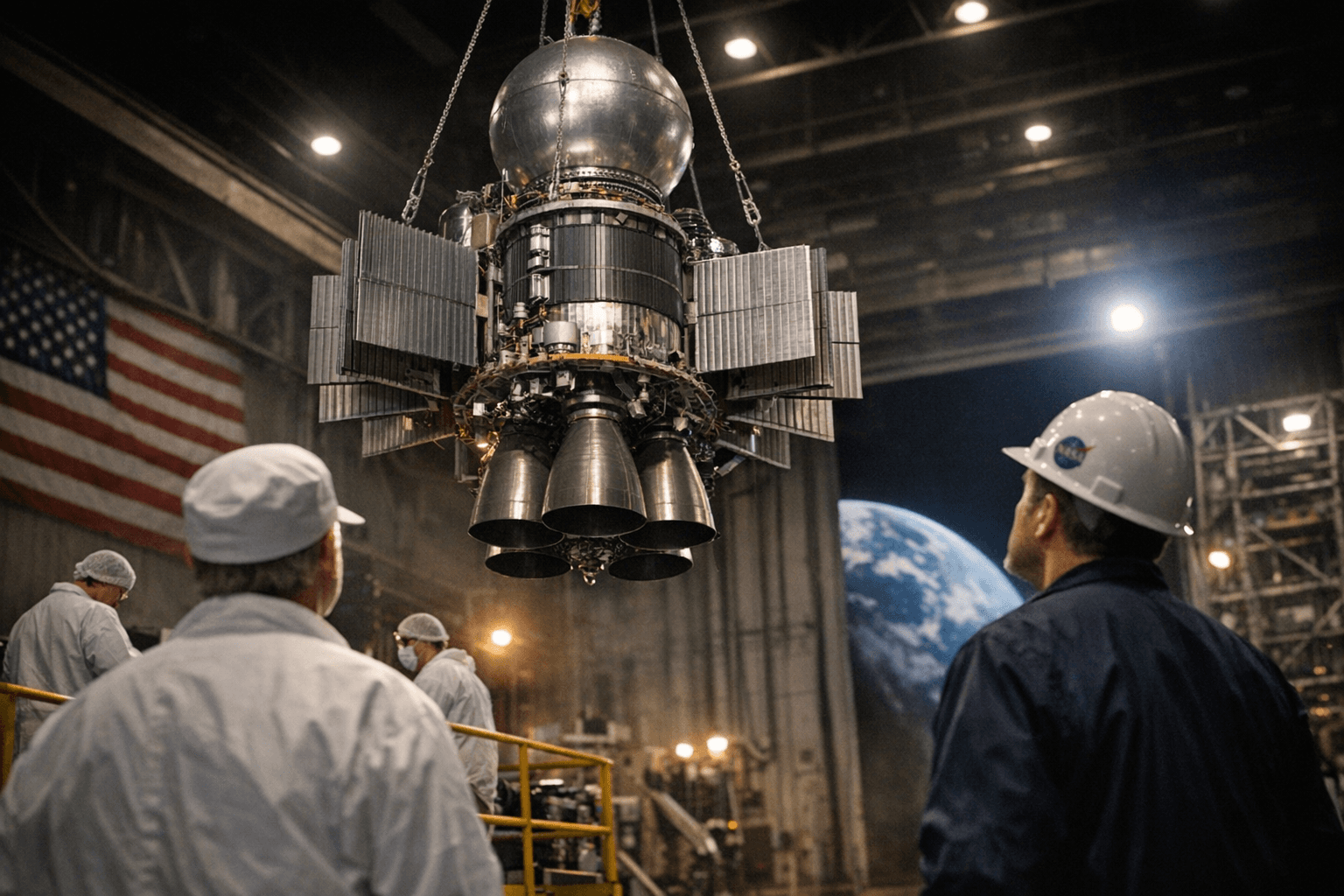
NASA Administrator Jared Isaacman, invoking more than $20 billion spent across six decades of failed space nuclear programs, unveiled Space Reactor-1 Freedom at a Washington D.C. "Ignition" event on March 24: a 20-plus kilowatt fission spacecraft built partly from Lunar Gateway hardware under active construction at Lanteris Space Systems in Palo Alto, California, targeting a December 2028 launch to Mars under President Trump's national space policy.
SR-1 Freedom is a nuclear electric propulsion spacecraft, not a nuclear thermal rocket, and that distinction is the entire technical argument for its feasibility on this timeline. Where the 1960s NERVA program used super-cold liquid hydrogen fed into a super-hot reactor core to produce thrust directly, SR-1's fission reactor generates electricity to power xenon ion thrusters. The spacecraft features a 20-plus kilowatt fission reactor fueled by High-Assay Low-Enriched Uranium and Uranium Dioxide, encased in a Boron Carbide Radiation Shield, with heat transferred through an advanced closed Brayton cycle power conversion system. The Power and Propulsion Element, rated for up to 48 kilowatts via three 12-kilowatt engines and four 6-kilowatt thrusters, was originally designed for Gateway and will be adapted to become the electric propulsion system for SR-1 Freedom.
That repurposed hardware is what makes the 2028 window anything other than theoretical. "PPE gives us a huge leg up. That's the only thing that makes this achievable," said Steve Sinacore, NASA's Fission Surface Power program executive. "That's a very capable spacecraft bus that is going to be adaptable." Isaacman was equally direct: "Frankly, after roughly $20 billion in failed programs over time, we haven't earned the right to do that. That's why we're leveraging hardware we already have."
The historical baseline matters. Kilopower, the NASA-DOE program that produced the KRUSTY demonstration reactor and posted positive test results in 2018, operated in the 1-to-10-kilowatt range using a Stirling converter cycle. The only U.S. fission reactor ever to reach orbit, SNAP-10A, stopped working after 43 days in 1965 due to a nonnuclear component failure. SR-1 Freedom targets twice Kilopower's maximum output, replaces Stirling with a higher-efficiency Brayton cycle, and must sustain operation across approximately one year of deep-space transit to Mars, the first nuclear-propelled spacecraft to exit Earth's sphere of influence.
Sinacore's schedule leaves almost no slack: mission design must be complete by June 2026, large-scale assembly begins in January 2028, and testing closes in October 2028 for a December launch. Miss that window, and the next Earth-Mars alignment is roughly 26 months away.
Two gates stand out as the most probable schedule threats. The first is nuclear safety launch approval: unlike RTG missions, where the INSRP review process is well-worn, a fission reactor launch constitutes a first-time regulatory path requiring new safety analyses and defined risk thresholds. The reactor does not activate until 48 hours after launch, reducing ground-hazard exposure, but the approval framework is still being developed in parallel with the hardware. The second is PPE integration: adapting a solar-powered Gateway module to operate off a reactor power bus involves new power management interfaces and thermal architecture changes, all on a schedule with no programmatic reserve.
The U.S. Department of Energy is supporting reactor design, safety systems, and nuclear integration throughout. If SR-1 reaches Mars and deploys Skyfall, three Ingenuity-class helicopters that deploy to the Martian surface for terrain scouting, it will have accomplished what 12-plus predecessor programs could not across six decades: operate an American fission reactor in deep space and return the data to prove it worked.
Know something we missed? Have a correction or additional information?
Submit a Tip

