Neutron scattering reveals strong entanglement in a strange metal
A Grenoble neutron beam found quantum Fisher information peaking at a strange-metal quantum critical point in Ce3Pd20Si6, hinting at strong entanglement.
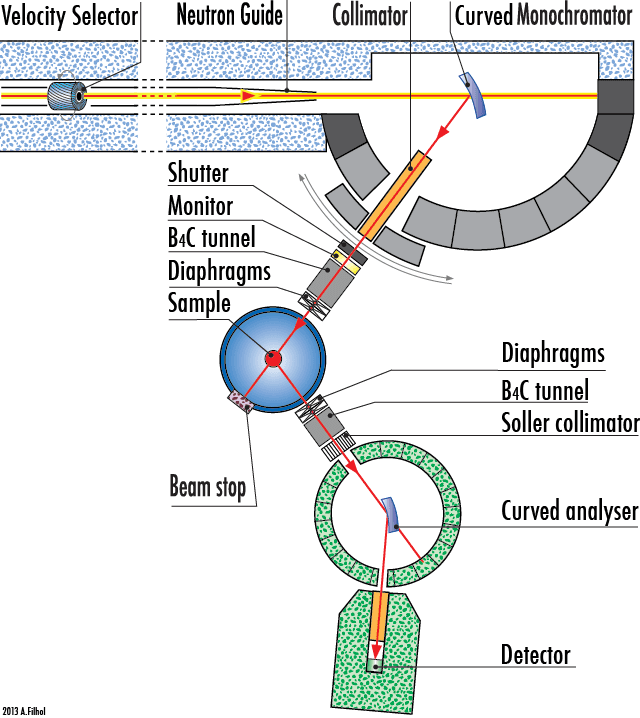
Neutron scattering at the Institut Laue-Langevin has pushed a heavy-fermion metal into the quantum-information conversation. Using the cold-neutron triple-axis spectrometer ThALES in Grenoble, TU Wien and collaborators tracked a centimeter-sized crystal of Ce3Pd20Si6 down to 60 millikelvin and 1.73 tesla, where the compound sits at its field-induced quantum critical point. The team reported that the spin quantum Fisher information peaked there, a signature they interpret as unusually strong entanglement in the strange-metal state.
The work lands in a regime neutron scientists know well: strange metals are the ones whose low-temperature resistivity rises linearly with temperature instead of following the T-squared law of an ordinary Fermi liquid. In Ce3Pd20Si6, that behavior is tied to Kondo screening breakdown at a magnetic-field-driven critical point, so the experiment did more than map transport. It used inelastic neutron scattering to watch the magnetic fluctuations themselves at the moment the electronic state changed character.
Nature Physics highlighted the result in a July 3 News & Views item, while the underlying paper, Quantum Fisher information in a strange metal, appeared in June. The journal’s summary says quantum Fisher information increased as the strange metal formed, matching the team’s interpretation that the many-electron state becomes more strongly entangled as it approaches criticality. The Institut Laue-Langevin called it the first detection of a high degree of quantum entanglement inside a centimeter-sized strange metal crystal.
Ce3Pd20Si6 is not a new face in the phase-diagram literature. Earlier work had already identified it as a magnetic-field-induced antiferromagnetic quantum critical system, and prior studies reported two low-temperature phase transitions around 0.5 K and 0.31 K in the cubic heavy-fermion cage compound. That history gave the team a well-charted target, but the new analysis applied a quantum-information lens to a system neutron scattering was already known to interrogate cleanly.
For Rice University’s Qimiao Si, the point is that the measurement lets scientists track how electrons in a quantum critical metal lose their individual identity and act collectively. Silke Bühler-Paschen at TU Wien framed the same idea more plainly: the question is not whether the whole crystal becomes a Schrödinger-cat object, but whether its constituents are collectively entangled, more like an anthill than a single particle. For neutron work, that is a useful reminder of how far a beamline can reach: from magnetic order and lattice dynamics to the entanglement structure hidden inside a strange metal, all with a classic nuclear probe.
This article was produced by Prism’s automated news system from verified source data, official records, and press releases, then run through automated quality and moderation checks before publishing. The system is built and supervised by the people who set the standards it runs under. Read our full AI policy.
Did this article answer your question?