NRC Clarifies Radioactive Material Transport Rules for Temporary Jobsite Moves
NRC's new RIS 2026-03 confirms that short moves of radioactive material within a defined temporary jobsite skip the full 10 CFR 71.5 packaging rules, ending years of uneven regional enforcement.
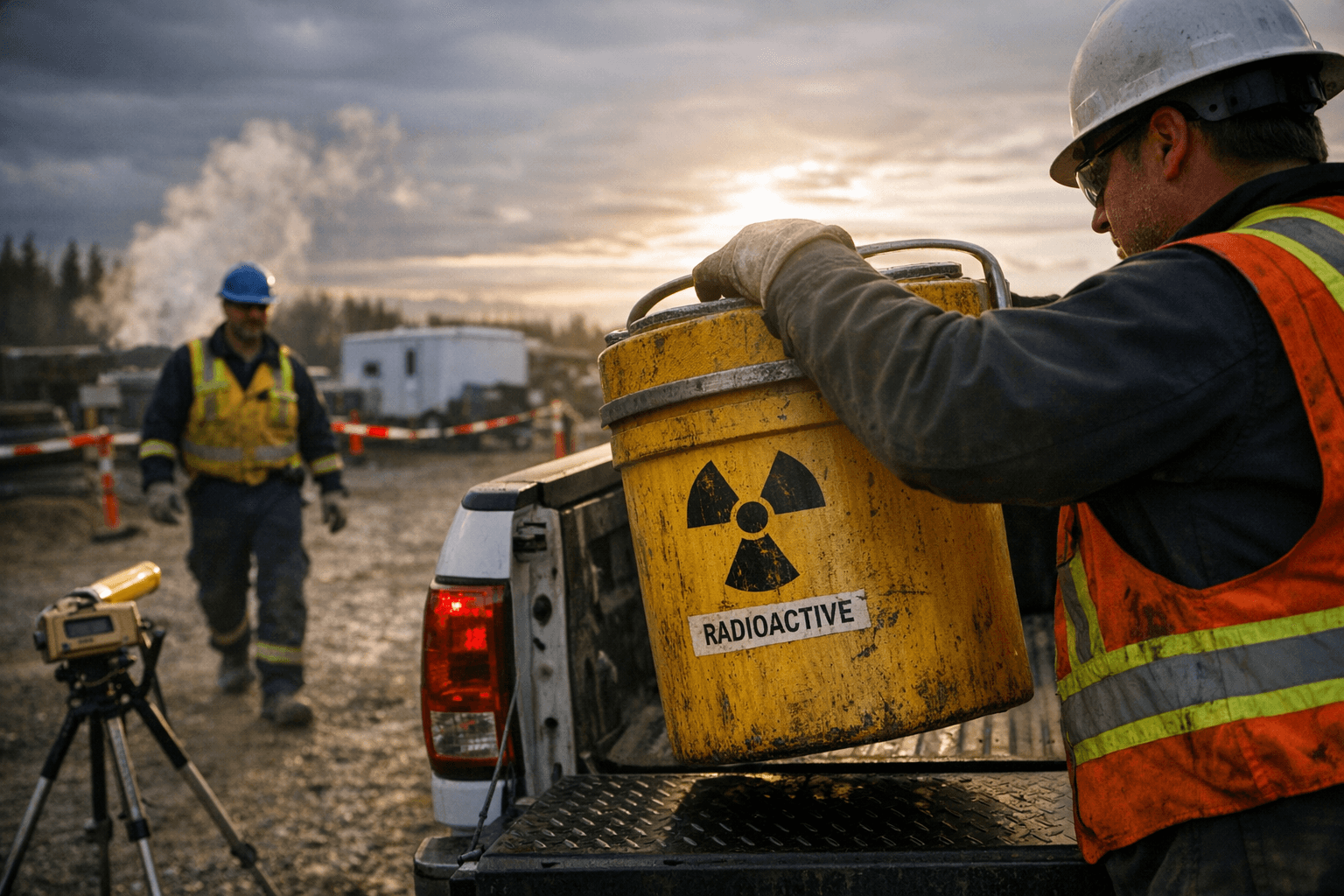
Moving a radiographic source from one shooting position to the next across an active pipeline construction site has never felt like a "transport" event to the crew doing it. The NRC agreed, officially, on March 31. Regulatory Issue Summary 2026-03, published in the Federal Register by the Office of Nuclear Material Safety and Safeguards and the Office of Nuclear Reactor Regulation, confirmed that the packaging and transport requirements of 10 CFR 71.5(a) and 71.5(b) do not apply when a licensed service provider moves radioactive material within a properly defined temporary jobsite.
The clarification resolves a compliance fault line that industrial radiography crews, well logging operators, and construction NDT contractors have navigated inconsistently for years. Whether a short on-site relocation of a sealed source triggered full Part 71 requirements had varied by regional office interpretation, creating an enforcement lottery that could attach paperwork burdens, delay work, or expose a field team to a violation over a move measured in yards.
What RIS 2026-03 makes plain: geography is now the decisive test. So long as the movement stays within the temporary jobsite boundaries as defined by the applicable section of 10 CFR, the DOT-aligned requirements of 71.5(a) and 71.5(b) do not activate. Cross that boundary with the source, and they do, fully. Inspectors visiting a jobsite under this guidance will not focus on how far the material moved but whether it stayed inside the defined footprint.
For decommissioning contractors and plant modification crews, the stakes are equivalent. Moving radioactive components between adjacent work areas on a refurbishment project, or transitioning a sealed source between contiguous exposure zones during construction NDT, now has a clear compliance footing that did not exist in practice before. What remains non-negotiable on both sides of the line: Part 34 already requires that the license authorizing material use, copies of relevant regulations, and equipment utilization records are physically present at every temporary jobsite, and that obligation is unchanged.
The NRC staff itself was among those raising questions that prompted the document. A draft version published in the Federal Register in March 2025 opened a comment period before the agency finalized its analysis in a staff document dated March 24, 2026, with publication following one week later. That year-long development cycle reflects how seriously the agency weighted the clarification; uneven regional enforcement of 71.5 was generating real friction on active projects at precisely the moment the NRC is advancing its Part 53 final rule and a broader package of regulatory updates.
For any crew dispatching sources from a field station, the compliance posture now has a cleaner shape. Document your jobsite boundaries before work begins, keep required license paperwork on-site, confirm every relocation stays within the authorized footprint, and apply full Part 71 packaging controls the moment material moves beyond it. The question that will matter to the next inspector is not what you moved but where you moved it.
This article was produced by Prism’s automated news system from verified source data, official records, and press releases, then run through automated quality and moderation checks before publishing. The system is built and supervised by the people who set the standards it runs under. Read our full AI policy.
Did this article answer your question?